

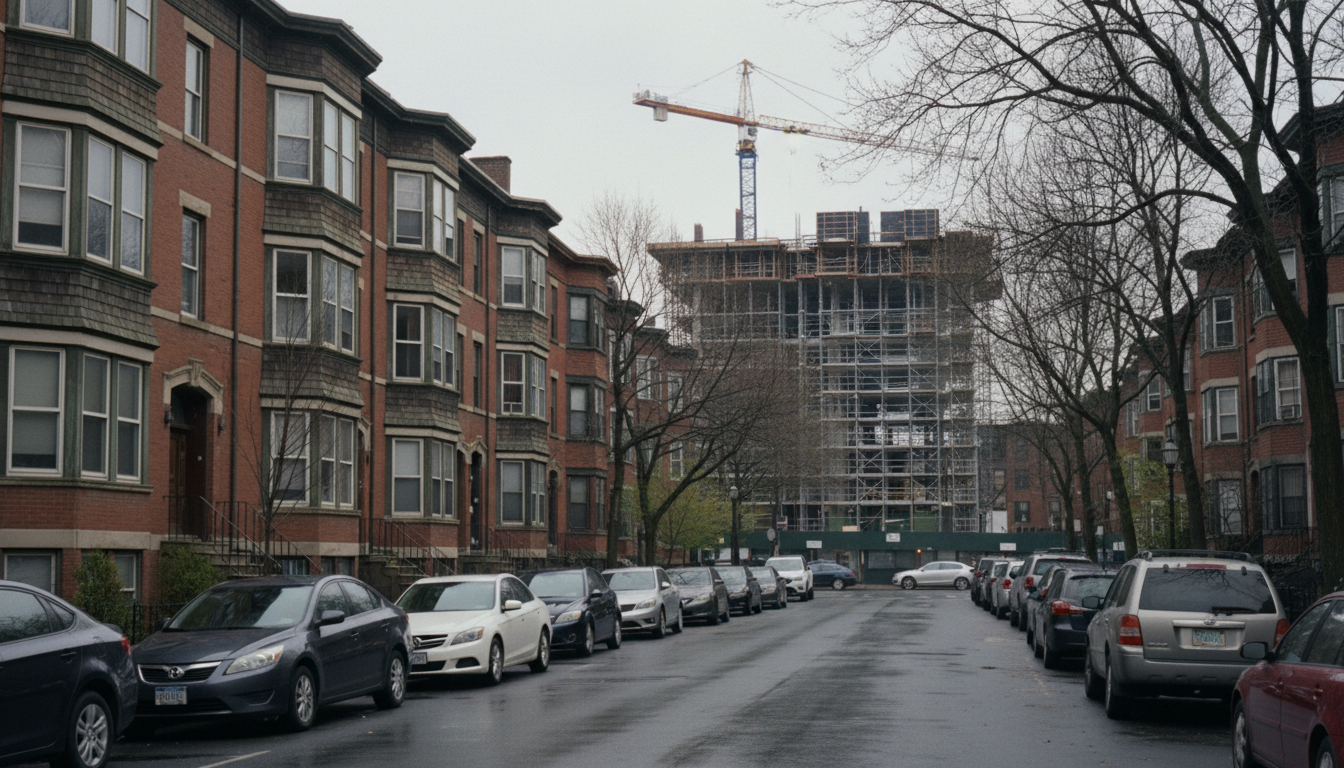
You tour the apartment on a quiet Sunday afternoon, sign the lease, move in — and three weeks later a construction crew shows up next door at 7 a.m. every weekday. It's one of the more common ways a good-looking apartment turns into a bad living situation, and it's almost entirely preventable with a few checks before you sign.
This guide covers both halves of that problem: how to actually check a Boston building for planned or active nearby construction before you commit, and — if you find out you weren't told — what Massachusetts law says about your options.
How to check for nearby construction before you sign
Search Boston's building-permit records for the address (and nearby parcels)
Construction and renovation projects require permits from the City of Boston, and those permits are public. Before signing, search the address — and the addresses immediately around it — for any approved or pending building permits. This won't catch every possible future project, but it will surface anything already in motion or planned.
Ask the landlord directly — and what their answer (or non-answer) tells you
Ask plainly: is there any construction planned or underway on this building or nearby that could affect noise? A landlord or property manager who gives a direct answer, even if it's "yes, there's a project next door finishing in three months," is giving you real information to decide with. A vague answer, a change of subject, or a flat "not that I know of" from someone who should know is itself useful information — treat it as a reason to dig further, not as reassurance.
Visit at different times of day
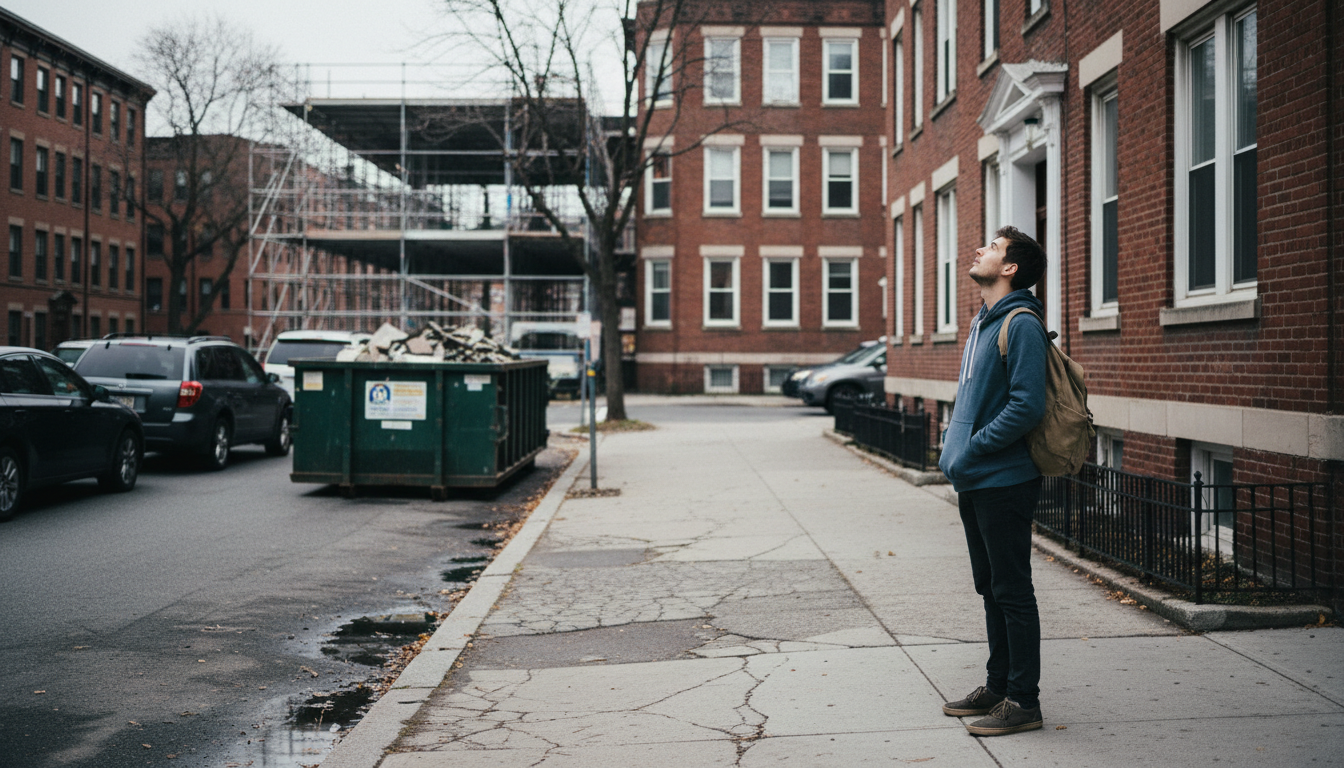
A unit that's silent during a Sunday-afternoon showing can be a different experience on a Tuesday morning. If you can, visit — or at least walk the block — on a weekday during typical working hours, when nearby construction (if any) is most likely to be active.
What Boston's noise ordinance actually allows (decibels, hours)
Boston regulates noise directly: under the city's noise ordinance, sound generally can't exceed 50 decibels between 11 p.m. and 7 a.m., or 70 decibels at any other time, with some exceptions for permitted construction (Boston.gov). Regular construction hours in Boston are 7 a.m. to 6 p.m. on weekdays; work outside those hours (including weekends) generally requires a separate after-hours permit, which you can check against the city's afterhours permit database. Knowing these numbers gives you a baseline for what's "normal" versus what's excessive if you're evaluating noise after you've moved in.
If it turns out you weren't told: your rights under Massachusetts law
The covenant of quiet enjoyment, in plain English
Every residential lease in Massachusetts includes an implied "covenant of quiet enjoyment" — your landlord can't seriously interfere with your ability to actually use and live in the apartment you're renting, and this right exists whether or not your lease mentions it by name. It can't be signed away.
Why construction is one of the strongest quiet-enjoyment cases a renter can have
Not every noise complaint rises to a legal issue — a neighbor's occasional loud night or a one-time emergency repair generally doesn't. But ongoing construction that a landlord knew about and didn't disclose is a stronger case than most: it's a sustained condition, not a one-off disturbance, and if the landlord had knowledge of it before you signed, that knowledge is central to the claim. This is a recognized legal theory, not a guarantee of a specific outcome in any individual case — how strong your case is depends on what the landlord actually knew and when.
What the Statement of Condition does (and doesn't) cover
Massachusetts requires landlords who collect a security deposit to provide a signed statement of the apartment's condition upon receipt of the deposit, or within 10 days of the start of your tenancy — whichever is later. You then have 15 days after receiving that statement (or 15 days after move-in, whichever is later) to add your own corrections (Massachusetts General Laws Chapter 186, Section 15B). This document is about the physical condition of the unit itself — it's not designed to capture something like nearby construction, so don't expect it to substitute for asking directly.
Remedies: rent reduction, lease termination, damages
Massachusetts law (G.L. c. 186 §14) makes it illegal for a landlord to seriously interfere with your quiet enjoyment of the apartment. If a landlord's undisclosed construction rises to that level, the statute provides for actual and consequential damages, or three months' rent — whichever is greater — plus court costs and attorney's fees. The same statute also carries a civil-court-adjacent penalty: a fine between $25 and $300, or up to six months' imprisonment, though in practice these disputes are typically resolved through the civil damages remedy rather than criminal prosecution. None of these are something to pursue on your own without documentation and, ideally, some legal guidance — see below.
How to file a complaint (if you're already living with it)
Document everything — dates, times, decibel estimates
If you're dealing with unexpected construction noise, start documenting immediately: dates, approximate times, how long it lasts, and what it sounds like. A phone's voice-memo app is enough to capture a representative sample. This record is what turns "it's loud sometimes" into something a city inspector — or, if it comes to that, a court — can actually evaluate.
Boston ISD / 311 — the actual process
For a noise complaint tied to construction, you can contact Boston's Inspectional Services Department at 617-635-5300 or [email protected], or file through 311 (Boston.gov). If the construction is happening outside the ordinance's allowed hours, check whether the site has an after-hours work permit before assuming it's unpermitted — legitimate after-hours work does happen, but it requires its own approval.
When to escalate to a legal remedy vs. when to negotiate directly with the landlord
Not every situation needs a lawyer. If the construction is new to you and your landlord seems unaware, a direct conversation — sharing your documentation and asking for a rent adjustment or other accommodation — is often the fastest path and worth trying first. Escalation toward a formal complaint or legal remedy makes more sense when the landlord already knew (especially if they didn't disclose it before you signed), when the disruption is severe and ongoing, or when a direct conversation hasn't gone anywhere.
This is genuinely a "get help" situation once it gets past the informal-conversation stage. Talk to Mass Legal Help, the Massachusetts Attorney General's Consumer Advocacy and Response Division hotline at (617) 727-8400 (weekdays), or a tenant-rights attorney before pursuing rent withholding or a damages claim — getting the process wrong can undercut a legitimate claim, and getting the legal standard wrong can leave you exposed.
FAQ
How do I check if there's construction planned near a Boston apartment before I sign? Search the city's building permit records for the address and surrounding parcels, and ask the landlord directly whether they're aware of any planned or active nearby work.
Is a landlord legally required to tell me about nearby construction before I sign a lease? There's no specific Massachusetts statute requiring landlords to proactively disclose future construction plans — the relevant protection is the general quiet-enjoyment doctrine (G.L. c. 186 §14), which comes into play after the fact if the landlord already knew about ongoing or imminent construction and didn't tell you. It's about what they knew and withheld, not a standalone disclosure checklist.
What decibel level counts as excessive noise in Boston? Boston's ordinance generally sets the threshold at 50 decibels between 11 p.m. and 7 a.m., and 70 decibels at any other time, with exceptions for permitted construction during allowed hours.
Can I break my lease because of construction noise? Possibly, if it rises to a real quiet-enjoyment violation — but this depends heavily on the specific facts and isn't something to decide on your own. Talk to a tenant-rights resource before acting.
What should I do first if construction noise starts after I've already moved in? Document it, then talk to your landlord directly before escalating — many situations resolve with a conversation and don't require a formal complaint or legal action.
Does normal city noise count the same as construction noise? No — ordinary city sounds (traffic, occasional sirens, typical street noise) are generally treated as part of urban living, not a quiet-enjoyment violation. Sustained, disclosed-or-should-have-been-disclosed construction is a different category.
This article is informational and isn't legal advice.