

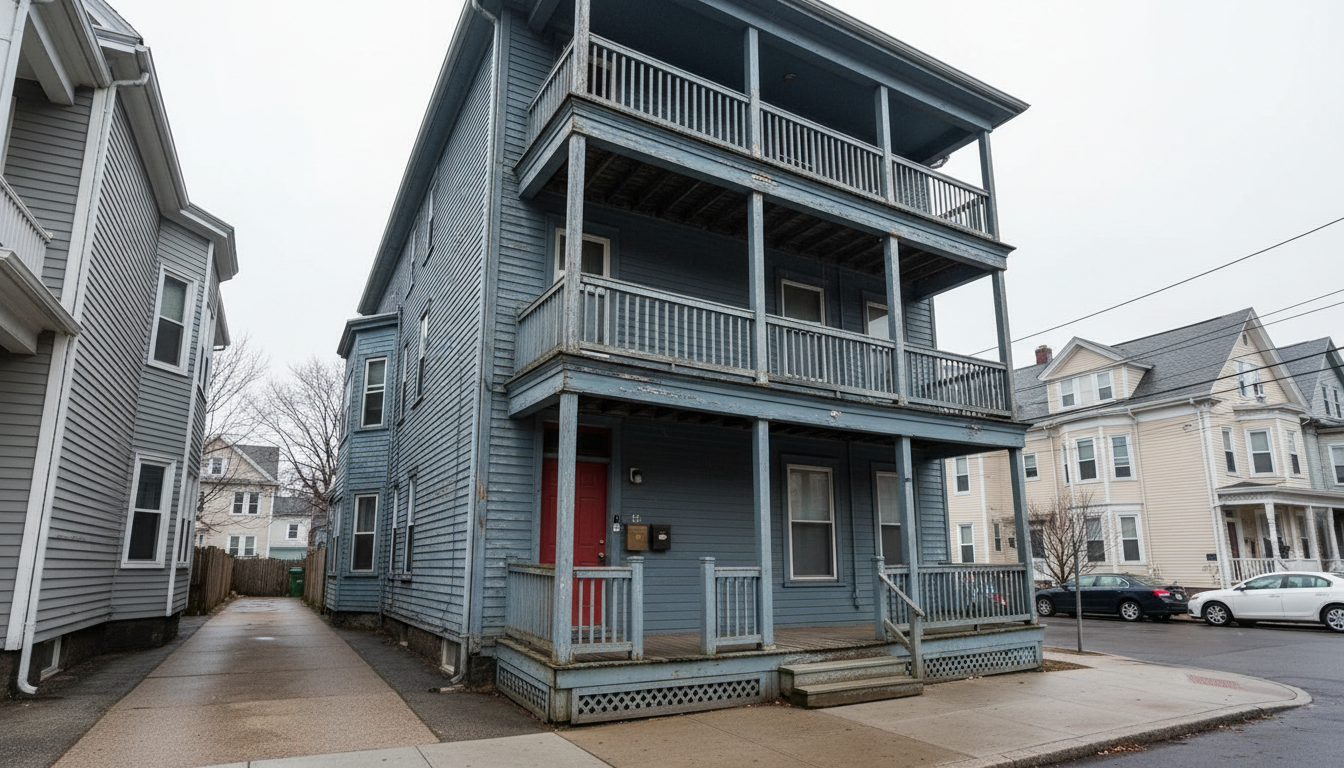
It usually starts with a hunch. The heating bill is twice the neighbor's. There are three apartments in a house the city says is a two-family. You share a mailbox with the landlord who lives upstairs. One Boston renter on r/bostonhousing pieced exactly this together — checked the property records, found only two gas meters for a building with three units, and realized their apartment was never legally permitted in the first place.
If you're in that situation, the first thing to know is this: an unpermitted apartment in Boston does not strip you of your rights as a tenant. It changes some of the calculus, and it raises a few genuinely hard questions that need a lawyer — but you are not powerless, and you are not automatically about to be thrown out. This is a plain-English guide to illegal apartment tenant rights in Massachusetts: what makes a unit unpermitted, how to confirm it yourself, the rights you keep regardless, and where the line is between what you can do on your own and what needs a professional.
What makes a Boston apartment "unpermitted" or illegal?
An apartment is "unpermitted" (or "illegal," "unwarranted," or "non-conforming") when it's being rented as housing without the city's sign-off to be used that way. The key document is the certificate of occupancy — issued by Boston's Inspectional Services Department, it confirms a unit is approved for people to live in. If a building is permitted as a two-family but has been quietly carved into three apartments, that third unit doesn't have one.
The most common culprits in Boston's housing stock are conversions: a basement, an attic, or an in-law space turned into a separate rental without permits. None of that is your fault as the tenant — but it's worth knowing, because an unpermitted unit can carry real risks (the city can ultimately order it vacated) alongside the rights you keep.
How to confirm it yourself — start with Boston ISD
You don't have to take anyone's word for it. Boston's permit and occupancy records are public, and you can check a property by address.
Look up the certificate of occupancy and permit history
Start with the city's Inspectional Services Department (ISD). You can search a property's historical permit records and certificate of occupancy by address through permitfinder.boston.gov, the city's "How to Find Historical Permit Records" guide, or the Analyze Boston open-data portal. If you'd rather talk to a person, ISD takes calls at 617-635-5300, Monday–Friday, 8 a.m.–4 p.m. (Boston.gov, Inspectional Services Department). What you're looking for is simple: how many units is this property legally approved for, and does a certificate of occupancy exist for your unit? A certificate of occupancy is issued by ISD with Boston Fire Department sign-off and confirms the unit is approved for residential occupancy.
The warning signs
You can often spot the red flags before you even pull records:
- More units than the property is permitted for — three mailboxes or three buzzers on a house listed as a two-family.
- Shared or mismatched utility meters — for example, one gas meter serving what's supposed to be two separate apartments, so you may be paying for someone else's heat or cooking.
- No certificate of occupancy for your specific unit, or a landlord who can't produce one.
- A basement, attic, or "bonus" space that was clearly converted without the layout a legal apartment needs.
None of these alone is proof, but together they're a strong signal to pull the ISD records.
Your rights don't disappear because the unit is unpermitted
Here's the reassuring part, and it's grounded in Massachusetts law: your core protections as a tenant apply whether or not your unit is permitted.
Habitability applies regardless of permit status
Massachusetts holds landlords to the State Sanitary Code (105 CMR 410), which sets the minimum standards for a home to be fit to live in — and the implied warranty of habitability that comes with it doesn't ask whether your unit is legal. Among the specifics the code requires: proper egress (105 CMR 410.260), and heat of at least 68°F from 7 a.m. to 11 p.m. and at least 64°F overnight, during the heating season of September 15 to May 31 (Mass.gov, 105 CMR 410). If your landlord isn't maintaining those conditions, you have the right to report it to the Boston housing inspection authority or the board of health — the same as any other tenant. Being in an unpermitted unit does not waive habitability.
Retaliation — the six-month rule
Massachusetts has a real anti-retaliation protection, and it's one of the strongest tools you have. Under G.L. c. 186 §18, if a landlord sends a notice of termination, raises your rent, or substantially changes the terms of your tenancy within six months after you report a code violation to the inspection authority (in Boston, the commissioner of housing inspection), the law creates a rebuttable presumption that the action was retaliatory. That flips the burden: the landlord can only overcome it with clear and convincing evidence of an independent, legitimate reason. The damages are significant — a minimum of one month's rent, up to three months' rent or actual damages (whichever is greater), plus attorney's fees (G.L. c. 186 §18). And the protection recently got broader: in Campbell v. Abdulla (Mass. App. Ct., No. 2024-P-0043), the court extended the retaliation defense to "for cause" evictions, not just nonpayment or no-fault cases.
One important caution, and please don't skip it: that six-month presumption is tied to a landlord's notice of termination. Whether a simple refusal to renew your lease counts the same way is unsettled in Massachusetts — the statute speaks in terms of evictions and terminations, not renewals, and there isn't clear case law equating a non-renewal with an eviction. So if your landlord declines to renew after you complained, you may have a retaliation argument, but it is genuinely uncertain ground. Treat mid-tenancy retaliation (an eviction, rent hike, or term change within six months of a report) as strong footing — and treat a refusal-to-renew as a "talk to a tenant attorney" question, not a sure thing.
Practical steps if you're living in one
If you've confirmed (or strongly suspect) your unit is unpermitted, here's the on-the-ground playbook.
Document everything. Save the ISD records, photos of the conditions, your lease, the utility bills, and every message with your landlord. Date-stamp it all. If anything ever becomes a legal dispute, contemporaneous records are what carry the day.
It's worth pausing on how renters end up here in the first place: an illegal unit is almost never advertised as one. It's listed and rented like any normal apartment, and you only find out later.
Heads up: an illegal unit is almost never advertised as one — it's rented like any normal apartment, and you find out later. Spot Easy was built partly because Boston renters keep getting handed misrepresented listings; every unit is verified by a human, which weeds out the too-good-to-be-true setups that turn out not to be what they were sold as.
Reporting to 311 or Boston inspection — and the real risk. You can report code violations through BOS:311 (the app, Boston.gov/311, or by dialing 311), and to trigger an inspection you can contact ISD directly at 617-635-5322 and ask for a written violation report. If the violations aren't corrected, ISD can take the landlord to court (Boston.gov, "Housing code in Boston" / "Renting in Boston"). One more protection worth knowing: if an apartment is unlivable, the owner cannot charge rent for it (Boston.gov, "Renting in Boston").
But understand the trade-off honestly. Boston can condemn a unit that doesn't meet housing codes, and an inspector will post a notice to vacate. If the unit is condemned under the State Sanitary Code and tenants are ordered out, the city must provide relocation assistance and a relocation payment under G.L. c. 79A §13 (unless otherwise provided), and displaced tenants may also apply for Emergency Assistance through the Department of Transitional Assistance and emergency housing through CHAMP (Mass Legal Help, "What if your building is condemned"). Those backstops exist — but the blunt reality, as one r/bostonhousing renter who'd been through it warned, is that reporting can mean "you'd be likely to lose the apartment." That doesn't mean don't report — sometimes conditions are dangerous enough that you should — but go in with your eyes open, and ideally after talking through your situation with a tenant advocate.
The hard legal questions — get professional help
This is the part where honest beats confident. Some of the biggest questions an unpermitted-unit tenant asks do not have a clean, do-it-yourself answer in Massachusetts, and you should treat them as lawyer territory:
- Is my lease void or unenforceable because the unit is illegal? Can I get back rent I've already paid? You'll find articles online that answer this confidently — but those are written for other states, and they do not reflect settled Massachusetts law. This is genuinely complex and unsettled here, and the stakes are high enough that you should not act on a generic internet answer. Talk to Mass Legal Help, the Massachusetts Attorney General's office, or a tenant-rights attorney before relying on any theory about lease voidness or rent recovery.
- Can I sue my landlord? Massachusetts gives tenants real claims to work with. Under the covenant of quiet enjoyment (G.L. c. 186 §14), a tenant can sue for actual damages or three months' rent, whichever is greater — and it's the landlord's conduct, not their intent, that controls (Blackett v. Olanoff, 371 Mass. 714 (1977)); owing rent doesn't bar the suit. The same conduct can also be an unfair or deceptive practice under Chapter 93A, the Consumer Protection Act (extended to tenants in 1971), which can carry double or treble damages — though courts allow only one recovery if the sole 93A violation was a failure to repair (Wolfberg v. Hunter), and two recoveries only when the same act violates two different rights (Ianello v. Court Management Corp.) (Mass Legal Help, "Your Right to a Decent Place to Live"; malegislature.gov §14). These remedies exist — but which one fits your facts, and whether a suit is worth it, is a case-by-case legal judgment. This is attorney territory: consult Mass Legal Help or a tenant-rights attorney about your situation, not a how-to.
- Should I withhold rent, or fix problems and deduct? Massachusetts does give tenants a repair-and-deduct remedy, but it's narrow and condition-heavy. Under G.L. c. 111 §127L, a tenant can use up to four months' rent in any twelve-month period to make repairs — but only if the violation endangers health, safety, or well-being and has been certified by the board of health or code-enforcement authority (in Boston, the commissioner of housing inspection), the owner was notified in writing, and the owner then failed to begin repairs within 5 days or substantially complete them within 14 days (malegislature.gov, c. 111 §127L; Mass Legal Help). There's no single mandated "withholding" process, and documentation — photos, written notices — is essential. Because these remedies are so narrow and the risks real, don't act on them based on a blog post: get advice on your situation first.
Free and low-cost help exists: Mass Legal Help (masslegalhelp.org), the Massachusetts Attorney General's consumer line, and the Boston Office of Housing Stability are all good starting points.
When the unit's illegality helps you vs. hurts you
It's worth holding both sides of this in your head, because the same fact cuts two ways.
It can help you as leverage: a landlord renting an unpermitted unit generally does not want city inspectors involved, and your habitability and anti-retaliation rights still apply in full. That combination can give a tenant more practical standing than they'd expect.
It can hurt you because the ultimate enforcement — condemnation — falls on the housing, not just the landlord. If the unit is ordered vacated, you're the one who has to find a new place, often on short notice. That's the core tension of an unpermitted apartment in Boston, and it's exactly why the "report it" decision deserves real thought (and ideally a quick conversation with a tenant advocate) rather than a snap reaction.
FAQ
How do I check if my Boston apartment is permitted? Look up the property's certificate of occupancy and permit history by address through permitfinder.boston.gov, the city's Historical Permit Records guide, or Analyze Boston — or call Inspectional Services at 617-635-5300 (Mon–Fri, 8–4). You're checking how many units the property is legally approved for and whether your unit has a certificate of occupancy.
Do I still have tenant rights if my apartment is unpermitted? Yes. Massachusetts habitability standards (105 CMR 410) and the anti-retaliation protections of G.L. c. 186 §18 apply regardless of whether your unit is permitted. Being in an illegal unit does not waive those rights.
My landlord won't renew my lease after I complained — is that illegal retaliation? Mid-tenancy retaliation (a termination, rent increase, or term change within six months of a code-violation report) carries a rebuttable presumption of retaliation under G.L. c. 186 §18. Whether a refusal to renew counts is unsettled in Massachusetts — you may have an argument, but talk to a tenant-rights attorney rather than assuming.
Can I get my rent back, or is my lease void, because the unit is illegal? This is genuinely unsettled in Massachusetts, and the confident answers you'll find online are written for other states. Don't rely on them — consult Mass Legal Help, the MA Attorney General's office, or a tenant-rights attorney before acting.
If I report the unit to the city, will I lose my apartment? Possibly. If inspectors determine the unit can't be legally occupied, the city can order it vacated, which may force you to move. Reporting is sometimes the right call, especially for dangerous conditions — but weigh it carefully and get advice first.
This article is informational and isn't legal advice.