

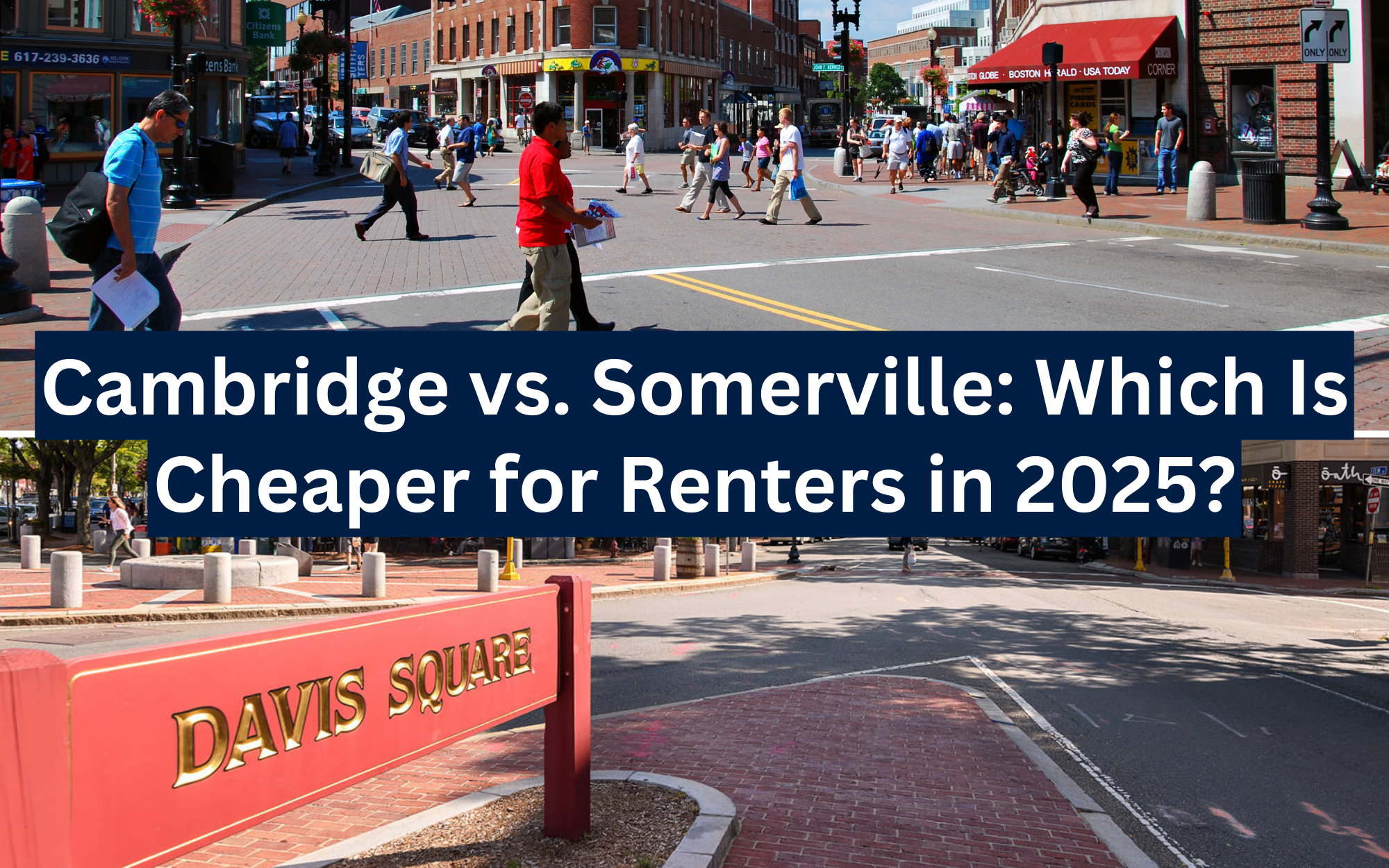
In the dynamic Boston metro housing market, Cambridge and Somerville are two of the most popular destinations for renters—especially among young professionals, students, and families.
But in 2026, is Somerville actually cheaper than Cambridge for renters?
We'll explore rental prices, cost of living, neighborhoods, transportation, and forecasted trends in a data-driven comparison.
By the end, you'll be well-equipped to analyze affordability, evaluate commute vs. rent, and choose the right city for your lifestyle and budget.
2026 Rental Market Overview: Cambridge vs. Somerville
Average & Median Rent
The Spot Easy Rent Index publishes average asking rents by bedroom count for Cambridge and for Somerville, from our own listings and updated monthly. Compare the two there rather than against a national aggregator, because the figures those sites publish for a single city move with whatever mix of units they happen to carry that month.
Snapshot Comparison
Verdict: Cambridge is more expensive at every bedroom count we publish, and the gap widens as units get bigger. Somerville is the cheaper city on our own listings, not marginally but by several hundred dollars a month.
Comparing Rent by Apartment Type
These are average asking rents from the Spot Easy Rent Index for August 2026, drawn from our own listings rather than a national aggregator.
- One-bedroom: Cambridge $2,975, Somerville $2,570, so Somerville is about $405 cheaper.
- Two-bedroom: Cambridge $3,825, Somerville $3,253, about $572 cheaper.
- Three-bedroom: Cambridge $4,615, Somerville $3,801, about $814 cheaper.
Studios are the exception. The Rent Index publishes a Cambridge studio average of $2,366 and no Somerville figure at all, because too few Somerville studios were on the market to report one. If a studio is what you want, Cambridge is where they exist in number.
The gap is wider than a headline comparison suggests, and it grows with bedroom count: roughly $400 on a one-bedroom and more than $800 on a three-bedroom. Somerville is not marginally cheaper than Cambridge, it is substantially cheaper.
Cost of Living Beyond Rent

Utilities & Taxes
While specific utility costs aren't detailed, Cambridge’s higher property values (a legacy of repealed rent control and robust real estate demand) may translate to slightly higher taxes and operating costs.
Somerville's dense urban environment and new development also impact expenses.
Transportation & Commute
- Somerville: Benefit from the Green Line Extension and seven MBTA stations, raising transit accessibility for commuters.
- Cambridge: Benefits from multiple Red Line stations and established walkability in squares like Kendall and Central.
Other Living Expenses
While not quantified here, both cities share similar cost-of-living profiles, with Somerville often offering a slight edge on everyday affordability beyond rent due to its evolving neighborhoods.
Neighborhood-Level Differences
Cambridge
The Spot Easy Rent Index publishes Cambridge at city level rather than by neighborhood, so we do not publish a neighborhood-by-neighborhood ranking. The pattern renters report is that the squares closest to Harvard and MIT and the newer buildings toward East Cambridge ask the most, while the western and northern edges of the city ask less. Compare what is actually live on Cambridge listings before you settle on an area.
Somerville
While specific neighborhood breakdowns aren't in the data, known areas like Ball Square, Davis Square, Union Square, and Assembly Row are popular for walkability and transit.
With growing demand, rental prices in these nodes likely vary significantly—and can be more affordable than Cambridge’s central squares.
Rental Availability & Lease Flexibility
Demand & Inventory
- Somerville: Apartments spend an average of 14 days on market, down from 17, and half of Boston’s 31-day average—signaling strong demand and low vacancy.
- Cambridge: No direct inventory data, but tight renting conditions persist in a high-demand urban market.
Lease Terms & Zoning Influence
Cambridge's dense real estate and development rules can limit new supply.
Somerville’s expanding transit corridor (Green Line extension) has opened areas for development—but also added gentrification pressures.
What Each City Is Like to Live In

What Drives Demand
- Cambridge: Anchored by Harvard, MIT, and a biotech cluster, which keeps demand high year round and holds rents above the metro median.
- Somerville: Dense housing stock, a large arts and small-business presence, and the Green Line Extension opening up new areas.
Neighborhood Character & Amenities
- Cambridge: Urban, walkable, and innovation-driven; “City of Squares” with deep transit access.
- Somerville: Suburban feel in parts, high walkability in Davis and Union Squares, thriving arts culture, community path networks.
Rental Forecast: What to Expect Next
- Cambridge rent growth in 2026 is forecasted to remain modest, around +1–2%, as supply tries to keep pace with demand.
- Somerville shows stronger YOY growth in multi-bedroom units (+4–7%), indicating demand pressure—though overall average rents still inch upward (~1–2%).
Influencing Factors
- Transit expansion in Somerville is likely to spur rental price increases in certain neighborhoods.
- Zoning & development in Cambridge will determine supply trends; with limited new inventory, high baseline rents may persist.
So, Is Somerville Actually Cheaper Than Cambridge in 2026?

By the Numbers
- Across studios, one-bedroom, and two-bedroom apartments, Somerville tends to be slightly more affordable than Cambridge—differences typically range from $60 to $120 per month.
- The overall average rent sometimes leans higher in Somerville depending on data source, but pricing is closer when broken down by unit type and neighborhood.
Qualitative Factors
- Somerville: Offers growing affordability, improved transit, vibrant neighborhood culture, and walkability.
- Cambridge: Commands a premium for prestige, biotech infrastructure, and central access—but some affordable neighborhoods exist on the periphery.
Verdict
Yes—Somerville is generally more affordable for renters across comparable unit types and offers strong value for cost-conscious movers in 2026.
Though not dramatically cheaper, its edge is meaningful when factoring in lifestyle trade-offs.
Final Thoughts: Choosing the Right City for Your Budget & Lifestyle
If you’re prioritizing affordability:
Choose Somerville—especially if you're open to emerging neighborhoods near transit, desire walkability, or want slightly more space for your rent.
If you value proximity to top-tier employers and innovation hubs:
Cambridge remains attractive—for students or biotech professionals who can leverage public transit and amenity-rich neighborhoods.
Other considerations:
- Commute: Both cities offer robust MBTA access; Cambridge slightly edges in coverage.
- Schools & Safety: Both cities have varying quality across neighborhoods; research your target area specifically.
- Lease Flexibility: Tight markets in both mean leases can still be competitive—timely searching and preparedness go a long way.
Recommendation
- Use rental platforms and tools to compare listings by unit type and neighborhood.
- Budget with a margin—rents may continue to increase modestly in both cities.
- Plan visits to walk neighborhoods, gauge vibe, and check commute times before signing.