

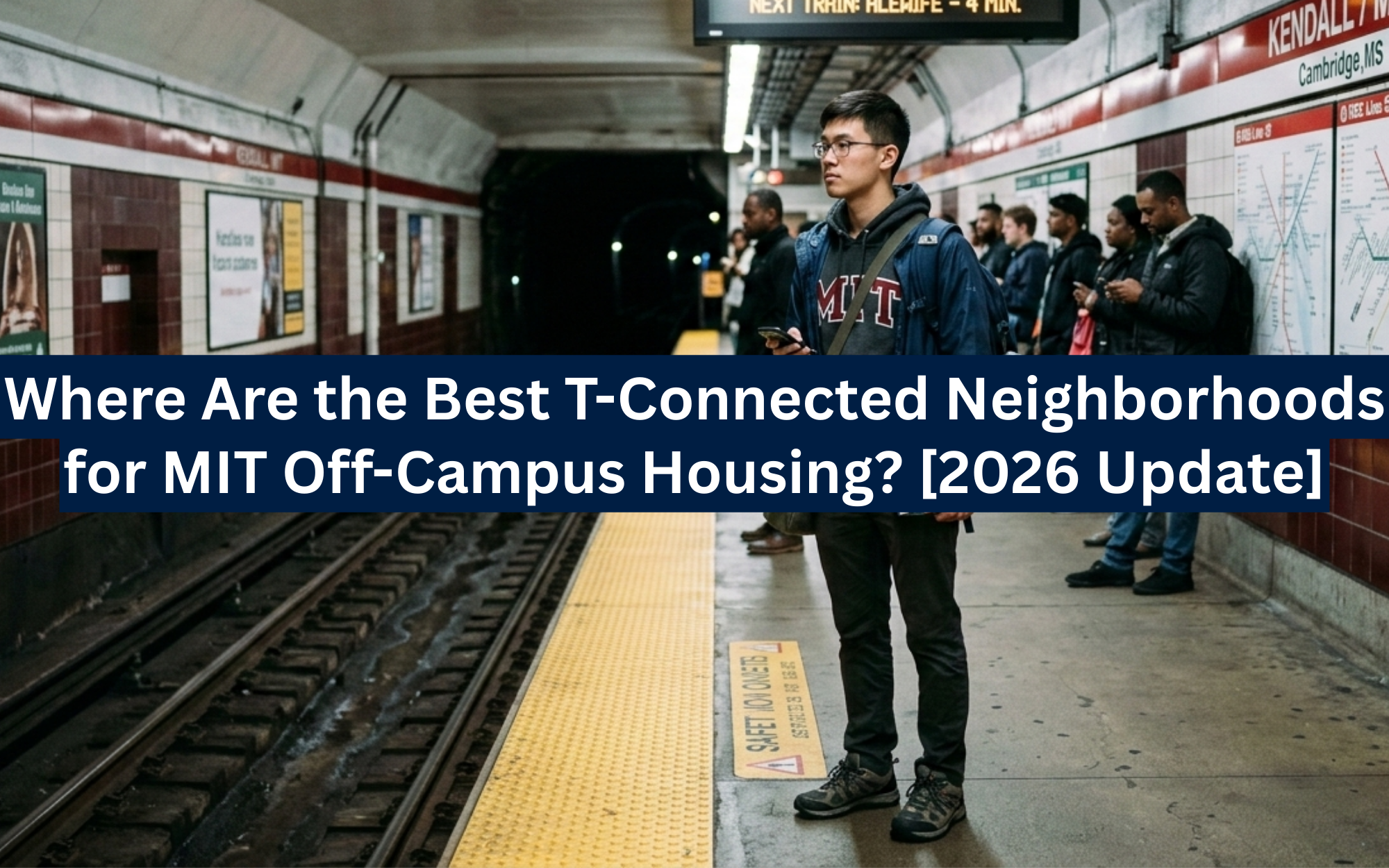
If you’re looking for MIT off-campus housing, the fastest way to narrow your search is to think in transit, not zip codes. MIT sits right next to Kendall/MIT—a major hub on the Red Line—so the easiest commutes usually come from neighborhoods that connect cleanly to the Red Line (or have reliable, low-stress bus connections into Kendall and Central Cambridge).
This guide ranks the best T-connected neighborhoods for living off campus—based on commute simplicity, walkability to stations, student vibe, safety comfort, and overall livability. Whether you want a lively area with college students, a quieter place that’s still well connected, or something budget-friendly and T-accessible, you’ll find a match here.
Quick Answer: Best T-Connected Neighborhoods for MIT Off-Campus Housing
If you want the “just tell me where to live” version, here’s the shortlist:
- Closest + shortest commute: Kendall / East Cambridge
- Best balance of convenience + energy: Central Square
- Classic student hub: Harvard Square
- Quiet but very connected: Porter Square
- More space + strong transit + lots of rentals: Davis Square
- Great vibe + solid access (often via bus/Green Line): Inman Square, Union Square (Somerville)
- Budget-friendlier student neighborhoods: Allston, Brighton (more Green Line oriented)
Now let’s break it down so you can choose based on your priorities.
How to Choose a T-Connected Neighborhood Near MIT
Before you fall in love with a listing, run it through this simple checklist. It will save you time, money, and a lot of “Why is this commute so annoying?” regret.
1) Put Red Line access at the top (most of the time)
MIT is essentially anchored to Kendall/MIT on the Red Line. If you can get on the Red Line without transferring, your commute is usually predictable—especially in winter or on late nights when you don’t want to rely on complicated connections.
Best Red Line clusters for MIT: Kendall → Central → Harvard → Porter → Davis
2) Prioritize walk time to the T
“Close to the T” can mean wildly different things. Aim for a place that’s walkable to the T—ideally within 10–12 minutes on foot. That’s the difference between “easy commute” and “daily friction.”
3) Decide your vibe: lively vs quiet
Some areas are mostly lots of college students around (fun, social, sometimes noisy). Others are a more diverse mix of people (often calmer, more residential).
Ask yourself:
- Do you want a lively off-campus experience?
- Or do you need “quiet but well connected” for focus, family, or sleep?
4) Use transit to predict rent
In Boston/Cambridge, proximity to T stops and rent are tightly linked. The closer you are to a convenient station, the more competitive and expensive listings tend to be.
5) Consider special requirements early
If you’re searching for:
- a room for me and my daughter
- a pet-free home near MIT
- a lease for a month (like July 6th – Aug 4th)
…your best strategy is to target neighborhoods with lots of rental inventory and common sublet activity, then filter aggressively.
Ranked: Best T-Connected Neighborhoods for MIT Students (and Anyone Commuting to Campus)

1) Kendall Square / East Cambridge
Best for: shortest commute to MIT, convenience-first renters
T access: Red Line (Kendall/MIT), plus extremely walkable options
Commute style: walk or a one-stop ride
If your goal is the shortest commute to MIT, it’s hard to beat Kendall and East Cambridge. You can often walk to campus, bike easily, or take a quick Red Line hop if the weather is brutal. It’s the easiest answer for people who want to maximize time and minimize transit complexity.
Why people love it
- Campus is right there
- Very walkable
- Feels “plugged in” to MIT life
Tradeoffs
- Rent can be high
- Inventory may skew toward newer buildings or competitive listings
- The vibe can feel less “student neighborhood” and more professional
Ideal for
- Busy grad students
- Interns and visiting researchers
- Anyone who wants the easiest possible routine
2) Central Square (Cambridge)
Best for: balanced commute + lively neighborhood life
T access: Red Line (Central), easy connection to Kendall
Commute style: short Red Line ride, plus walk/bus options
Central Square hits the sweet spot for many renters: quick access to Kendall/MIT, plenty of food and nightlife, and a very walkable layout. It’s lively without being “only college students,” which makes it great if you want energy but also a broader mix of people.
Why people love it
- Fast commute
- Great restaurants and services
- Feels like a real neighborhood, not just a campus extension
Tradeoffs
- Some blocks are busier and louder than others
- Listings can move fast
Ideal for
- Students who want city energy
- People who want “walkable to the T” living
- Anyone who hates transfers
3) Harvard Square (Cambridge)
Best for: classic student hub + strong transit + walkability
T access: Red Line (Harvard)
Commute style: one-seat Red Line ride to Kendall
Harvard Square is one of the most iconic Boston neighborhoods for students. It’s full of bookstores, coffee shops, and a strong student vibe. The Red Line ride to Kendall is straightforward, and the area is very walkable.
Why people love it
- Classic “college town in a city” feel
- Tons of study-friendly places
- Easy Red Line access
Tradeoffs
- Can be crowded, especially around the square
- Rent is often premium close to the station
- Noise varies block to block
Ideal for
- People who want lively areas with college students
- Those who like to be out and about
- Students without a car
4) Inman Square (Cambridge)
Best for: neighborhood charm + quieter streets + solid connectivity
T access: often via bus/walk to Central/Kendall or nearby stations
Commute style: flexible—bus/walk/bike plus quick Red Line access
Inman Square is a favorite for renters who want a cozy neighborhood feel while staying connected. It’s not always “right on top of a station,” but it can be extremely practical if you’re comfortable using buses, walking to the Red Line, or biking.
Why people love it
- Feels residential and charming
- Great food scene
- Often quieter than the biggest squares
Tradeoffs
- You must be smart about exact location (station walk time matters)
- Commute depends on your comfort with bus connections
Ideal for
- “Quiet but well-connected” renters
- People who like neighborhood character
- Those prioritizing calm over being directly on a station
5) Porter Square (Cambridge)
Best for: calm + connected + practical daily living
T access: Red Line (Porter)
Commute style: direct Red Line ride to Kendall
Porter Square is underrated for MIT off-campus housing. It’s highly connected, often calmer than the busiest student hubs, and still a very manageable commute. For many, it offers a strong mix of value, space, and convenience.
Why people love it
- Red Line access without the chaos
- Good balance of residential streets and amenities
- Easy, predictable commute
Tradeoffs
- Less “nightlife center” than Harvard or Davis
- Some listings are a bit farther from the station—watch walking distance
Ideal for
- Grad students
- People wanting quiet evenings
- Anyone seeking “safe areas with good transit” vibes
6) Davis Square (Somerville)
Best for: lots of rentals + community vibe + strong transit
T access: Red Line (Davis)
Commute style: one-seat Red Line ride to Kendall
Davis Square is one of the best answers if you want more inventory, more neighborhood life, and still easy transit to MIT. It’s lively—often with a lot of students—but also feels like a real community with events, cafes, and day-to-day convenience.
Why people love it
- Strong rental market and variety
- Walkable, lively, and social
- Red Line access is straightforward
Tradeoffs
- Longer ride than Central/Harvard (still easy)
- Can get noisy around the square
- Competition can be intense during peak rental months
Ideal for
- People who want fun off-campus housing locations
- Students who like being around other students
- Renters who want more apartment options than Kendall/Central
7) Union Square (Somerville)
Best for: local energy + growing transit access + lots to do
T access: Green Line access nearby, plus buses connecting toward Cambridge
Commute style: Green Line + bus/walk, depending on exact route
Union Square has become a strong choice for renters who like Somerville’s vibe and want solid transit options. It’s not the most “direct-to-Kendall” setup compared to Red Line squares, but it can work beautifully—especially if you find a place that’s truly close to the T and you’re comfortable with a slightly more flexible commute.
Why people love it
- Great food and neighborhood feel
- Lively but not as tourist-heavy as some hubs
- Often more “creative/local” vibe
Tradeoffs
- Commute may require more planning than Red Line neighborhoods
- Exact address matters a lot for walk time
Ideal for
- People who want Somerville energy
- Those who want a “more diverse mix of people”
- Renters prioritizing lifestyle over the absolute shortest commute
Best Green Line Neighborhoods for MIT Off-Campus Housing (Budget-Friendly Picks)

If you’re trying to save money, or you want a very student-heavy environment, Green Line neighborhoods can be a smart move. Just understand: the commute may involve more variation than a simple Red Line ride to Kendall.
8) Allston
Best for: budget-friendly student housing, social life, roommate-style options
T access: Green Line stops nearby (plus buses)
Commute style: Green Line + bus/walk; varies by exact location
Allston is famous for being one of the most common Boston college student neighborhoods. If you want a lively area with lots of students, cheaper room options, and plenty of energy, Allston belongs on your list.
Why people love it
- Often more affordable than Cambridge
- High availability of rooms for rent
- Strong student social scene
Tradeoffs
- Commute can be less direct
- Noise can be an issue on some streets
- You’ll want to be intentional about being close to a T stop or reliable bus route
Ideal for
- Undergrads
- Roommate groups
- Anyone prioritizing budget first
9) Brighton
Best for: slightly calmer feel with Green Line access; more residential pockets
T access: Green Line stops in parts of Brighton
Commute style: similar to Allston; depends heavily on where you live
Brighton can feel more residential than Allston while still keeping you connected to transit. It’s often a good compromise if you want something a bit quieter but still budget-aware.
Why people love it
- Some quieter streets
- Potentially more space for the price
- Still within reach of Boston’s student ecosystem
Tradeoffs
- Commute planning matters
- “Close to the T” varies—check walking distance carefully
Ideal for
- Renters who want calm but still city access
- People who like a neighborhood feel
- Those balancing budget with comfort
Rent Trends: What to Expect (Without Getting Lost in Numbers)
Boston’s rental market changes quickly, and MIT-adjacent areas are highly competitive. Instead of guessing exact numbers, think in tiers:
Highest-demand (often highest cost)
- Kendall / East Cambridge
- Central Square
- Harvard Square
These areas offer the easiest commutes and the most “walk everywhere” convenience.
Strong value for transit + livability
- Porter Square
- Davis Square
- Some parts of Inman Square
These can offer more space, a calmer environment, and still a great transit experience.
Often more budget-friendly (especially for rooms)
- Allston
- Brighton
- Some pockets of Somerville farther from the busiest hubs
Pro tip: If you’re comparing two apartments, the one that’s a genuine 7-minute walk to a station often feels “cheaper” in day-to-day life than a slightly less expensive place that’s a 20-minute walk plus a transfer.
Safety & Comfort Near the T: Practical Ways to Choose Wisely
People often ask for “safe neighborhoods near MIT.” Safety is personal and depends on what feels comfortable to you—especially if you’ll be commuting at night or with family.
Instead of relying on vague labels, evaluate the block and the walk:
- Is the path to the T well-lit?
- Are there active storefronts or foot traffic along the route?
- Does the station entrance area feel comfortable at your typical commuting times?
- Is the apartment on a quieter side street or directly on a loud corridor?
If your priority is quiet but well-connected, you’ll often do best a few blocks away from the busiest square—still close enough to walk, but not right on top of the loudest nightlife.
Special Case: One-Month Lease Near MIT (July 6 – Aug 4)
If you need a lease for a month—especially a specific range like July 6th – Aug 4th—your strategy should shift from “traditional leases” to sublets and short-term rentals.
Where short-term options are most common
- Neighborhoods with lots of students and frequent summer movement:
- Harvard Square
- Central Square
- Porter / Davis
- Allston
- Somerville squares (Inman/Union/Davis)
What to search for in listings
Use keywords like:
- “sublet,” “summer sublet,” “furnished,” “short-term,” “one month”
- “no pets” or “pet-free”
- “family friendly” if you need a room for me and my daughter
- “near Red Line” or “walk to T stop”
Red flags to avoid
- Refusal to do a live video tour
- Pressure to send money immediately
- Unverifiable identity or incomplete lease terms
- Listings that won’t state an exact address range or nearest T stop
Short-term housing is where scammers love to operate—so stay practical and cautious.
Neighborhood Matchmaker: Choose Based on Your Life
If you want the shortest commute to MIT
- Kendall / East Cambridge
- Central Square
If you want the best Red Line lifestyle without a car
- Central Square
- Harvard Square
- Porter Square
- Davis Square
If you want “quiet but well-connected”
- Porter Square
- Residential pockets near Central or Harvard (a few blocks off the main square)
- Parts of Inman Square
- Some Brighton pockets (if you’re truly close to transit)
If you want lots of college students around
- Harvard Square
- Allston
- Davis Square (often a strong mix of students + locals)
If you want a more diverse mix of people
- Central Square
- Somerville squares (Union/Inman/Davis)
If budget is your top priority
- Allston
- Brighton
- Look for slightly longer walks to the T, but avoid long transfers if you can
FAQs: T-Connected MIT Off-Campus Housing
What’s the shortest commute to MIT by the T?
In most cases, the simplest setup is living near Kendall/MIT or somewhere on the Red Line with a direct ride to Kendall. The fewer transfers you have, the more reliable your commute feels.
What are the best areas for MIT students without a car?
Focus on Red Line squares (Kendall, Central, Harvard, Porter, Davis) and locations that are genuinely walkable to the T. These areas make daily errands, social life, and campus commuting much easier without driving.
Allston vs Harvard Square: which is better for students?
Harvard Square is a Red Line hub with a classic campus vibe and very direct access to MIT. Allston often has more budget-friendly room options and a strong student scene, but commutes can be less direct depending on your exact location and line access.
How close should I live to a T stop?
If you can, aim for 10–12 minutes walking distance. That’s usually the difference between “easy transit lifestyle” and “commute feels like a project.”
Where can I find a one-month lease near MIT?
Short-term stays are most commonly found through sublets in student-heavy neighborhoods like Harvard, Central, Porter, Davis, Allston, and Somerville squares. Use “sublet,” “furnished,” and exact date range filters—and always verify the listing carefully.
Final Recommendation: Start with Red Line, Then Choose Your Vibe
If you want the simplest, most reliable answer to “where are the best T-connected neighborhoods for MIT off-campus housing,” start with the Red Line. For most students and commuters, it’s the cleanest route to Kendall/MIT and the easiest way to live without a car.
Then decide what matters most:
- Maximum convenience: Kendall / East Cambridge
- Best overall balance: Central Square
- Classic student energy: Harvard Square
- Quiet + practical: Porter Square
- Lots of rental options + great community: Davis Square
- Budget-friendly student zones: Allston and Brighton