

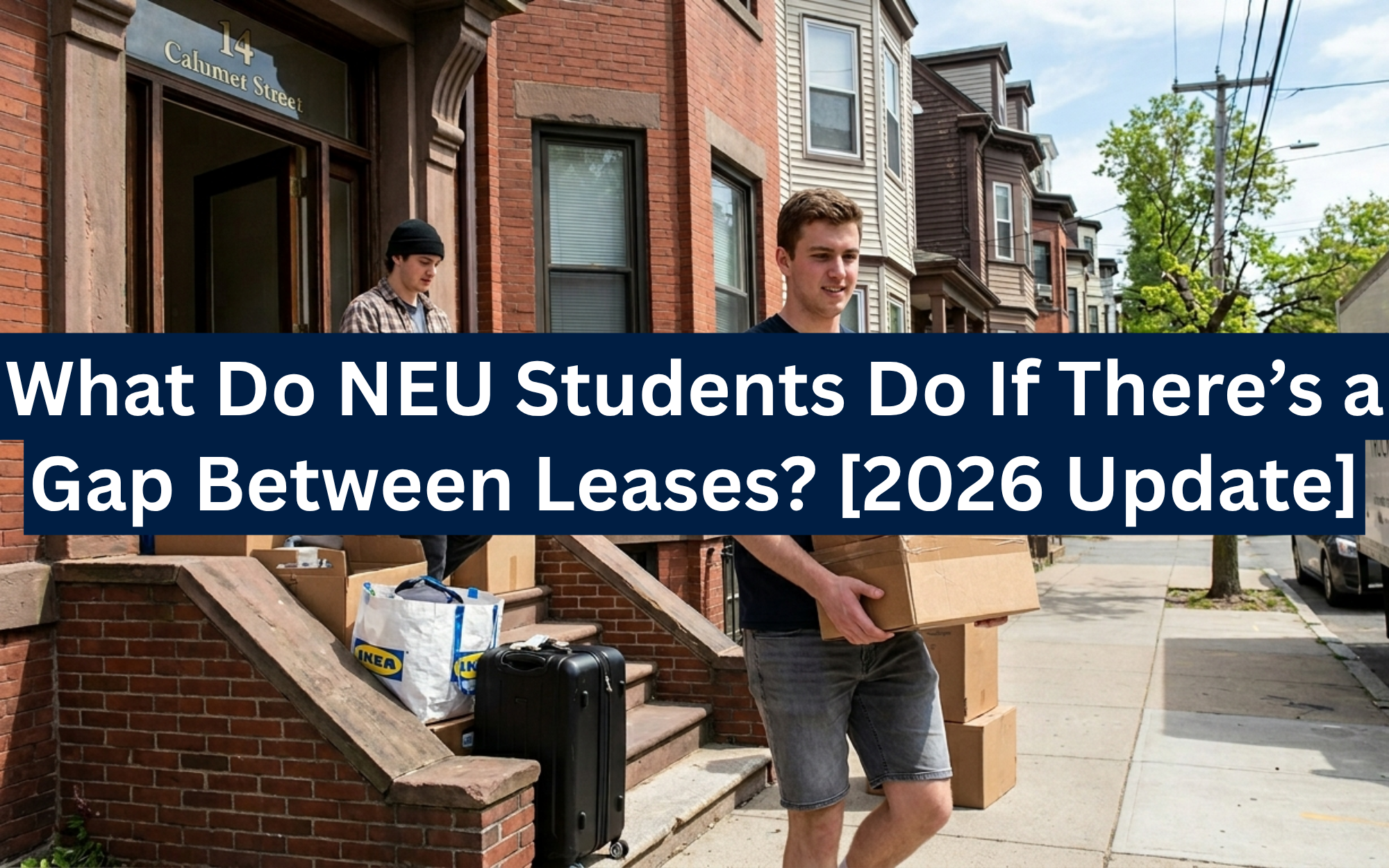
If you go to Northeastern and your old place ends before your new one begins, you are not alone. A lease gap is one of the most common housing problems NEU students deal with, especially around August 31 and September 1, when Boston’s rental cycle creates a mismatch between your move-out date and move-in date.
In real life, most students solve this problem in a few practical ways. They line up temporary housing, use storage, stay with friends, book a short hotel or Airbnb stay, or find a very short sublet until their next lease starts.
The good news is that this problem is manageable when you plan ahead. The best way to handle a housing gap is to think about it in two parts:
- Where will you stay?
- Where will your stuff go?
Once those two pieces are covered, the move becomes much less stressful.
Why This Happens So Often for Northeastern Students
This issue is common because Boston housing runs on a very specific calendar. Many leases end on 8/31, and many new leases begin on 9/1. That sounds simple, but the timing often does not line up perfectly.
For example:
- your landlord may expect you fully out on August 31
- your new apartment may not give you keys until September 1
- you may be moving from on-campus housing to off-campus housing
- you may be returning from co-op and trying to secure a new apartment during the city’s busiest moving period
That creates a lease gap — even if it is only for one night.
For Northeastern students, this can be even trickier because university housing and private leases follow different systems. Your housing assignment and university move schedule are one thing. A private landlord’s lease term dates are another.
If you signed a year-long lease, it is usually a legally binding contract, so you cannot assume your landlord will adjust dates just because your academic schedule changed.
Does Northeastern Provide Housing During the Gap?
This is often the first question students ask.
In many cases, students cannot rely on university housing to cover the gap between leases. If you are moving out of university housing and into an off-campus apartment, you may need to make your own arrangements between the posted move-out date and your new move-in date.
That means you should not build your whole plan around the hope that you can stay in a residence hall for one extra night. If you are not continuing directly into another university housing assignment, you should prepare for the possibility that University housing is not available during that short transition period.
If you are moving between university housing assignments, your situation may be different. In that case, always check your exact housing assignment, move-to-from period, and any instructions connected to continuing contracts.
What NEU Students Actually Do During a Lease Gap
Most students use one of the following strategies.
1. Stay With Friends for a Night or Two
This is one of the most common solutions. If the gap is short, many students stay with a friend, roommate, or classmate for one or two nights.
This works best when:
- the gap is very short
- you can travel light
- you have already put most of your belongings into storage
- you only need a place to sleep until your next lease begins
It is not glamorous, but it is often the cheapest and simplest option.
2. Book Temporary Housing
Many students choose temporary accommodations such as:
- a hotel
- an Airbnb
- a short home sharing stay
- other forms of short-term housing
This option makes sense if:
- you want privacy
- you have family helping you move
- you do not want to rely on a favor
- your move-in date might be delayed
- you want a reliable backup plan
Even a one-night booking can make the transition smoother, especially during the busy late-August moving period.
3. Find a Short Sublet
A short sublet is another popular option, especially if the gap is longer than one or two nights.
This can work well if:
- someone you know is leaving temporarily
- another student has an extra room
- you need low-cost short-term housing
- your new apartment is not ready yet
If you go this route, make sure the dates are clear and confirm the arrangement in writing. If utilities, keys, or move-out timing matter, ask about them upfront.
4. Go Home Briefly
For students who live close enough, going home for a day or two can be the easiest option.
This works especially well if:
- home is within driving or train distance
- you can store your belongings nearby
- you do not want to spend money on a hotel
- your gap is short
This is not practical for everyone, but for many students in the Northeast, it is a realistic and affordable choice.
What Do Students Do With Their Stuff?

For many students, this is actually the hardest part.
Finding somewhere to sleep for one night is one thing. Figuring out what to do with your clothes, bedding, books, kitchen gear, and boxes is another.
That is why storage becomes such an important part of the plan.
Common Storage Solutions
Students usually handle their belongings in one of these ways:
- rent short-term student storage
- split belongings between a storage unit and a friend’s place
- keep essentials with them and store everything else
- use a car or family vehicle for temporary transport
- ship boxes to the new address if timing allows
Pack a “Bridge Bag”
One of the smartest things you can do is pack a small bag just for the gap between leases.
Your bridge bag should include:
- one or two changes of clothes
- toiletries
- medication
- chargers
- important documents
- laptop and valuables
- anything you need for one or two nights
That way, the rest of your belongings can stay boxed up and out of the way.
Separate Essentials From Non-Essentials
Before move-out day, divide your belongings into two groups:
Essentials
- things you need during the housing gap
Non-essentials
- things that can go directly into storage or wait until move-in
This makes the transition much easier and prevents you from digging through boxes in a hotel room, on a friend’s couch, or in a car.
Can You Ask to Move In Early?
Sometimes, yes.
One of the best ways to solve a lease gap is to remove it entirely by asking for an earlier move-in date.
You cannot count on this, but it is always worth asking. A landlord or property manager may allow you to:
- pick up keys early
- move in the night before
- drop off boxes before the full move-in
- access the apartment earlier than expected
Even a few extra hours can make a huge difference.
Instead of asking a vague question like, “Can I move in early?” ask something more specific:
- “Can I get the keys the evening of August 31?”
- “Can I bring boxes in on the morning of September 1?”
- “Is early move-in possible if the unit is ready?”
The earlier you ask, the better your chances.
What If You’re Leaving for a Co-op Outside Boston?
This gets more complicated if your housing situation overlaps with co-op dates.
If you are leaving for a co-op outside of Boston, you may need to think about more than just a one-night housing gap. You may be dealing with:
- ending one housing arrangement early
- returning to Boston later
- deciding whether to keep or leave a lease
- figuring out finding housing upon your return
This matters because private leases usually do not change just because your co-op schedule changes. If you signed a year-long lease, it is still your responsibility unless the lease allows something like subletting.
That is why students going on co-op often need to check:
- whether their lease allows a sublet
- whether they need to find short-term housing when they return
- whether cancelling university housing affects their timeline
- whether they will face a new housing gap after co-op ends
Best Northeastern Housing Resources to Check First
If you are dealing with a lease gap, start by checking the Northeastern housing pages and support resources tied to your situation.
Focus on:
- Northeastern housing move-in and move-out information
- on-campus housing deadlines
- off-campus housing support pages
- Network Housing & Relocation
- relocation guides for leases, sublets, and moving
- cancellation schedule information if co-op or housing status is changing
These resources can help you confirm:
- your actual move-out date
- whether your new assignment has a different timeline
- whether a move-to-from period applies
- what housing options may exist during intersession
- how to plan around the late-August rush
Always check your details early rather than waiting until the last week of August.
A 7-Step Plan for Handling a Lease Gap
If you want a simple process, use this checklist.
1. Confirm Your Dates
Double-check your exact move-out date and move-in date. Do not rely on assumptions.
2. Ask About Early Move-In
Contact your landlord or property manager and see whether early access is possible.
3. Reserve Temporary Housing Early
If you think you may need a hotel, Airbnb, or short-term stay, book it before prices jump.
4. Arrange Storage
Set up student storage or another plan for the belongings you will not need during the gap.
5. Pack a Bridge Bag
Keep your essentials with you so you do not have to open every box during the transition.
6. Confirm Transportation and Key Pickup
Know exactly how you are getting from your old place to your temporary stay and then to your new place.
7. Have a Backup Plan
Even if everything looks set, have a second option in case your move-in is delayed or plans change.
Common Mistakes Students Make
A lease gap is stressful enough without avoidable mistakes. Here are some of the most common ones:
Assuming the Dates Will “Probably Work Out”
Never assume your old landlord will be flexible or your new place will be ready early.
Waiting Too Long to Book Temporary Housing
The closer it gets to September 1, the more expensive and limited your options become.
Not Thinking About Storage Early
Your biggest problem may not be where you sleep — it may be where your boxes go.
Packing Everything the Same Way
If you do not separate essentials from non-essentials, the gap becomes much harder to manage.
Not Confirming Key Pickup
You need to know exactly when and where you will get keys for the new place.
What Is the Best Option?
The best solution depends on how long the gap is and what your budget looks like.
- One night gap: stay with friends, use storage, travel light
- Two to three nights: hotel, Airbnb, or short home-sharing stay
- Longer gap: short sublet or other short-term housing
- Minimal budget: couch-surfing plus storage
- Most convenient: early move-in if your landlord allows it
For most NEU students, the best answer is not one single option. It is usually a combination of options that work together.
For example:
- store your belongings
- stay with a friend for one night
- move into your new place the next morning
Or:
- keep essentials with you
- book temporary accommodations for two nights
- move the rest of your things from storage once the new lease begins
FAQ
What do NEU students do if there is a gap between leases?
Most students use a mix of temporary housing, storage, staying with friends, or a short sublet until the next lease begins.
What is a lease gap?
A lease gap happens when your old lease ends before your new lease starts, leaving you without a place to stay for a short period.
What should I do with my stuff during a housing gap?
Use storage, keep essentials with you, and pack a bridge bag for the days between move-out and move-in.
Can I move into my new apartment early?
Sometimes. It depends on the landlord or property manager, but it is always worth asking.
Is staying with friends the cheapest solution?
Usually, yes. For a one-night gap, staying with friends is often the simplest and most affordable option.
Is a short sublet a good option?
Yes, especially if the gap is longer than one or two nights or if your move-in is delayed.
Final Thoughts

So, what do NEU students do if there is a gap between leases?
Most students solve it by creating a simple bridge plan. They figure out where they will stay, where their belongings will go, and whether there is any way to reduce the gap by moving in early. That might mean staying with friends, booking temporary housing, finding a short sublet, using student storage, or combining several of those options.
The biggest mistake is waiting until the last minute.
A lease gap can feel overwhelming, especially during the August 31 to September 1 rush, but it is a very common student problem. With a little planning, it becomes something you can handle without panic.
If your lease ends before your next one starts, think ahead, book early, pack smart, and treat the gap like a short transition instead of a crisis.