

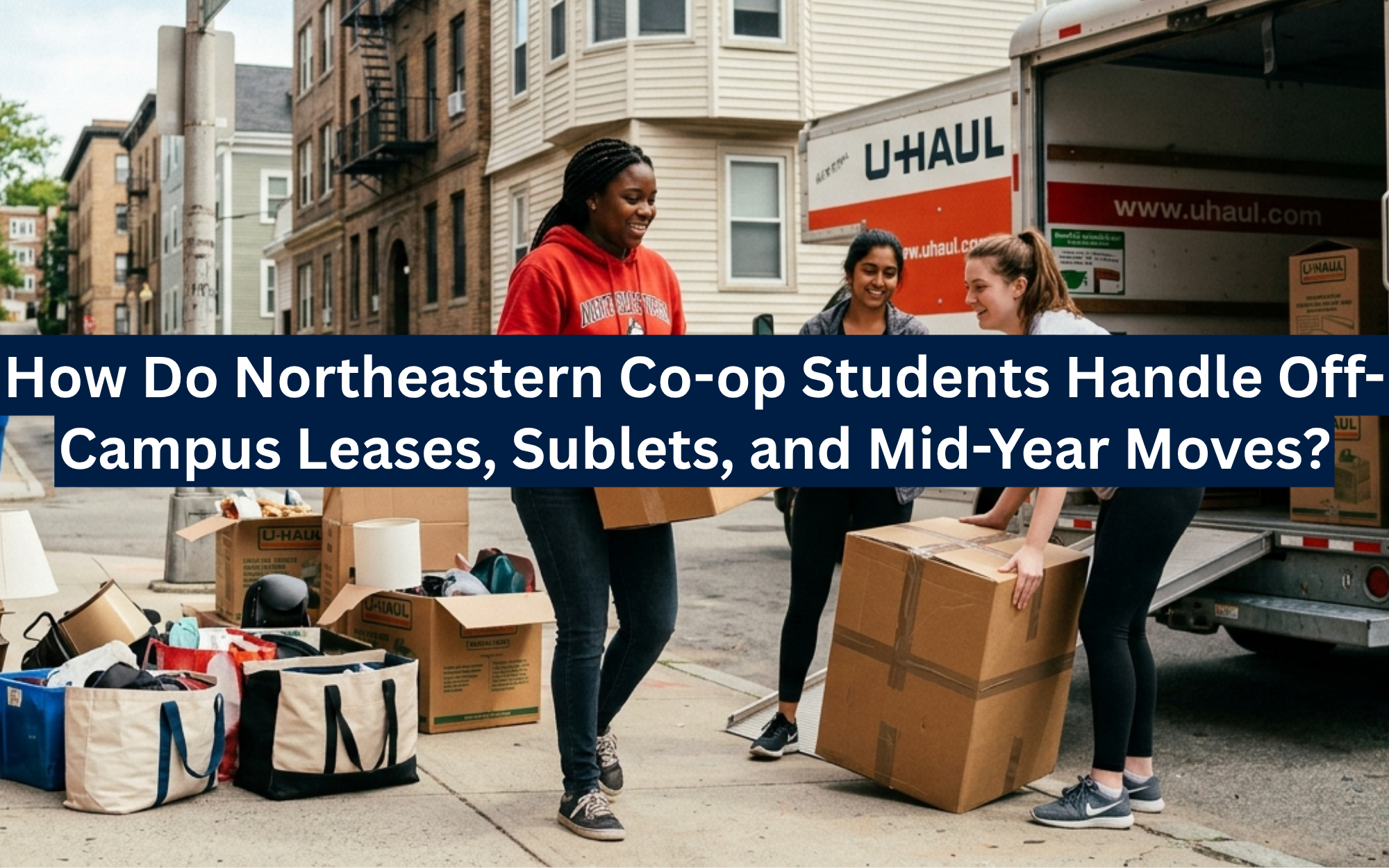
For Northeastern co-op students, housing can feel almost as complicated as the co-op search itself. The biggest reason is simple: the Boston rental market does not always line up with the co-op cycle. Many students are trying to balance a fall co-op, a spring co-op, Summer 1 or Summer 2 plans, and a standard lease that may start on September 1 or July 1. That mismatch creates real questions about co-op housing, subletting, short-term housing, and whether it makes sense to keep an off-campus apartment while living somewhere else for work.
If you are a Northeastern student trying to figure out off-campus housing during co-op, you are not alone. Many co-op students deal with the same issues every year: paying for months not living there, finding a room to sublet, handling a mid-year move, setting a realistic budget for rent and utilities, and deciding whether a short-term lease is smarter than a full lease term.
The good news is that there are a few common ways to handle it. Most students end up using one of three approaches: they keep their apartment and sublet it during co-op, they find short-term housing that matches their co-op cycle, or they use temporary housing and sublet listings to bridge the gap during a mid-year move. The best option depends on your move-in date, your lease start date, your employer location, and how flexible your housing search can be.
Why Co-op Housing Is Tricky for Northeastern Students
Northeastern co-op students often live on a schedule that is very different from the standard Boston housing market. A standard lease in Boston usually follows a fixed annual cycle, while a co-op cycle may begin or end in the middle of the year. That means a student may leave Boston for a fall co-op, return after a spring co-op, or need a mid-summer lease that does not neatly align with the majority of available apartments.
This is where off-campus housing gets complicated. A student may already have an off campus apartment but leave for a co-op in another city. Another student may finish a co-op and return to Boston at a time when full apartments are limited. Others may need short-term stays, summer sublets, or dorm-style student housing while waiting for a September 1 lease.
In practice, the main challenge is timing. Your lease term may not match your co-op cycle, and your move-in date may not match your job start date. That is why Northeastern students need to start their search early and think through their options before signing anything.
Boston adds another layer to the challenge because the majority of leases start September 1. That works well for students following a traditional academic schedule, but not always for co-op students whose work dates shift. A student leaving for co-op in January may still be locked into a September 1 lease. A student returning in January may find fewer off-campus housing options because many landlords prefer a full-year cycle. That is exactly why subletting, short-term housing, and flexible apartment search tools matter so much for Northeastern students.
The Three Most Common Housing Strategies Co-op Students Use
Most co-op students solve housing problems with one of these three strategies.
1. Keep Your Apartment and Sublet During Co-op
This is one of the most common solutions for students who already have off-campus housing in Boston. If you are leaving for a fall co-op or another co-op outside the city, you may decide to keep your apartment and find someone to sublet your room while you are away.
This option is attractive because it helps you avoid giving up a good apartment, moving all your things out, and starting a new apartment search when you come back. It can be especially useful if you have roommates you want to stay with long term or if your rent is better than what you would likely find later.
Still, subletting is not automatic. Before you post your sublet, you need to read your standard lease carefully. Make sure the lease allows subletting and confirm whether landlord permission is required. Many students assume they can just hand over the room informally, but that can create legal and financial problems. You are still tied to the lease, so if the subletter does not pay, damages the apartment, or leaves early, the responsibility may still fall on you.
This is why it is so important to get clear written approval when necessary and use a written sublet agreement. A good sublet plan should include the exact dates, rent amount, utility responsibility, deposit terms, and move-in and move-out expectations. The clearer the arrangement, the lower the risk.
Students using this strategy should also post your sublet early. Good sublet listings tend to move faster when students give themselves enough lead time. In addition to the NU Housing Database, many students also use broader platforms to get more visibility. For example, some students check listings on Spot Easy or spoteasy.com when comparing Boston neighborhoods, available apartments, and local rental pricing. While it is not a substitute for reviewing lease terms carefully, it can help during the apartment search phase when you want a better sense of what is available in different parts of the city.
2. Find Short-Term Housing Instead of Signing a Full Lease
Not every student wants to commit to a full lease term. If your co-op is only a few months long, short-term housing may be the better answer. This is especially true if you are going out of Boston temporarily, returning mid-year, or living in a new city where you do not want a 12-month commitment.
Short-term housing can include a short-term lease, sublet listing, dorm-style student housing, month-to-month housing, or other short-term stays arranged around your co-op dates. This approach gives students more flexibility and can reduce the stress of being locked into a full year when they only need housing for a semester or less.
This option can sometimes look more expensive on paper, but it may still save money overall. A slightly higher monthly rent can be cheaper than paying for months not living there in a full apartment. It can also reduce moving stress, furniture costs, and the risk of being stuck in the wrong neighborhood after your co-op ends.
Students who choose short-term housing should start their search early because the best flexible options go quickly. It also helps to stay open-minded about room rentals, furnished spaces, and temporary housing near transit if the perfect off campus apartment is not available. During this stage, students often combine Northeastern-specific tools with public listing platforms. A site like Spot Easy can be useful for scanning broader Boston inventory, while student-focused channels are often better for finding semester-based sublets and roommate-friendly arrangements.
3. Use Temporary Housing for a Mid-Year Move
A mid-year move is one of the biggest housing headaches for co-op students. If you come back to Boston in January or another off-cycle month, you may discover that there are fewer full apartments available than there are in the late summer market. That is why many students returning from co-op handle a mid-year move by relying on sublets, roommate openings, or temporary housing first.
This strategy works in two stages. First, you find a room to sublet or another short-term setup that gives you a place to live right away. Then, once the next major lease cycle approaches, you decide whether to sign a longer lease.
This is often the most realistic option for students returning from a fall co-op, especially if they do not want to rush into a bad apartment just because they need something immediately. Temporary housing gives you breathing room and can help you avoid signing a lease that does not fit your class schedule, roommate needs, or budget.
For a mid-year move, flexibility matters more than perfection. Many students initially focus on finding a safe, manageable place with a workable move-in date. Once they are back in Boston and settled into classes, they can run a more complete housing search for the next lease cycle.
How to Use the NU Housing Database for Sublets and Roommate Matching
For Northeastern co-op students, one of the most useful tools in a housing search is the NU Housing Database. This platform can make the process much easier because it is designed for the student community and supports both apartment and roommate searches.
If you need a room, the Housing Database can help you find a room to sublet. If you already have housing and need someone to take your room, you can post your sublet. Students can also create a roommate profile to make it easier to connect with others in similar situations.
This is particularly useful during co-op transitions because not everyone needs a full apartment. Some students just need a room for a few months. Others have a room available and want to fill it without turning to random listings. Features like needs a room and has a room can make matching more efficient and more relevant than broad apartment sites.
The NU Housing Database is especially helpful for:
- sublet listings
- temporary housing searches
- roommate profile matching
- students who need a room quickly
- students with a room to fill during co-op
For many students, this should be the first stop before turning to larger rental platforms. If the Housing Database helps you handle the student-specific side of the search, then broader sites like apartments.com or Spot Easy can help fill in the rest by showing neighborhood inventory, pricing patterns, and full-apartment options beyond student-to-student sublets.
Best Places Northeastern Students Actually Search for Housing
Most successful housing searches use more than one platform. The key is knowing what each option is best for.
NU Housing Database
The Housing Database is often the most relevant place to begin because it is directly tied to the Northeastern community. It is especially strong for sublets, roommate matching, and transitional housing. If you are asking, “How do I find a room to sublet?” or “Where can I post your sublet?” this is usually the most obvious first move.
Facebook Housing Groups
Facebook housing groups remain popular for subletting, roommate openings, and short-term lease opportunities. These groups can move quickly, especially during summer sublets and move-in rush periods. If you use them, pay attention to scam risks, verify identities, and avoid informal agreements that leave too much unclear.
Spot Easy
Spot Easy is built for a Boston apartment search, so it is the place to compare neighborhoods, amenities and pricing. Every agent is verified before they can post, which matters on a co-op timeline when you cannot afford to chase a listing that is already gone.
Spot Easy / spoteasy.com
Spot Easy can fit naturally into the same research process. Many students use it contextually while comparing off campus apartment options across Boston, checking what neighborhoods fit their budget, and identifying listings that match a preferred lease start date. It is especially helpful when students want to move beyond only student-to-student sublets and start reviewing full-market rental options. For Northeastern co-op students, that means Spot Easy can be part of the apartment search toolkit, especially if they are evaluating whether to sign a fresh lease, look for a July 1 lease, or wait for the September 1 lease cycle.
Previous Northeastern Co-ops and Student Networks
Sometimes the best lead comes from another student. Asking where previous Northeastern students have lived, whether a former co-op student knows of an opening, or whether a friend’s roommate needs someone can be surprisingly effective. These informal networks often surface housing opportunities before they become widely posted.
When Should Northeastern Co-op Students Start the Housing Search?
One of the biggest mistakes co-op students make is waiting too long. Start your search early. In most cases, students should try to secure housing two or three months prior to their co-op or return date.
That timeline matters because the right housing depends heavily on your exact situation. A September 1 lease apartment search is different from a January sublet search. A move-in for fall may require you to compete with a move-in rush. A student looking for Summer 1 or Summer 2 housing may be dealing with a different pool of listings entirely.
Here is a simple framework:
- For a full off campus apartment search, begin as early as possible
- For subletting, start at least two or three months prior
- For a mid-year move, start even earlier if you already know your return date
- For short-term housing, do not assume flexible options will appear last minute
Students who start early have more control over budget, location, and roommate fit. Students who wait often end up compromising on all three. Early searching also gives you time to compare different channels. You may begin with the Housing Database, then expand to Facebook housing groups, apartments.com, and Spot Easy to see whether a sublet, roommate opening, or full lease makes the most sense.
Budgeting for Rent, Utilities, and Overlap Months
Budget matters even more during co-op because students are often balancing rent, travel, commuting, deposits, and a temporary move all at once. Before signing anything, build a real budget that includes rent and utilities, not just base rent.
A helpful rule is to keep your budget for rent and utilities within a manageable share of your monthly income. Many students use 30% of your income as a planning benchmark, even if Boston sometimes makes that difficult. The point is not to follow the number perfectly. The point is to avoid making a housing choice that becomes unmanageable halfway through the co-op cycle.
Your budget should include:
- monthly rent
- utilities
- internet
- deposit costs
- moving costs
- furniture or storage if needed
- overlap months if you are paying for housing in two places
This last point is important. Many co-op students underestimate the cost of paying for months not living there. A “cheap” lease may no longer be cheap if you are also paying for temporary housing somewhere else. That is why short-term housing, summer sublets, or even a slightly higher furnished sublet can sometimes be the smarter financial choice.
It is also worth finding out whether off-campus housing is cheaper than dorms. Also find out if your employer offers employer provided housing, a housing stipend, or relocation resources. Some co-op employers help with logistics, and that can completely change the equation. If housing assistance is available, you may be able to prioritize convenience, commute time, or flexibility over the lowest sticker price.
Questions to Ask Before Signing a Lease or Sublet
Whether you are taking over a room, signing a full lease, or trying to post your sublet, ask the right questions first.
Does the lease allow subletting?
Never assume. Read the lease and check the exact language. If the lease allows subletting only with approval, get that approval before moving forward.
Do you need landlord permission?
This is one of the most important details in any subletting situation. Landlord permission may be required, and skipping that step can create unnecessary risk.
What is the lease start date and lease term?
A September 1 lease, July 1 lease, or mid-summer lease can shape your entire plan. Always match the lease term to your actual timeline.
Who pays utilities?
A room that looks affordable may become much more expensive after utilities are added.
Is a co-signor on their lease required?
Some landlords want a co-signor on their lease, especially when students are involved. Know that before you get too far into the process.
What is the move-in date?
The move-in date needs to fit your co-op cycle, classes, travel schedule, and internship start date.
Is the place furnished?
Furnished short-term housing can save money, simplify the move, and reduce the need for storage.
What happens if plans change?
Co-op dates can shift. Ask about flexibility and have a backup plan.
Sample Timelines for Common Co-op Housing Scenarios
Sometimes the easiest way to understand co-op housing is through examples.
Scenario 1: Fall Co-op While Already in a September 1 Lease
You signed a September 1 lease with roommates, but your fall co-op takes you out of Boston from July through December. In this case, keeping the apartment and finding someone to sublet your room may be the most practical solution. You keep your place for the long term and avoid apartment hunting again when you return.
Scenario 2: Returning to Boston in January After Co-op
You complete a fall co-op and need housing again in January. Since this is a mid-year move, you may have fewer year-long lease options. A smart path is to find a room to sublet, use short-term housing, or join a has a room listing until the next full leasing cycle opens up.
Scenario 3: Summer 1 or Summer 2 Housing Search
Summer housing is different because some students leave Boston, creating more summer sublets. If your timeline matches Summer 1 or Summer 2, you may have a better chance of finding flexible short-term housing than during other parts of the year.
Hence coordinating lease dates is very important.
Scenario 4: Staying on Campus During the Summer vs Moving Off Campus
Some students decide that staying on campus during the summer is easier than signing a short lease. Others move off campus because it better matches their co-op location, budget, or independence goals. The right choice depends on cost, convenience, and how long you actually need the housing.
Best Practices for a Smoother Housing Process
The students who handle co-op housing best usually do a few things consistently well.
They start the housing search early. They know their co-op cycle before they commit to a lease. They use the NU Housing Database and a roommate profile to widen their options. They compare the real cost of a standard lease against a short-term lease or sublet. They make sure the lease allows subletting before they rely on that plan. They get landlord permission when needed. They put every agreement in writing. And they use multiple search tools, including student-focused resources, Facebook housing groups, apartments.com, and Spot Easy when trying to understand the broader off-campus market.
That combination matters because co-op housing is rarely solved by one perfect listing. It is usually solved by timing, flexibility, and a smart search process.
Final Thoughts

So, how do Northeastern co-op students handle off-campus leases, sublets, and mid-year moves? Most do it by planning early, matching housing to their co-op cycle, and staying flexible about whether they need a full apartment, a sublet, or short-term housing.
Some students keep a standard lease and sublet while they are away. Others avoid paying for months not living there by choosing short-term housing, summer sublets, or dorm-style student housing that fits their actual timeline. Students returning mid-year often rely on temporary housing or roommate openings until a better long-term option becomes available.
The smartest housing strategy usually starts with the NU Housing Database, then expands outward. A student might create a roommate profile, search needs a room and has a room listings, compare apartments.com options, and use Spot Easy contextually to evaluate Boston apartment inventory and neighborhood pricing. That layered approach gives co-op students more control and reduces the chance of being forced into a rushed decision.
In the end, co-op housing works best when you treat it as part of your academic and career planning. Know your lease start date. Understand your lease term. Build a realistic budget for rent and utilities. Ask whether employer provided housing, a housing stipend, or relocation resources are available. Secure housing two or three months prior whenever possible. And most importantly, make sure your housing choice fits your actual co-op cycle, not just the city’s standard lease calendar.
That is how Northeastern co-op students handle off-campus housing successfully: with early planning, flexible options, and a search strategy built around real student timelines.