

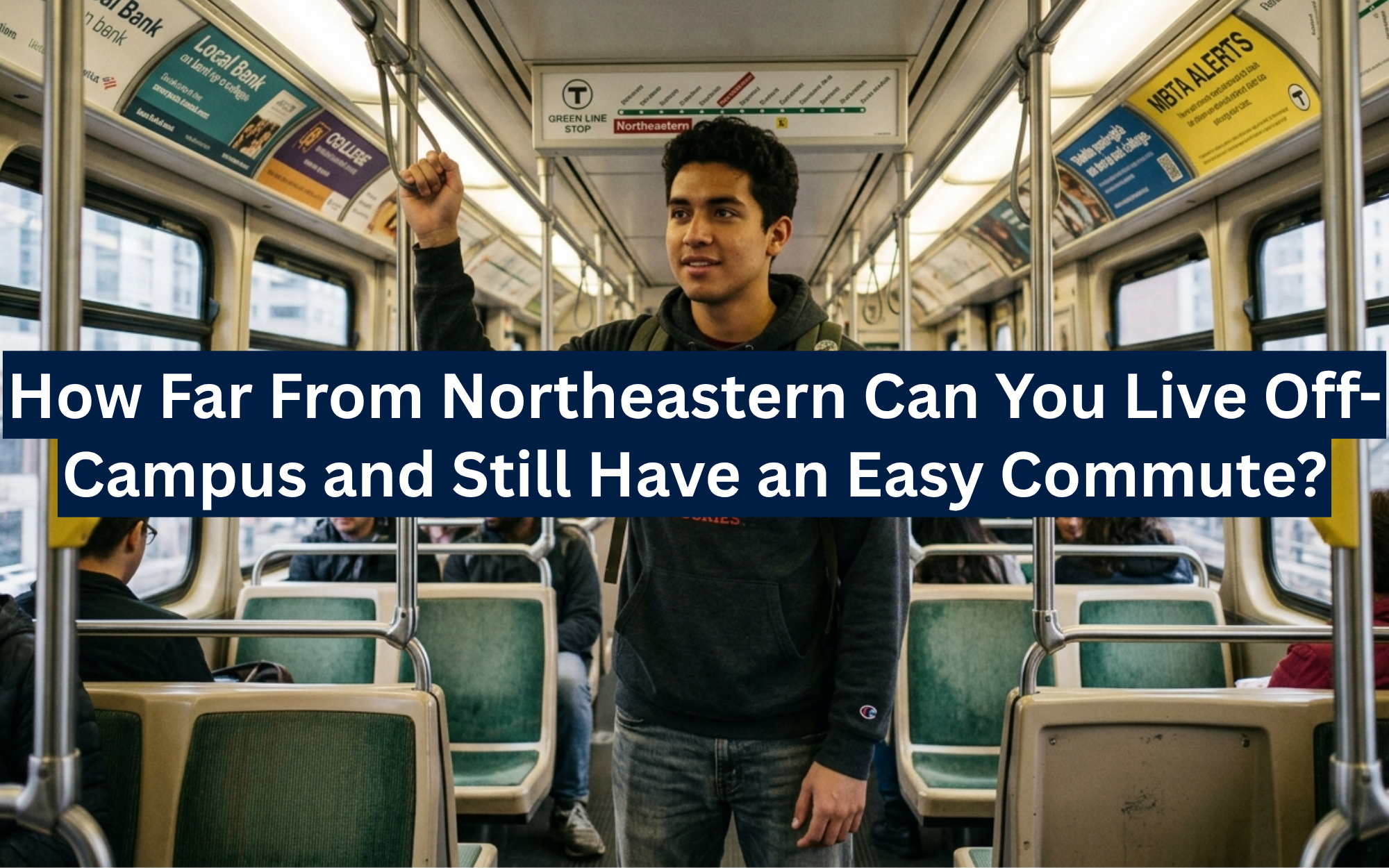
For many students, moving off-campus is a chance to save money, get more space, and experience more of Boston beyond campus. But one question comes up almost immediately: how far from Northeastern can you live off-campus and still have an easy commute? The answer depends on more than just miles. In Boston, your campus commute is shaped by walkability, access to public transportation, and whether you can get to class with a simple walk, a direct subway ride, or a frustrating series of transfers.
In general, most students can live about 1 to 1.5 miles from campus and still have a very manageable commute, especially if they are within a 15-minute walk, a 15-20 minute walk, or a short ride on the MBTA. Neighborhoods like Mission Hill, Fenway, Kenmore, Back Bay, Roxbury, and Jamaica Plain all offer different tradeoffs between rent, distance, and convenience. The key is not just asking how many miles away a place is, but how easy it feels to get from your front door to class every day.
What Counts as an Easy Commute to Northeastern?
An “easy commute” means different things to different students, but most people define it by time, reliability, and effort. A short distance is helpful, but that does not always guarantee a smooth trip. In Boston, one apartment may be slightly farther from campus yet still feel closer because it has better transit access or better walkability.
For most Northeastern students, an easy off-campus commute usually falls into one of these categories:
- A 10 to 15 minute walk
- A 15-20 minute walk
- A short minute subway ride with no transfers
- A simple one-line public transportation route using the Orange Line or Green Line
That is why the idea of commute distance should always include both miles and minutes. A place that is only one mile away but poorly connected may feel less convenient than a place that is a little farther but sits right near a subway stop. When students talk about a good commute Boston setup, they usually mean something direct, predictable, and easy to repeat every day, even in bad weather.
How Far From Northeastern Is Still Reasonable for Off-Campus Housing?

A reasonable distance for off-campus housing near Northeastern is usually somewhere between walking distance and about 1-1.5 miles with solid transportation access. That range works well because it keeps the campus commute short enough to manage without turning every class day into a long travel routine.
Here is a useful rule of thumb:
- Under 1 mile: Usually very easy, often walkable
- 1 to 1.5 miles: Still manageable with a strong walk or quick subway ride
- Beyond 1.5 miles: Possible, but much more dependent on MBTA reliability and direct access
- Over 2 miles: Can still work, but no longer feels effortless for many students
If you are close enough for a 15-minute walk, you are in a very comfortable zone. A 15-20 minute commute is still appealing for most students, especially if it avoids transfers and long waits. Once your route starts to involve multiple transit connections, unpredictable delays, or a long gap between your apartment and the nearest stop, the convenience drops fast.
So how far is too far? Usually, it is not about raw distance. It is about friction. The more steps involved in getting to class, the less “easy” your commute becomes.
Why Miles Matter Less Than Walkability and Transit
Students often search for apartments by distance from campus, but that only tells part of the story. In a city like Boston, walkability can completely change how a commute feels. A well-connected neighborhood with sidewalks, shops, and direct train access often feels much more convenient than a place that looks close on a map but is awkward to reach.
For example, an apartment 1 mile from campus in a neighborhood with strong pedestrian routes may feel easier than an apartment just under a mile away that requires busy intersections, unreliable buses, or a steep uphill route in winter. That is why Northeastern students looking at students off-campus housing should think in terms of lived commute experience, not just mileage.
The best off-campus setups usually combine at least one of these advantages:
- Strong proximity campus
- Direct Orange Line access
- Direct Green Line access
- Good pedestrian routes and short minute walk times
- A neighborhood with reliable public transportation
Best Neighborhoods for an Easy Northeastern Commute
Mission Hill
Mission Hill is one of the most popular choices for Northeastern students, and for good reason. It offers a strong balance between price, student presence, and a manageable commute. Depending on where you live in Mission Hill, you may be able to do a 15-minute walk to campus or combine walking with the Green Line.
This area appeals to students who want to stay connected to campus life without paying the premium that often comes with living directly beside Northeastern. It is also one of the first neighborhoods students consider when looking for off-campus housing that still feels close to school.
The biggest advantage of Mission Hill is that it often fits the sweet spot: not right on campus, but close enough to make commuting simple.
Fenway
Fenway is another strong option for students who want high walkability and easy access to Northeastern. Many parts of Fenway are within a 15-20 minute walk, and the neighborhood offers a lively student-friendly environment. If you want the feeling of being off-campus without actually feeling far away, Fenway is a very practical choice.
Fenway also works well for students who value convenience over size. Apartments may vary in price and layout, but the neighborhood’s biggest strength is how easy it often is to reach campus on foot or with a short ride.
For many students, Fenway feels like an extension of the campus orbit.
Kenmore
Kenmore is especially useful for students who want strong Green Line access. It may not be the first place every student thinks of, but it can offer a reasonable campus commute, particularly for those comfortable using the MBTA daily.
A commute from Kenmore may involve more transit than a walk-heavy neighborhood like Fenway, but it can still feel easy when the route is direct. If your priority is living in a more connected part of Boston while keeping a relatively simple trip to class, Kenmore deserves consideration.
Back Bay
Back Bay offers a more central and often more upscale tree-lined feel than some other student areas. It can be a great choice for students who want city access, polished streets, and strong transportation options. Depending on the exact location, some students may be able to walk, while others may rely on the subway.
The tradeoff is usually cost. Back Bay is often more expensive than other neighborhoods popular with students. Still, for those who can make it work, the commute is often very smooth. Its appeal lies in combining urban convenience with a strong sense of place.
Roxbury
Roxbury can be a practical option for students seeking relatively more affordable off-campus housing, but commute quality can vary a lot from one block to the next. Some areas are close enough to make the route very easy, while others depend more heavily on public transportation.
This is where raw distance can be misleading. One apartment in Roxbury may offer a quick and direct path to campus, while another may technically be nearby but feel less convenient in daily life. Students considering Roxbury should pay careful attention to actual commute distance, walking routes, and the nearest MBTA options.
Jamaica Plain
Jamaica Plain is farther from Northeastern than Mission Hill or Fenway, but it can still work well for students who are willing to trade a little more commute time for different neighborhood benefits. JP is often appreciated for its residential feel, local character, and in some parts its tree-lined streets.
The biggest factor here is the Orange Line. Students with easy line orange access may find that Jamaica Plain remains very livable even though it is farther from campus in terms of miles. If your goal is more space, a different neighborhood atmosphere, or potentially better value, Jamaica Plain can absolutely be a viable off-campus option.
Walking vs. Subway: Which Commute Feels Easier?
A 15-minute walk and a 15-minute subway trip may sound equal on paper, but they often feel very different. Many students prefer walking when possible because it is predictable. You leave when you want, move at your own pace, and do not need to factor in train delays or platform waits.
That said, a short minute subway trip can be much easier in winter, in heavy rain, or when your apartment is beyond comfortable walking distance. The ideal setup is often one of the following:
- A direct 15-minute walk
- A 15-20 minute walk
- A short one-line subway ride
- A walk-subway combo with no transfer headaches
The less complicated the route, the better. A direct commute almost always beats a technically short trip with multiple moving parts. This matters especially for early classes, evening labs, or days when you are commuting back and forth more than once.
The MBTA Lines That Matter Most for Northeastern Students
Orange Line
The Orange Line is one of the most useful transit options for students living farther from Northeastern, especially in places like Jamaica Plain. Access to the Orange Line can make a neighborhood that looks more distant on a map feel much more practical in everyday life.
For students coming from areas south of campus, the line orange can be the difference between a stressful commute and a very manageable one. It is particularly helpful for students who do not mind living farther out as long as they have a direct and reliable route.
Green Line
The Green Line is highly relevant for students living in Mission Hill, Fenway, and Kenmore. Because so many off-campus neighborhoods connect well through line green, students can often piece together an easy commute that combines a short walk and quick rail access.
The green line also supports the kinds of neighborhoods many students already prefer for lifestyle reasons. If you want to stay in a lively area with good city access and still keep your Northeastern trip simple, Green Line access is a major advantage.
How to Decide Your Personal Commute Limit
Not every student has the same definition of “easy.” A lot depends on your schedule, your budget, and your lifestyle.
If you have classes spread across the day, a longer commute can become draining because you may end up traveling back and forth multiple times. If you only need to be on campus for a tight block of time, you may be more comfortable living farther away. Weather matters too. A route that feels easy in September may feel very different in February.
Ask yourself:
- How often will you go to campus each week?
- Are you okay with a daily subway ride?
- Do you want to be within a minute walk of class?
- Is a slightly longer commute worth better rent or more apartment space?
- Would you rather live near campus activity or in a quieter neighborhood?
For many students, the answer ends up being a compromise. They want enough proximity campus to keep daily life simple, but enough distance to find better prices or a more comfortable apartment.
A Good Rule of Thumb for Northeastern Off-Campus Housing
If you want a simple benchmark, here it is: the best range for most students is a location that offers either a 15-minute walk, a 15-20 minute walk, or a short direct ride on the MBTA.
That means:
- Best-case scenario: within easy walking distance
- Still easy: around 1 mile with strong walkability
- Still workable: 1-1.5 miles with direct public transportation
- Less ideal: longer trips that require waiting, transferring, or backtracking
This is why neighborhoods like Mission Hill, Fenway, Kenmore, Back Bay, Roxbury, and Jamaica Plain all remain part of the conversation. They sit at different points on the map, but what matters most is how they connect to Northeastern in real life.
FAQs
How far is too far to live from Northeastern off-campus?
For most students, anything beyond 1.5 miles starts to feel less convenient unless there is excellent public transportation and a direct route to campus.
Is Mission Hill a good place for Northeastern students?
Yes. Mission Hill is one of the most popular neighborhoods for Northeastern students because it offers a strong balance of affordability, student presence, and a manageable commute.
Can you commute to Northeastern from Jamaica Plain?
Yes. Jamaica Plain can work well, especially if you have easy access to the Orange Line. It is farther out, but still manageable for many students.
What MBTA lines are best for getting to Northeastern?
The Orange Line and Green Line are the most relevant for many Northeastern commuters, depending on which neighborhood they live in.
Is Fenway within walking distance of Northeastern?
In many cases, yes. Fenway is often within a 15-20 minute walk, making it one of the more convenient off-campus choices.
What is a good daily campus commute for students?
A good daily commute is usually a 15-minute walk, a 15-20 minute walk, or a short direct subway ride with no transfers.
Final Take: How Far Is Too Far?
So, how far from Northeastern can you live off-campus and still have an easy commute? For most students, the answer is about 1 to 1.5 miles, or any neighborhood that gives you a 15-minute walk, a 15-20 minute walk, or a short direct subway ride. Beyond that, living farther away can still work, but your experience depends much more on MBTA access, walkability, and commute complexity.
The smartest way to think about how off-campus housing near Northeastern works, is not just in terms of miles, but in terms of friction. A short, direct route almost always feels easier than a technically closer apartment with a messy commute. In Boston, neighborhoods with strong public transportation, solid pedestrian access, and reliable transit connections often offer the best mix of convenience and value.
For many Northeastern students, the sweet spot is simple: stay close enough for a manageable walk or a one-line train ride, and you can enjoy off-campus life without making your daily commute a burden.