

Massachusetts landlords entered 2026 under a new rental fee landscape. The biggest change is simple but operationally significant: a landlord can no longer require a tenant to pay the broker fee for a broker the landlord hired.
The Massachusetts broker fee law took effect on August 1, 2025. In 2026, landlords, property managers, brokers, and leasing teams should treat broker fee compliance as a standard part of rental operations, not as a one-time legal update.
The rule is not that broker fees are banned. Broker fees can still exist. The key question is: who hired the broker?
If the landlord hired the broker, the landlord pays the broker fee. If the tenant independently hired a broker and entered into a written agreement, the tenant may pay that broker. For landlords, the compliance challenge is making sure listings, leases, broker agreements, staff scripts, rent advertising, and move-in cost sheets all reflect that rule.
This checklist explains what Massachusetts landlords need to update in 2026 to reduce risk under the new broker fee law.
Quick Summary: What Changed for Massachusetts Landlords?
The Massachusetts broker fee law changed who can be required to pay a residential rental broker fee.
Before the law changed, many Massachusetts tenants, especially in Boston and Greater Boston, were often expected to pay a broker fee even when the broker was listing or showing the apartment on behalf of the landlord.
Under the new rule, the broker fee follows the broker relationship. The party that originally engaged and contracted with the broker or salesperson is responsible for paying that broker.
For landlords, the practical takeaways are:
- You can still hire a broker to rent your property.
- You can still pay a broker commission.
- You cannot require a tenant to pay the broker fee for a broker you hired.
- You should remove “tenant pays broker fee” language from listings and leases.
- You should review all upfront charges to make sure you are not replacing the broker fee with another prohibited fee.
- You should train property managers, leasing staff, brokers, and anyone communicating with tenants.
- You should keep written records showing who hired the broker and who pays the broker.
The safest compliance mindset is this:
If the landlord hires the broker, the landlord pays the broker. If the tenant hires their own broker, the tenant may pay that broker under a separate written agreement.
2026 Landlord Compliance Checklist
Use this checklist to review your rental process before listing a unit, renewing a broker agreement, or entering peak leasing season.
1. Remove “Tenant Pays Broker Fee” From All Listings

Start with your public-facing rental listings. Outdated listing language is one of the easiest ways to create compliance risk.
Review every place your rentals appear, including:
- Zillow
- Apartments.com
- MLS listings
- brokerage websites
- property management websites
- landlord websites
- Facebook Marketplace
- Craigslist
- email flyers
- printed rental sheets
- social media posts
- internal leasing databases
Remove language such as:
- “Tenant pays one-month broker fee”
- “Broker fee due from tenant”
- “Tenant responsible for listing broker commission”
- “Fee equal to one month’s rent due at lease signing”
- “Leasing fee paid by incoming tenant”
- “Broker fee split between landlord and tenant”
Replace it with clear, compliant language.
Example:
Landlord has engaged and will compensate the listing broker. Tenant is responsible only for lawful move-in costs and any broker the tenant independently hires in writing.
The goal is to avoid any suggestion that a tenant must pay the landlord’s broker as a condition of renting the apartment.
2. Update Landlord-Broker Agreements
Your broker agreement should make the fee arrangement clear.
If you hire a broker to list, advertise, show, or lease your property, your agreement should identify:
- who hired the broker,
- what services the broker will provide,
- how much the landlord will pay,
- when the commission is earned,
- when payment is due,
- whether the broker may work with tenant-side brokers,
- how tenant inquiries will be handled,
- what fee language the broker may use in listings,
- who approves advertising copy,
- what compliance obligations the broker has.
Avoid vague agreements that leave open the possibility that the tenant will be charged later.
A landlord-broker agreement should not say or imply that the tenant is responsible for the landlord’s broker fee. It should also prohibit the broker from collecting a fee from the tenant for landlord-side work unless legally permitted and separately documented.
Suggested clause concept:
Landlord has engaged Broker to market and lease the property. Landlord is responsible for Broker’s compensation for services performed on Landlord’s behalf. Broker shall not require a tenant or prospective tenant to pay Landlord’s broker fee as a condition of applying for, leasing, or occupying the property.
Have counsel review final contract language before using it.
3. Update Lease Templates and Addenda
Many landlords use lease templates that have been copied forward for years. Those documents may contain outdated broker fee language.
Review your lease, addenda, application packet, move-in cost sheet, and payment instructions.
Remove or revise language such as:
- “Tenant shall pay broker fee”
- “Tenant responsible for all brokerage commissions”
- “Broker fee due at lease signing”
- “Leasing fee due before move-in”
- “Tenant agrees to pay all listing fees”
- “Tenant responsible for landlord’s rental agent”
- “All fees are nonrefundable”
- “Administrative fee due with lease”
The lease should clearly separate lawful move-in charges from broker compensation.
A compliant lease file should make it easy to answer:
- What did the tenant pay?
- Why was each amount charged?
- Who received each payment?
- Was any amount paid to a broker?
- If so, who hired that broker?
If the answer is not clear from the file, your documentation needs improvement.
4. Audit All Upfront Tenant Charges
The broker fee law should be reviewed alongside Massachusetts rules limiting upfront charges.
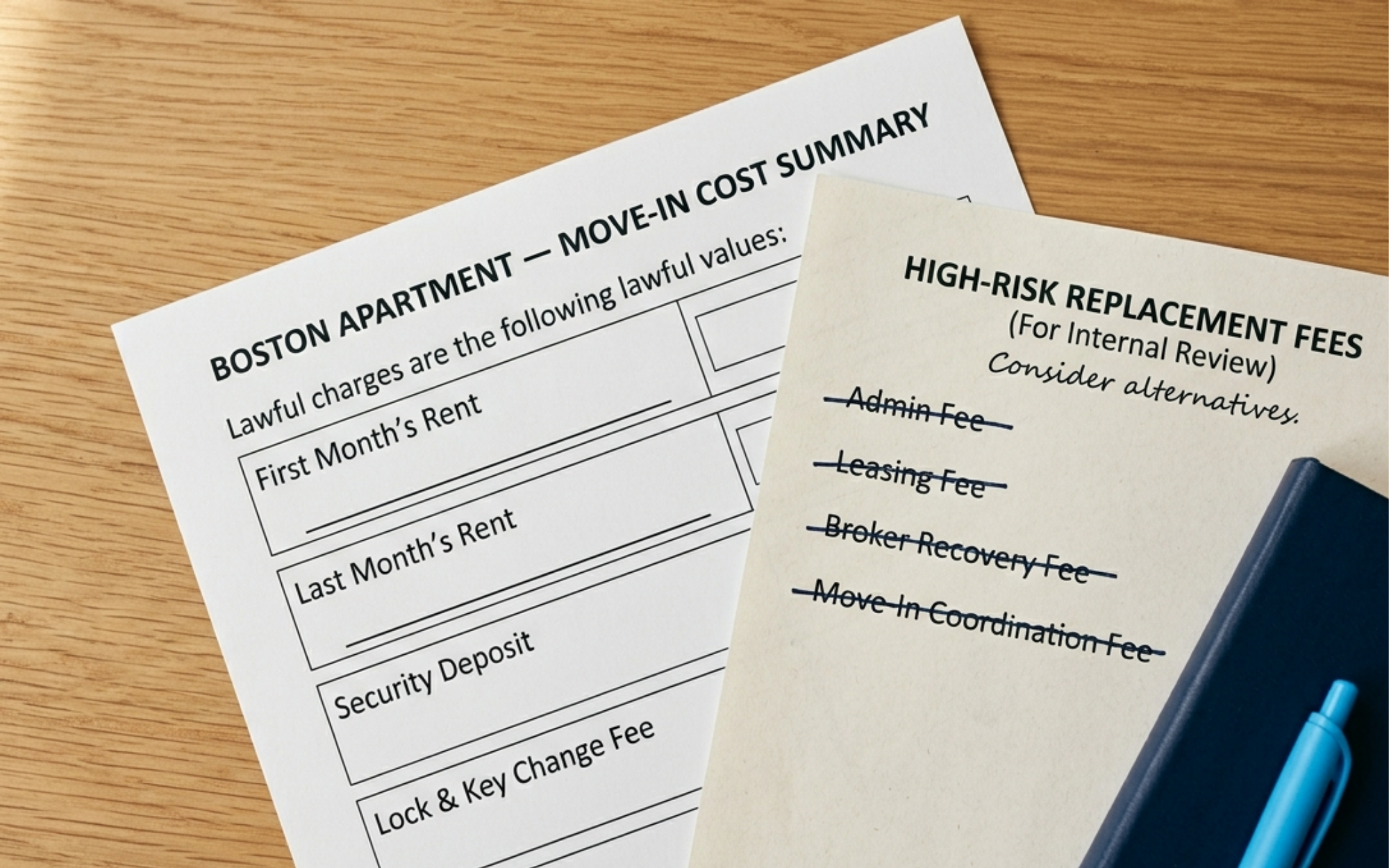
Landlords should be cautious about any move-in charge beyond the familiar categories:
- first month’s rent,
- last month’s rent,
- security deposit,
- lock and key cost.
Do not replace a prohibited broker fee with a new fee label.
High-risk substitute fees include:
- admin fee,
- leasing fee,
- application fee,
- processing fee,
- move-in coordination fee,
- rental package fee,
- showing fee,
- listing fee,
- tenant onboarding fee,
- background check fee,
- credit check fee,
- broker recovery fee.
A fee does not become legal just because it has a new name. If the purpose is to recover the landlord’s broker cost from the tenant, it may create the same problem as the old tenant-paid broker fee.
For each upfront charge, document:
- the amount,
- the reason for the charge,
- whether it is refundable,
- where it is disclosed,
- where the money is deposited,
- whether Massachusetts law allows it.
5. Train Property Managers, Leasing Staff, and Brokers

A compliance policy is only useful if the people speaking to renters understand it.
Train anyone who communicates with prospective tenants, including:
- property managers,
- leasing agents,
- brokers,
- showing assistants,
- office administrators,
- bookkeepers,
- maintenance staff who help with showings,
- virtual assistants,
- outside marketing vendors.
Training should cover:
- who pays the broker fee,
- what not to say in listings,
- what not to put in emails or texts,
- what fees can and cannot be quoted,
- how to handle tenant questions,
- when to escalate to management or counsel.
Use a simple staff script:
Under Massachusetts law, the party who hires the broker pays the broker. If the landlord hired the listing broker, the tenant is not required to pay that broker’s fee. Tenants are responsible only for lawful move-in charges and any broker they independently hire in writing.
Staff should not improvise on legal fee questions. One outdated text message can create risk.
6. Document Who Hired the Broker
The central legal question is who engaged the broker. Your records should answer that question without confusion.
Keep copies of:
- listing agreements,
- broker engagement letters,
- commission agreements,
- emails confirming broker engagement,
- broker invoices,
- payment records,
- listing drafts,
- approved advertising copy,
- tenant communications,
- move-in cost sheets,
- lease execution records.
If a dispute arises, documentation matters.
A landlord should be able to show:
- the landlord hired the listing broker,
- the landlord agreed to pay that broker,
- the tenant was not required to pay that broker,
- all tenant charges were lawful and disclosed.
Strong records protect landlords, property managers, and brokers.
7. Review Rent Advertising and “Total Price” Compliance
Broker fee compliance is not the only rental advertising issue in 2026. Landlords should also review how they advertise rent and mandatory charges.
Avoid advertising a low monthly rent and then adding required charges later. If a tenant must pay a recurring monthly amount to rent the unit, that cost should be clearly disclosed.
Review your ads for:
- base rent,
- required monthly fees,
- parking charges,
- amenity fees,
- utility charges,
- trash fees,
- pet rent,
- technology fees,
- any required service charge.
Even when a fee is not a broker fee, hidden mandatory charges can create consumer protection risk.
A practical advertising rule:
Do not surprise tenants with required fees after they inquire.
Your listing should match your lease, and your lease should match your move-in cost sheet.
8. Create a Dual Representation and Referral Policy

Landlords who work with brokers should ask how tenant inquiries will be handled.
Potential problem areas include:
- one broker trying to represent both landlord and tenant,
- a listing broker asking the tenant to sign a tenant representation agreement,
- a broker collecting from both sides,
- co-broking confusion,
- referrals to tenant agents without clear disclosure.
A landlord does not need to manage every brokerage issue, but the landlord should not encourage or benefit from a confusing fee structure.
Ask your broker:
- Who do you represent?
- Will you ask tenants to sign any agreement?
- Will you collect money from tenants?
- How will tenant-side agents be handled?
- Will any co-broker compensation be offered?
- How will conflicts be documented?
- What happens if a tenant asks you to represent them?
Put the answers in writing.
9. Repeat the Audit Before Peak Leasing Season
Broker fee compliance is not a one-time update.
Massachusetts landlords, especially in Boston, Cambridge, Somerville, Brookline, Allston, Brighton, and other competitive markets, should repeat this review before the busiest leasing periods.
A good annual compliance calendar includes:
- January: review lease templates and broker agreements,
- March: update listing language and marketing templates,
- May: train staff before summer leasing,
- July: audit September 1 move-in files,
- October: review disputes and update procedures.
If you use multiple brokers or property managers, repeat the process with each one.
Who Pays the Broker Fee Under Massachusetts Law?
The new Massachusetts broker fee rule is built around the concept of engagement.
The party that originally engaged and entered into a contract with the broker or salesperson pays the broker fee.
For landlords, that means:
- If you hire the broker, you pay.
- If your property manager hires the broker on your behalf, you should expect the landlord side to pay.
- If the broker lists your apartment for you, you should not require the tenant to pay that broker.
- If the tenant independently hires their own broker, that is a separate tenant-side relationship.
The rule applies to residential rentals. Commercial lease arrangements may involve different rules and should be reviewed separately.
Broker Fees Are Not Banned — Mandatory Tenant-Paid Fees Are
One common mistake is saying, “Broker fees are illegal in Massachusetts.”
That is not accurate.
A more precise statement is:
Mandatory tenant-paid broker fees are prohibited when the tenant did not hire the broker.
A broker can still charge a fee. A landlord can still pay a broker. A tenant can still hire a broker. The law is about preventing landlords from requiring tenants to pay for a broker relationship the landlord created.
This distinction matters for landlords because inaccurate language can confuse tenants and staff. Your compliance materials should avoid absolute statements such as:
- “No broker fees are allowed.”
- “Tenants never pay brokers.”
- “Landlords always pay every broker.”
- “Broker fees are banned.”
Use precise language instead:
- “The party who hired the broker pays.”
- “The landlord pays the landlord’s broker.”
- “A tenant may pay a broker the tenant independently hired.”
- “Tenants cannot be required to pay the landlord’s broker fee.”
What Landlords Must Remove From Listings and Lease Documents
Use this table when reviewing your forms.
| Risky Language | Why It Is a Problem | Better Approach |
|---|---|---|
| “Tenant pays broker fee” | May shift landlord’s broker cost to tenant | “Landlord compensates landlord’s broker” |
| “One-month broker fee due at lease signing” | Ambiguous and likely outdated | Identify only lawful move-in charges |
| “Tenant responsible for listing agent commission” | Listing agent is usually landlord-side | Remove from tenant-facing documents |
| “Leasing fee due from tenant” | May disguise broker compensation | Remove unless reviewed by counsel |
| “Admin fee due before move-in” | May exceed allowed upfront charges | Explain lawful basis or remove |
| “All fees are nonrefundable” | Overbroad and risky | List each lawful charge separately |
| “Tenant pays all rental fees” | Too vague | Use itemized move-in cost sheet |
| “Broker fee may apply” | Unclear and confusing | State who pays which broker |
The goal is clarity. A tenant should be able to look at the listing and understand what they must pay, what the landlord pays, and whether any tenant-side broker relationship exists.
Allowed Upfront Costs: First Month, Last Month, Security Deposit, Key and Lock
Landlords should not treat the broker fee law as an invitation to invent new move-in fees.
In Massachusetts, the traditional permitted upfront charges are limited. Landlords commonly collect:
- First month’s rent
- Last month’s rent
- Security deposit, generally not more than one month’s rent
- Cost to purchase and install a key and lock
Each has its own requirements. For example, security deposits must be handled carefully, with proper receipts, account handling, and return procedures.
Avoid adding new upfront fees unless they have been legally reviewed. The risk is especially high when a new fee appears immediately after removing a tenant-paid broker fee.
Examples of risky replacement fees:
- “broker recovery fee,”
- “leasing admin fee,”
- “tenant placement fee,”
- “listing convenience fee,”
- “move-in processing fee,”
- “application handling fee.”
If the purpose of the fee is to reimburse the landlord for the broker, it should not be charged to the tenant.
Can a Landlord Raise Rent to Offset Broker Fees?
This is one of the most common landlord questions.
A landlord may generally set the rent for a new tenancy based on market conditions, property costs, and business needs. But landlords should be careful about how they discuss and structure rent after the broker fee law.
Lower-risk approach:
“The rent for the apartment is $3,200 per month.”
Higher-risk approach:
“Rent is $3,000, but if you do not pay the broker fee, we will increase it to $3,200.”
Very high-risk approach:
“The broker fee is built into a required monthly surcharge.”
The problem is not that landlords have costs. The problem is making rent look like a disguised broker fee pass-through.
Best practices:
- Set rent before advertising.
- Do not describe rent as reimbursement for the broker fee.
- Do not offer tenants a choice between paying the broker fee or paying higher rent.
- Do not add a separate broker surcharge.
- Keep rent advertising consistent.
- Speak with counsel before changing fee structures.
For long-term strategy, landlords may consider vacancy rates, tenant retention, competition, and whether a landlord-paid broker commission should be treated as a normal cost of leasing the property.
How Total Price and Junk Fee Rules Affect Rental Advertising
The broker fee law connects with a broader trend: regulators are paying closer attention to hidden fees and price transparency.
Landlords should advertise rental costs clearly. If a charge is mandatory, do not hide it in fine print or reveal it only after a tenant applies.
Examples of charges that should be reviewed for disclosure:
- mandatory amenity fees,
- required parking fees,
- utility package charges,
- trash removal fees,
- technology fees,
- pet rent,
- required insurance charges,
- move-in charges.
A good listing answers:
- What is the monthly rent?
- What other monthly charges are mandatory?
- What is due before move-in?
- What charges are refundable?
- What charges are optional?
- Are any fees paid to a broker?
- If so, who hired that broker?
Compliance is not just about avoiding illegal fees. It is also about avoiding confusing advertising that could be viewed as misleading.
Tenant Representation Agreements: What Landlords Need to Know
A tenant can still hire their own broker. When that happens, the tenant-side broker should use a written tenant representation agreement.
Landlords should understand this concept because it helps separate lawful tenant-paid broker fees from unlawful fee-shifting.
A tenant representation agreement should generally identify:
- the tenant,
- the broker or salesperson,
- services provided,
- fee amount,
- when the fee is earned,
- whether the broker may receive compensation from another source,
- term of the agreement,
- properties covered,
- any conflicts or limitations.
Landlords should not require a tenant to sign a tenant representation agreement with the landlord’s broker as a condition of seeing or renting the apartment.
A tenant-side broker relationship should be voluntary, separate, and documented before the broker provides tenant-side services.
Dual Representation and Co-Broking Risks
Dual representation and co-broking issues are especially important for brokers, but landlords should still understand the risk.
A landlord should ask whether the same broker or brokerage is trying to:
- represent the landlord,
- represent the tenant,
- collect from both sides,
- share compensation with another broker,
- convert tenant inquiries into tenant representation agreements.
If the arrangement is unclear, pause and get written clarification.
Landlord best practices:
- Ask your broker to identify who they represent.
- Require advance approval before any tenant-facing fee is requested.
- Avoid any arrangement where the tenant is pressured to pay your broker.
- Require brokers to follow current Massachusetts law and professional guidance.
- Keep conflict disclosures in the file.
Even if a broker creates the problem, the landlord may still be pulled into the dispute if the lease, listing, or payment process involved the landlord.
Penalties and Risks for Noncompliance
Noncompliance can create more than a refund issue.
Potential risks include:
- tenant disputes,
- delayed lease signing,
- refund demands,
- Attorney General complaints,
- Chapter 93A consumer protection claims,
- triple damages,
- attorney’s fees,
- broker licensing complaints,
- reputational harm,
- negative reviews,
- lost rental income.
Chapter 93A risk is especially important because it can increase exposure beyond the amount of the original fee. A relatively small improper fee can become a larger dispute if it is treated as an unfair or deceptive practice.
Landlords should view broker fee compliance as risk prevention.
The best defense is a clean process:
- accurate listings,
- updated contracts,
- lawful fee sheets,
- trained staff,
- written records,
- prompt correction of mistakes.
Sample Compliance Language for Landlords
These examples are not legal advice, but they can help your team understand the type of language to use.
Compliant listing language
Landlord has engaged and will compensate the listing broker. Tenant is responsible only for lawful move-in costs and any broker the tenant independently hires in writing.
Tenant inquiry response
Thank you for your interest. The landlord hired the listing broker and is responsible for that broker’s compensation. We will provide an itemized list of lawful move-in costs before lease signing.
Staff script
Under Massachusetts law, the party who hires the broker pays the broker. Since the landlord hired the listing broker, the tenant is not required to pay that broker’s fee.
Broker agreement checklist language
Your broker agreement should address:
- landlord engagement,
- landlord payment responsibility,
- commission amount,
- payment timing,
- listing language approval,
- prohibition on improper tenant pass-throughs,
- compliance with Massachusetts law,
- conflict procedures,
- documentation requirements.
Move-in cost sheet language
Use an itemized format:
- First month’s rent: $____
- Last month’s rent: $____
- Security deposit: $____
- Lock/key charge: $____
- Other lawful charge, if any: $____
- Broker fee charged to tenant: $0, unless tenant independently hired a broker in writing
Clear itemization reduces disputes.
FAQ: Massachusetts Broker Fee Law for Landlords
What is the Massachusetts broker fee law in 2026?
It is the rule that a residential rental broker fee must be paid by the party that hired or contracted with the broker or salesperson. A landlord cannot require a tenant to pay the landlord’s broker fee.
When did the law take effect?
The law took effect on August 1, 2025. In 2026, landlords should treat it as part of standard rental compliance.
Can landlords still hire brokers?
Yes. Landlords may still hire brokers to market, show, and lease residential rental property. The landlord should pay the broker the landlord hired.
Can landlords make tenants pay broker fees?
Not for a broker the landlord hired. A tenant may pay a broker only if the tenant independently hired that broker and agreed to the fee.
Are broker fees illegal in Massachusetts?
No. Broker fees are not banned. Mandatory tenant-paid broker fees are prohibited when the tenant did not hire the broker.
What listing language should landlords remove?
Remove language such as “tenant pays broker fee,” “broker fee due from tenant,” “tenant responsible for commission,” and “leasing fee due at signing.”
What upfront costs can landlords still collect?
Landlords commonly collect first month’s rent, last month’s rent, a security deposit, and lock/key costs, subject to Massachusetts rules. Be careful with any additional fees.
Can landlords charge a leasing fee instead?
A leasing fee may be treated as a disguised broker fee or improper upfront charge. Landlords should not use a renamed fee to recover the broker cost from tenants.
Can landlords raise rent to offset broker fees?
A landlord may generally set market rent for a new tenancy, but should avoid describing rent as a broker fee reimbursement, surcharge, or substitute fee.
What is a tenant representation agreement?
It is a written agreement between a tenant and a broker the tenant hires. It should explain services, compensation, and the tenant’s responsibility to pay.
Is dual representation prohibited?
Dual representation in rental transactions can create serious compliance issues. Landlords should ask brokers how they handle conflicts, tenant inquiries, and compensation.
What are the penalties for violating the broker fee law?
Potential consequences may include refund demands, Chapter 93A claims, triple damages, attorney’s fees, Attorney General complaints, broker discipline, and reputational harm.
Does the law apply outside Boston?
Yes. This is a Massachusetts law, not just a Boston rule.
Does the law apply to commercial leases?
The broker fee change discussed here focuses on residential rental property. Commercial lease arrangements should be reviewed separately.
Bottom Line for Massachusetts Landlords in 2026
The Massachusetts broker fee law is not just a legal headline. It changes the way landlords should run the leasing process.
For 2026, every Massachusetts landlord should be able to answer five questions:
- Who hired the broker?
- Who pays the broker?
- Do the listing and lease say the same thing?
- Are tenant upfront charges limited and itemized?
- Has the leasing team been trained?
The safest rule is simple:
The landlord pays the broker the landlord hired. The tenant pays only a broker the tenant independently hired in writing.
Landlords who update their listings, broker agreements, lease templates, staff scripts, and move-in cost sheets will be in a much stronger position than landlords relying on outdated rental practices.
This article is for general informational purposes only and is not legal advice. Massachusetts rental laws and enforcement guidance may change. Landlords, brokers, and property managers should consult qualified counsel before updating lease forms, fee structures, rent advertising, or broker agreements.