

Boston renters were promised relief when Massachusetts changed its rental broker fee rules. For years, tenants in Boston were often expected to pay a broker fee equal to one month’s rent, even when the broker appeared to be working for the landlord. The new law was supposed to reduce that burden.
But as renters started browsing listings, a new concern appeared almost immediately: did landlords just raise rent instead of paying broker fees themselves?
The honest answer is: some probably did, but not every rent increase can be blamed on the broker fee law.
Boston rents were already high. Housing supply was already tight. Demand was already strong. The broker fee change may have shifted some costs from upfront fees into monthly rent, but it did not create Boston’s housing affordability crisis by itself.
The real question for renters is not only whether rent went up. The better question is:
Are you paying more in total, or are you simply paying less upfront and more monthly?
To answer that, you need to compare total first-year cost, not just the advertised rent.
Quick Answer: Did Boston Landlords Raise Rent After the Broker Fee Ban?
Some Boston landlords may have raised rent after the broker fee law changed, especially if they now have to pay a broker they previously expected tenants to pay.
However, that does not mean every rent increase is caused by the broker fee ban. Boston rents have been rising for years because of limited housing supply, strong demand, high operating costs, and seasonal pressure around the September 1 lease cycle.
The broker fee law mainly changed who pays the broker fee upfront. It did not guarantee that monthly rent would fall.
| Period | % of Listings Listed as No-Fee |
|---|---|
| Jan–May 2025 Pre-Enforcement | ~10% |
| June 2025 Law Kicks In | 19% |
| August 2025 | 54% |
| September 2025 | 70% |
| March 2026 | 89% |
| May 2026 Latest | 92% |
Source: Spot Easy listing data · Agent-listed units only · Greater Boston market · Share of all agent-listed units
No-fee listings went from 10% to 92% of the Boston rental market in under 18 months. Source: Spot Easy platform data, agent-listed units.
Data from Spot Easy listings in Greater Boston backs this up: the share of no-fee listings on the platform jumped from roughly 10% before the law to over 90% by spring 2026. The law clearly reshaped how landlords list — but whether that shift helped or hurt renters depends on how rent moved alongside it.
In many cases, renters may still benefit because they no longer need to bring an extra month’s rent just to pay a broker fee before moving in. But if landlords increase rent enough, those savings can shrink or disappear over time.
That is why renters should compare:
- Monthly rent
- Broker fee
- Security deposit
- First month’s rent
- Last month’s rent
- Total move-in costs
- Total first-year housing cost
A listing with higher rent but no broker fee may still be cheaper in year one than a lower-rent listing with a large upfront fee.
What the Massachusetts Broker Fee Law Actually Changed
The phrase “broker fee ban” is common, but it can be misleading.
The law did not eliminate every possible broker fee. Instead, it changed who is responsible for paying the broker.
In general, the person who hires the broker or salesperson is responsible for paying that broker fee.
That means:
If the landlord hires the broker to list, advertise, show, or lease the apartment, the landlord pays the broker fee.
If the tenant hires the broker to help find housing, schedule tours, or represent them in the rental search, the tenant may still pay the broker fee.
This distinction matters because many Boston renters used to pay fees even when they did not feel like they had hired the broker. A tenant might see an apartment online, contact the listing agent, tour the unit, apply, and then be told they owed a broker fee equal to one month’s rent.
The new law aims to stop that kind of automatic tenant-paid fee when the broker was actually hired by the landlord.
But it does not stop landlords from setting rent at a level they believe the market will accept.
That is where the current debate begins.
Why Renters Think Landlords Are Baking Broker Fees Into Rent
Many renters are looking at new Boston listings and noticing that rent seems higher than expected.
A tenant might remember seeing two-bedroom apartments listed for $2,400 or $2,500, then see similar units listed closer to $2,700. Naturally, the question becomes: did the landlord just divide the broker fee by 12 and add it to the rent?
In some cases, that may be exactly what happened.
A landlord who previously expected the tenant to pay a $3,000 broker fee might now see that fee as a new business expense. Instead of absorbing it, the landlord may try to recover the cost by raising the rent.
For example:
A landlord pays a $3,000 broker fee.
The landlord spreads that cost over a 12-month lease.
$3,000 divided by 12 equals $250 per month.
So a unit that might have been listed at $2,500 could be listed at $2,750.
| Quarter | 1-Month Fee | No Fee | Monthly Gap |
|---|---|---|---|
| 2024 Q1 Pre-Law | $3,775 | $3,166 | –$609/mo |
| 2025 Q1 | $3,739 | $3,252 | –$487/mo |
| 2025 Q3 | $3,502 | $3,175 | –$327/mo |
| 2025 Q4 | $3,452 | $3,553 | +$101/mo |
| 2026 Q1 Latest | $3,758 | $3,744 | –$14/mo |
Source: Spot Easy listing data · Agent-listed units · Greater Boston market
The $609/month discount renters once got by taking a no-fee apartment has nearly vanished. Source: Spot Easy platform data.
Spot Easy listing data reflects this pattern. In early 2024, no-fee apartments in Greater Boston were priced an average of about $609 per month less than comparable apartments carrying a one-month broker fee. By early 2026, that gap had shrunk to less than $15 per month. The two pricing tracks have essentially converged. This is consistent with landlords repricing no-fee listings upward as the law moved the broker cost off tenants and onto landlords. It doesn't prove every landlord did it, but the market-wide trend is clear.
From the renter’s perspective, the broker fee did not disappear. It just moved into the monthly rent.
But there is a catch: landlords cannot always pass through the full cost. Rent is still limited by what tenants are willing and able to pay compared with competing apartments.
If similar units are listed for less, a landlord who raises rent too aggressively may face vacancy, longer marketing time, or fewer qualified applicants.
The Real Question: Monthly Rent or Total First-Year Cost?

Renters often focus on monthly rent because that is the number shown on listings. But the broker fee debate requires a different calculation.
You need to compare total first-year cost.
A lower-rent apartment with a broker fee can be more expensive in year one than a higher-rent apartment with no broker fee.
For example, imagine two apartments:
Apartment A costs $2,500 per month but requires a $2,500 broker fee.
Apartment B costs $2,650 per month with no broker fee.
At first glance, Apartment A looks cheaper because the monthly rent is $150 lower. But over the first year, Apartment A costs:
$2,500 × 12 = $30,000
Plus $2,500 broker fee
Total: $32,500
Apartment B costs:
$2,650 × 12 = $31,800
No broker fee
Total: $31,800
In that example, the higher-rent apartment is still $700 cheaper in the first year.
This is why the question “Did rent go up?” is only part of the answer.
The better question is:
Did rent go up by more than the old broker fee spread over the lease term?
The Break-Even Formula: How Much Can Rent Rise Before You Stop Saving?
Here is the simplest way to calculate whether a no-fee apartment still saves you money.
Broker fee ÷ 12 = monthly break-even rent increase
If the old broker fee would have been one month’s rent, divide that amount by 12.
For example:
A $2,400 broker fee divided by 12 equals $200 per month.
That means if a landlord raises rent by less than $200 per month, the tenant may still save money in the first year.
If the landlord raises rent by exactly $200 per month, the tenant roughly breaks even in the first year.
If the landlord raises rent by more than $200 per month, the tenant may pay more in the first year.
Here are a few examples:
| Old Broker Fee | Break-Even Monthly Rent Increase |
|---|---|
| $2,400 | $200/month |
| $2,700 | $225/month |
| $3,000 | $250/month |
| $3,600 | $300/month |
| $4,200 | $350/month |
So if you are looking at a Boston apartment where rent increased by $150 per month but the old broker fee would have been $3,000, you may still be better off in year one.
But if rent increased by $400 per month, the new price may cost more than the old rent-plus-broker-fee model.
Cost Comparison: Before and After the Broker Fee Law
Here is a simple example using a $2,500 apartment that previously required a broker fee equal to one month’s rent.
| Scenario | Monthly Rent | Broker Fee | First-Year Rent | Total First-Year Cost |
|---|---|---|---|---|
| Before law | $2,500 | $2,500 | $30,000 | $32,500 |
| After law, rent up $100 | $2,600 | $0 | $31,200 | $31,200 |
| After law, rent up $200 | $2,700 | $0 | $32,400 | $32,400 |
| After law, rent up $300 | $2,800 | $0 | $33,600 | $33,600 |
In this example, the renter still saves money in year one if rent rises from $2,500 to $2,600.
The renter roughly breaks even if rent rises to $2,700.
The renter pays more if rent rises to $2,800.
But even when the total first-year cost is similar, the upfront cash needed to move may be much lower without a broker fee.
That matters.
For many renters, the biggest problem is not only the total cost of housing. It is the amount of cash required before they can even get the keys.
Why Lower Upfront Moving Costs Still Matter

Even if some landlords raise rent, eliminating a large upfront broker fee can still help renters.
Before the law changed, a Boston renter might need to pay:
- First month’s rent
- Last month’s rent
- Security deposit
- Broker fee
- Moving costs
For a $3,000 apartment, that could mean needing $9,000 to $12,000 upfront before moving in.
That kind of move-in cost traps people.
A tenant may want to leave a bad apartment, unsafe housing, an unreasonable landlord, or a long commute, but they cannot afford to move because the upfront cost is too high.
Reducing broker fees can improve mobility. It can make it easier for renters to compare housing options, leave poor conditions, or relocate for work, school, or family needs.
So even if monthly rent rises somewhat, lower upfront costs can still be meaningful.
The tradeoff is that renters must watch whether the monthly increase becomes permanent.
The Year-Two Problem: Will Rent Go Back Down?
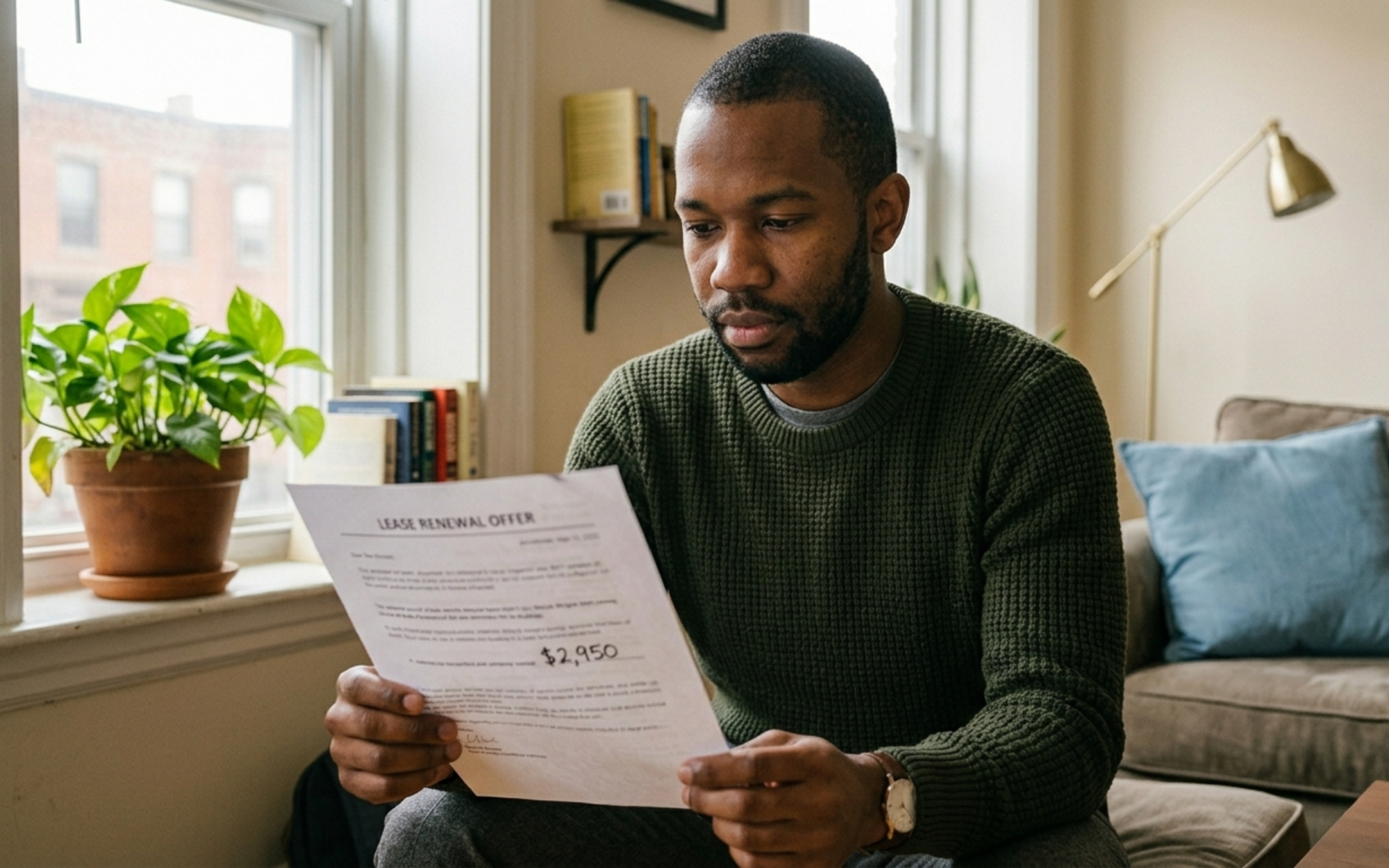
This is one of the biggest concerns with landlords baking broker fees into rent.
A broker fee is usually a one-time transaction cost. The landlord pays it when leasing the apartment.
But if the landlord raises rent to cover that one-time cost, will the rent go back down the next year?
Probably not.
For example, imagine a landlord raises rent by $250 per month to cover a $3,000 broker fee.
In year one, that increase equals the broker fee.
But in year two, if the same tenant renews and no new broker is needed, the landlord may still keep the rent at the higher level. They may even raise it again.
That means a one-time broker cost can become a permanent rent increase.
This is where renters may lose over the long term.
A renter who stays only one year may break even or save money. A renter who stays three years in a unit with permanently inflated rent may pay much more.
That is why tenants should ask about renewal expectations before signing.
Useful questions include:
“Is this rent higher because the landlord is covering the broker fee?”
“If I renew next year, will the rent be based on this amount?”
“Would the landlord consider a lower rent for a longer lease?”
“Can we discuss a renewal cap or multi-year lease?”
Not every landlord will agree, but asking can help.
Why Landlords Cannot Always Just Raise Rent by the Broker Fee
It is easy to assume landlords will simply pass every new cost to tenants. Some will try. But the market does not always allow it.
Rent depends on what tenants are willing to pay compared with other available apartments.
A landlord who raises rent too much may face:
- Fewer inquiries
- More vacancies
- Longer time on market
- Lower-quality applications
- More competition from similar apartments
- Pressure to reduce the price later
The ability to raise rent depends on several factors:
Neighborhood
A landlord in a high-demand area near transit, universities, or major job centers may have more pricing power than a landlord in a less competitive area.
Apartment condition
A renovated unit with laundry, parking, air conditioning, and modern appliances may support a higher rent. A dated unit with maintenance issues may not.
Seasonality
Boston’s rental market is heavily influenced by the September 1 lease cycle. Landlords may test higher rents early, then reduce prices if units do not move.
Unit type
One-bedroom apartments, student-heavy units, luxury buildings, and family-sized apartments may respond differently.
Whether a broker is actually used
Not every landlord hires a broker. Some landlords show and lease units themselves. Those landlords do not have the same broker cost to recover.
Broker negotiation
Landlords may also negotiate lower broker commissions, especially if they have multiple units or repeat business.
So while some rent increases may reflect broker fees, the pass-through is not automatic or universal.
Why Boston Rents Were Already Rising
It is important not to blame every rent increase on the broker fee law.
Boston has a long-running housing affordability problem. Demand for apartments is high, and housing supply has not kept up in many neighborhoods.
Rents can rise because of:
- Limited housing supply
- High demand from students and workers
- Competition near transit
- Higher property taxes
- Maintenance and insurance costs
- Utility costs
- Renovations and upgrades
- Inflation
- Seasonal September 1 demand
- Neighborhood popularity
- Lack of affordable housing options
A landlord may raise rent because of the broker fee law. But they may also raise rent because similar apartments are renting for more.
From a renter’s perspective, the cause may not matter much. The rent is still higher.
But for understanding the law’s impact, the distinction matters.
Anecdotes can show what renters are experiencing, but they do not prove market-wide causation. To know whether the broker fee law caused unusual rent increases, you would need to compare current rent trends with prior years, neighborhood by neighborhood, and account for seasonality.
Did the Broker Fee Ban Actually Help Renters?
Yes, but not equally for everyone.
| Quarter | Total Listings | Avg Rent (All Types) | Year-Over-Year |
|---|---|---|---|
| 2023 Q1 Baseline | 9,948 | $3,535 | — |
| 2024 Q1 | 13,150 | $3,691 | +$156 (+4.4%) |
| 2025 Q1 | 7,774 | $3,685 | –$6 (flat) |
| 2026 Q1 Latest | 4,777 | $3,746 | +$61 (+1.7%) |
Source: Spot Easy listing data · Agent-listed units · Greater Boston market
Market-wide Boston rents rose just $55 between 2024 and 2026 — no broad spike from the broker fee law. Source: Spot Easy platform data.
One encouraging signal in the data: overall Greater Boston rents on Spot Easy did not spike dramatically after the law. The platform-wide average across all listing types was $3,691 in early 2024 and $3,746 in early 2026 — a difference within normal seasonal variation. The repricing is concentrated within the fee-to-no-fee conversion, not a broad market-wide jump. Renters who were already paying no-fee rents mostly did not see unusual increases on top of that.
The law helps most when the renter would otherwise have paid a large broker fee upfront and the landlord does not raise rent enough to erase the savings.
It also helps renters who do not have thousands of dollars saved for move-in costs.
For example, a renter may be able to afford $2,700 per month but not an extra $2,700 broker fee due before move-in. Removing that fee can make housing more accessible, even if the monthly rent is slightly higher.
The law may especially help:
- First-time Boston renters
- Students
- Workers relocating to the city
- Renters leaving unsafe or poor housing
- Lower-income tenants
- People who move frequently
- Tenants who need more bargaining power
But the law may help less if:
- Rent rises by more than the old broker fee divided by 12
- The tenant stays multiple years at an inflated rent
- The tenant hires their own broker
- The landlord adds other costs elsewhere
- The market is so tight that tenants have little negotiating power
So the law is not a complete affordability solution. It is a move-in cost reform.
That distinction is important.
Listed Rent vs. Effective Rent vs. Move-In Cash
To compare apartments correctly, renters should understand three different numbers.
Listed Rent
This is the monthly rent shown in the listing.
Example: $2,700/month.
Effective First-Year Rent
This is the total first-year cost divided by 12.
Example:
$2,500 monthly rent plus $2,500 broker fee equals $32,500 for the year.
$32,500 divided by 12 equals about $2,708 effective monthly cost.
So a $2,500 apartment with a broker fee may effectively cost about $2,708 per month in year one.
Move-In Cash
This is the amount you need upfront before moving in.
It may include:
- First month’s rent
- Last month’s rent
- Security deposit
- Broker fee
- Key or lock fees where allowed
- Moving expenses
A no-fee apartment may have higher monthly rent but much lower move-in cash.
For many tenants, that difference is huge.
What Boston Renters Should Ask Before Signing a Lease
Before signing a lease, renters should ask direct questions about costs and representation.
Here are questions to send by email or text:
“Is there any broker fee for this apartment?”
“Who hired the broker?”
“Is the landlord paying the broker fee?”
“Does this agreement make me responsible for a broker fee?”
“Can you confirm all move-in costs in writing?”
“What was the prior rent for this unit?”
“Is this rent higher because the landlord is covering the broker fee?”
“What would renewal pricing look like next year?”
“Would the landlord consider a lower rent for a longer lease?”
“Are there any other required fees?”
These questions help you understand whether the landlord is passing costs into rent and whether the apartment still makes financial sense.
Sample Script for Negotiating Rent After the Broker Fee Law

Here is a simple message renters can use:
Hi, I’m interested in the apartment. Since there is no tenant-paid broker fee, I’m comparing the total first-year cost against similar listings. Is the landlord open to reducing the monthly rent or offering a longer lease term at a lower rate?
Another option:
Can you confirm whether the listed rent includes any adjustment for the landlord-paid broker fee? If so, would the landlord consider lowering the rent on renewal if no broker is needed next year?
And another:
I’m ready to apply, but the rent appears higher than comparable units. Would the landlord consider reducing the rent by $100–$150 per month for a strong applicant?
You may not always get a yes. But in a market where some landlords are testing higher prices, asking can matter.
How to Compare Apartments After the Broker Fee Law
Use this checklist before choosing an apartment:
First, calculate the monthly rent.
Second, ask whether there is a broker fee.
Third, calculate total first-year rent.
Fourth, add any required upfront costs.
Fifth, divide total first-year cost by 12 to find the effective monthly cost.
Sixth, consider how long you plan to stay.
Seventh, ask whether rent may increase again at renewal.
Eighth, compare similar apartments in the same neighborhood.
Ninth, factor in commute, utilities, parking, laundry, and apartment condition.
Tenth, get all fee promises in writing.
A $2,700 no-fee apartment may be better than a $2,500 apartment with a broker fee. But a $2,900 no-fee apartment may not be.
The math matters.
So, Did Boston Landlords Just Raise Rent Instead?
The best answer is:
Some landlords likely raised rent to offset broker fees, but the broker fee law is not the only reason Boston rents are high.
For renters, the key is to avoid focusing only on the monthly rent or only on the missing broker fee. You need to calculate the total cost.
The law may not make Boston apartments cheap. It may not stop landlords from raising rent. It may not solve the housing crisis.
But it can reduce the amount of money renters need upfront. That gives some tenants more flexibility, more mobility, and more ability to leave bad housing situations.
The biggest risk is that one-time broker costs become permanent rent increases. That is why renters should ask questions, compare total first-year costs, and negotiate where possible.
FAQ: Boston Rent Increases and Broker Fees
Did Boston landlords raise rent after the broker fee ban?
Some landlords may have raised rent to offset the cost of paying broker fees themselves. However, not every rent increase is caused by the broker fee law. Boston rents were already rising because of high demand and limited housing supply.
Did the broker fee ban make rent more expensive?
It may have contributed to some rent increases, but it is not the only factor. The law changed upfront fee responsibility. It did not control monthly rent prices.
Are broker fees completely banned in Boston?
No. A tenant may still pay a broker fee if the tenant hires the broker. The key rule is that the person who hires the broker generally pays the broker.
Who pays the broker fee now?
If the landlord hires the broker, the landlord pays. If the tenant hires the broker, the tenant may pay.
If rent increased by $200, am I still saving money?
It depends on the old broker fee. If the old broker fee was $2,400, then $200 per month is the break-even point over a 12-month lease. If the old fee was higher, you may still save in year one.
How do I calculate whether I’m better off?
Use this formula:
Broker fee ÷ 12 = monthly break-even increase
Then compare the rent increase to that number.
Can landlords legally raise rent to cover broker fees?
Landlords can generally set asking rent based on market conditions, unless restricted by a specific lease or applicable law. The broker fee law changes who pays the broker, but it does not freeze rent.
Will rent go down in year two?
Usually, renters should not assume rent will go down. If a landlord raises rent to cover a one-time broker fee, that higher rent may become the new baseline unless the tenant negotiates.
Does the law apply only to Boston?
No. The broker fee rule applies across Massachusetts, including Boston.
Is a no-broker-fee apartment always cheaper?
No. A no-fee apartment can still be more expensive if the monthly rent is high enough. Compare total first-year cost.
What should I ask before signing?
Ask who hired the broker, whether there is any broker fee, what the total move-in cost is, and whether the rent includes any broker-fee-related increase.
Why are Boston rents still so high?
Boston rents are high because demand is strong, housing supply is limited, and many neighborhoods have intense competition for available apartments. Broker fee reform helps with upfront costs, but it does not solve the underlying housing shortage.
Final Takeaway
Boston landlords may have raised rent in some cases after the broker fee law changed, but the real answer depends on the numbers.
A higher monthly rent does not always mean renters are worse off. If the rent increase is less than the old broker fee divided by 12, the renter may still save money in the first year.
But renters should be careful. If landlords permanently bake one-time broker costs into rent, tenants may pay more over the long term.
The smartest approach is to compare total first-year cost, not just monthly rent. Ask who pays the broker, confirm move-in costs in writing, and negotiate when a listing appears overpriced.
The broker fee law may not make Boston affordable overnight, but it can reduce one of the biggest upfront barriers to moving. For many renters, that still matters.