

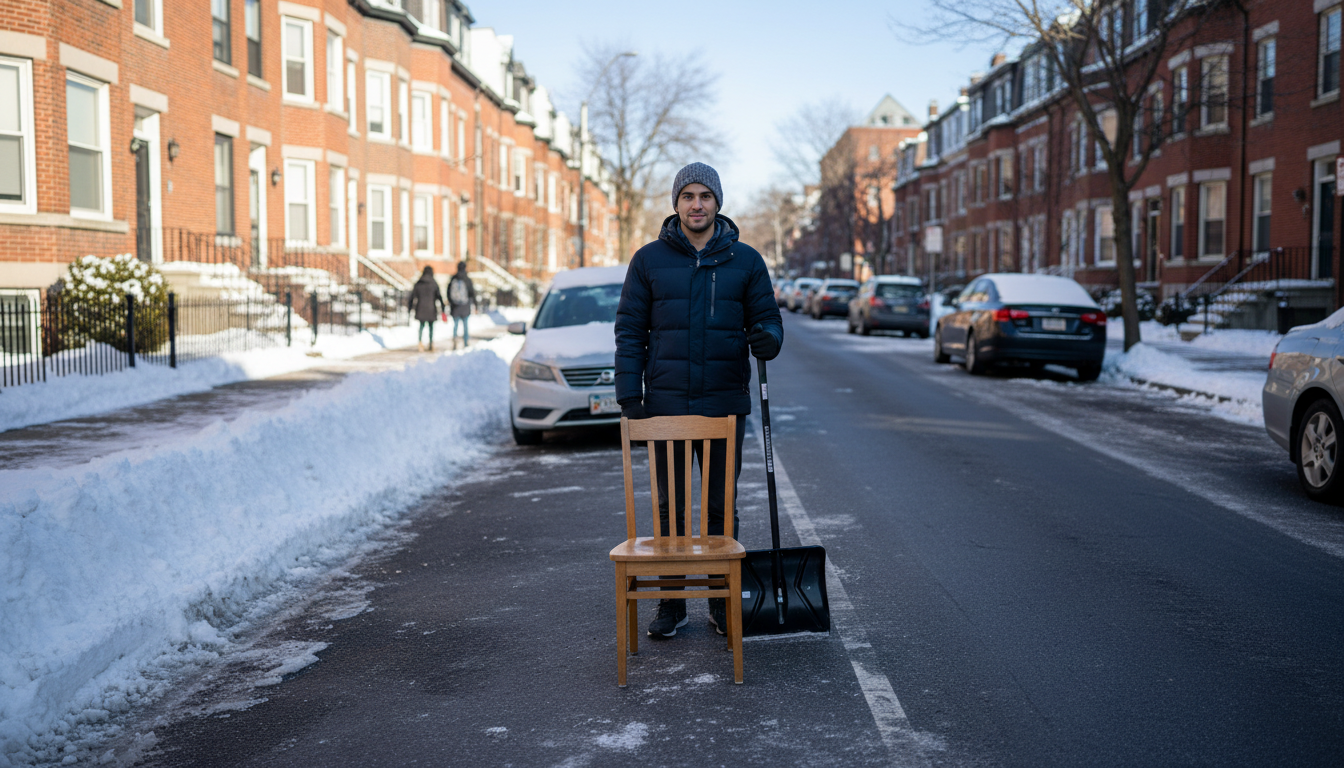
Boston's space saver rules are narrow: you can hold a cleared parking space with a chair or cone only after the city declares a snow emergency, for 48 hours after it ends, and never in the South End or Bay Village.
The first time you see one, you assume it is a joke. A kitchen chair in the middle of a cleared parking space. A traffic cone. An ironing board, once, memorably.
It is not a joke, but it is not a free-for-all either. Boston has a written rule about space savers, and it is narrower than the custom that has grown around it. The gap between the two is where new renters get into trouble, because the rule is easy to look up and the custom is not.
The rule is narrower than the custom
Boston's written space saver rule has four parts, per the city's own guidance on managing winter and snow.
| Question | What the city says |
|---|---|
| When can you use a space saver? | Only when the City declares a snow emergency. Not after an ordinary snowfall, not because you shoveled, not in advance |
| For how long? | 48 hours after the emergency ends. Not 48 hours after it starts, and not until the snow melts |
| Where is it banned? | The South End and Bay Village. Both, in full, regardless of the emergency |
| What happens then? | After the 48 hours, "you must remove it from the street" |
Two of those four rules get misreported constantly. The clock runs from the end of the emergency, not the start of the storm. And the ban covers two neighborhoods, not one. Some older coverage names only the South End. The city's current pages ban savers in both. If you live in Bay Village, the chair is not an option for you either.
What the city doesn't tell you
Boston's pages do not say what happens if you leave a space saver out past the 48 hours, and they do not say whether you may move someone else's.
Both of Boston's pages on this say you must remove your space saver after the 48 hours. No fine is published. No collection schedule is published. We checked both pages specifically for it.
Neither page says anything at all about moving someone else's space saver, in either direction. So anyone telling you it is "illegal" to move one, or that you are "allowed" to, is describing a custom rather than a rule.
So you have a narrow written rule, no published enforcement, and a street-level etiquette that varies block to block. People do retaliate against cars over this. We are not telling you that is acceptable, only that it happens and you should know before you move a chair.
For a renter, your neighbors' expectations will govern your street more than the city's page will, and you will not find those expectations written down anywhere. If you are new to a block, watching what everyone else does for one storm is worth more than winning an argument about the 48 hours.
If you live in the South End or Bay Village
Space savers are banned in the South End and Bay Village. The ban is total. It does not depend on a snow emergency and it does not have a 48-hour version.
This is worth knowing before you sign rather than after. If you own a car and you are choosing between the South End or Bay Village and somewhere else, you are choosing between a street where shoveling out buys you a held space by custom, and a street where it does not. That is a real difference in a bad winter, and a listing will not mention it.
Where to put your car during a snow emergency
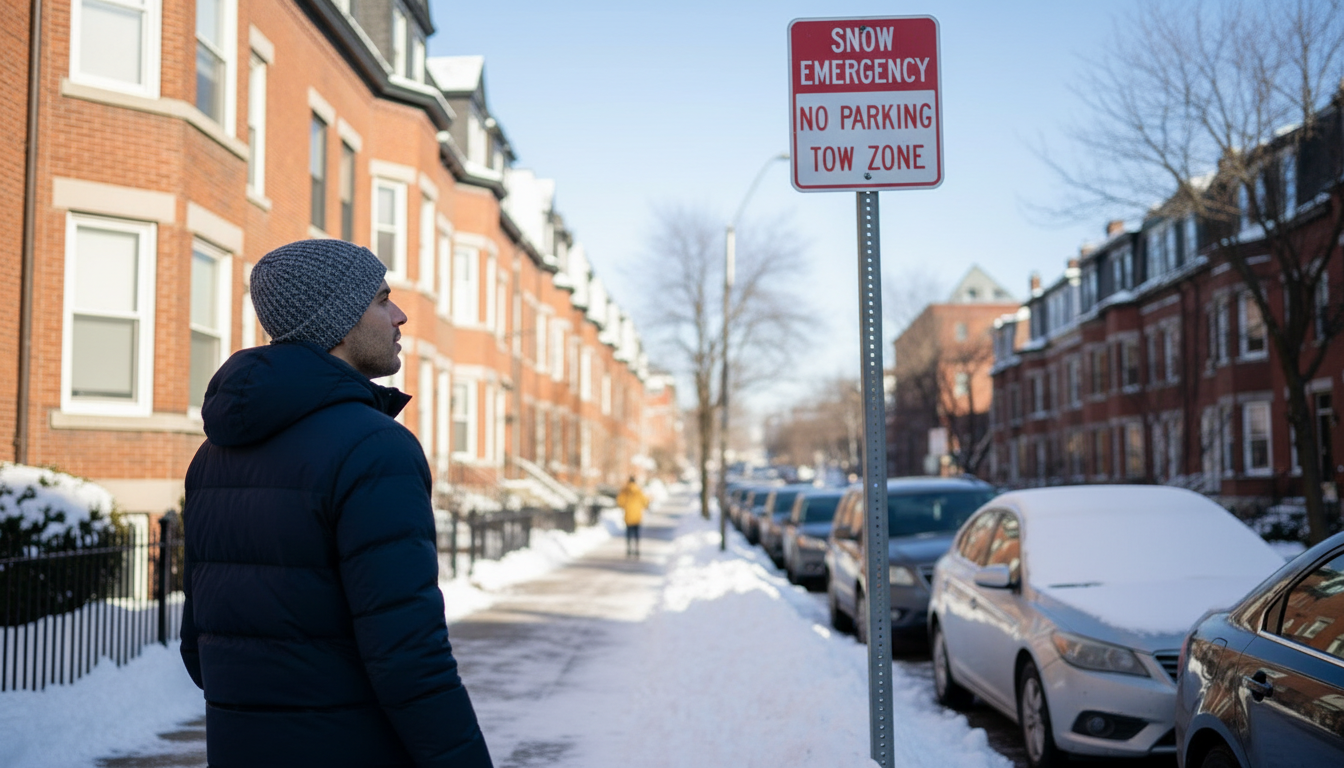
During a Boston snow emergency, move your car off the posted snow emergency arteries and onto a properly parked side street or a discounted garage, because the city will ticket and tow cars left on posted arteries.
- Check the posted signs on your street. The city's instruction is literally to check the signs, and it publishes a parking restrictions map. Restrictions are street-specific.
- Get off the snow emergency arteries. The city is blunt about this: "we will ticket and tow your car" if you are parked on a posted artery during a declared emergency.
- If you are parking on a side street, park properly. At least 20 feet from intersections and no more than 1 foot from the curb, so plows can actually get past.
- Do not block sidewalks, hydrants, ramps or driveways.
- Use a discounted garage if there is one near you. Some garages offer discounted parking during declared emergencies to Boston residents with a resident parking sticker or proof of Boston residency, and some limit the discount to residents of certain neighborhoods. Most listed garages charge $10 to $14 for each 24 hours. The discount window is specific: it starts two hours before the city declares the emergency and ends two hours after it is lifted. The city publishes the participating garages by neighborhood, with each garage's rate and terms. Some set their own exit time, so check before you park.
The resident sticker is tied to the address where your car is registered, and our guide to the Boston resident parking permit covers how to get one and what it does and does not get you.
If your car does get towed, the city publishes instructions for getting it back. A city tow costs $90 plus storage of $3 an hour, up to $15 a day. A private tow company can charge up to $132 for the tow plus $35 a day for storage. The ticket comes on top of that, and the city's fine table lists a Weather Emergency violation at $45.
What this means if you're apartment hunting with a car
If you own a car and plan to keep it, carry three things into a search.
Off-street parking is worth more in Boston than the monthly figure suggests. A deeded space or a driveway removes this entire problem, permanently, along with street cleaning and the nightly hunt for a permit space. Spot Easy's Boston apartment search has a Parking amenity filter, so you can narrow to listings with parking before you tour instead of finding out in February.
The custom is neighborhood-specific and the ban is not the only variable. Some blocks take savers extremely seriously; some barely use them. You cannot tell from a listing photo, but you can ask. Our guide to the easiest Boston neighborhoods to own a car in compares where a car is genuinely workable.
These space saver rules are Boston's. Cambridge, Somerville and Brookline each set their own. If you are comparing across the river, our guide to Cambridge rental parking permits covers that side.
FAQ
How long can a space saver stay out in Boston? Forty-eight hours after the city ends the snow emergency. The clock runs from the end of the emergency, not from the storm, and you are required to remove it after that.
Are space savers legal everywhere in Boston? No. They are banned in the South End and in Bay Village. Some older articles name only the South End; the city's current pages list both.
Can I move someone else's space saver? The city's guidance does not address it either way, so there is no rule to point at. It is governed entirely by neighborhood custom, and moving one is a reliable way to start an argument with a neighbor you have not met.