


These three areas share a border, and renters weigh them against each other constantly. Brookline costs more — but not by a consistent amount. The premium is small on a studio and substantial on a two-bedroom, which means the right answer depends on how you're renting rather than on which area is "better."
What the difference actually costs
| Size | Brookline | Allston–Brighton | Difference |
|---|---|---|---|
| Studio | $2,425 | $2,100 | $325 |
| 1 bedroom | $2,900 | $2,525 | $375 |
| 2 bedroom | $3,850 | $3,100 | $750 |
| 3 bedroom | $5,000 | $3,675 | $1,325 |
About these figures. Both columns come from Spot Easy's own listings, measured the same way in each area: average asking rent over the past 30 days, rounded. They describe the market, not any specific apartment, and they move month to month.
Where the gap actually opens up
The gap widens as the apartment gets bigger. Brookline's premium is almost the same for a studio and a one-bedroom, then roughly doubles at two bedrooms and widens again at three. The decision changes depending on how much space you need.
If you're renting a studio on your own, Brookline runs about $325 a month more. That is real money, but it is the smallest gap on the table, so transit, parking and which apartments you actually like deserve as much weight as the price.
If you're sharing a two-bedroom, the gap is around $750 a month — roughly $375 each. Over a twelve-month lease that's about $4,500 per person. That's a real number and worth pricing precisely against what Brookline offers you.
The likely explanation is housing stock rather than anything mysterious. Allston and Brighton have a higher proportion of larger units configured for sharing, which puts more supply into the two- and three-bedroom market. Brookline's larger apartments are more often in pre-war buildings where that supply is thinner.
What else changes when you cross the line
| Factor | Brookline | Allston–Brighton |
|---|---|---|
| Green Line | C and D branches; B along the northern edge | B branch only |
| Overnight street parking | Prohibited 2am–6am; 325 permit spaces town-wide | Boston resident permit system, by neighborhood |
| Municipality | Town of Brookline — own rules, services and permits | City of Boston |
| Housing stock | Pre-war apartment blocks, two- and three-family houses | Higher share of larger units configured for sharing |
| Lease cycle | September 1 | September 1, with more concentrated turnover |
Transit, in more detail
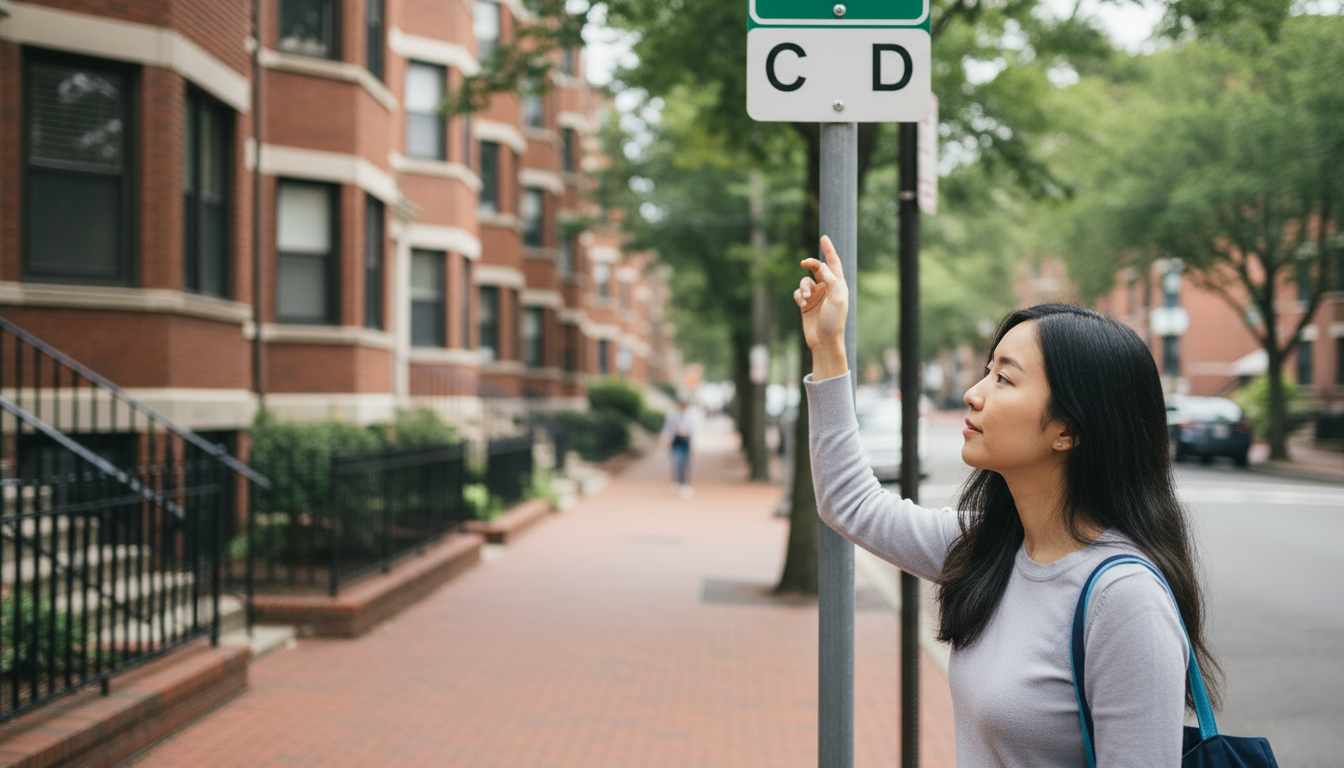
Brookline is served by the Green Line C branch along Beacon Street and the D through Brookline Village, and the B runs along Commonwealth Avenue just outside the town line, within walking distance of North Brookline. That means "I found a place in Brookline" tells you very little about the commute until you know which branch.
Allston and Brighton are served by the B branch, which runs the length of Commonwealth Avenue within Boston city limits.
That asymmetry matters when comparing two listings at similar prices. A Brookline apartment near the D is on the fastest branch in the system. An Allston apartment and a Brookline apartment both near the B are on the same branch with the same characteristics — in which case transit isn't a differentiator between them at all, and you should decide on something else.
Our guide to which Green Line branch to live on covers what separates them and why.
Parking is the sharpest difference
If you own a car, this is arguably more decisive than the rent gap.
Brookline prohibits street parking between 2 a.m. and 6 a.m., every day of the week, and the town's permit program covers 325 spaces in total. For a renter without an off-street space, that's a hard constraint rather than an inconvenience — the details are in our guide to Brookline overnight parking.
Allston and Brighton operate under Boston's resident permit system, where permits are tied to neighborhoods and overnight street parking is part of the normal arrangement rather than prohibited. Our guide to owning a car in Boston as a renter covers how permits work there.
Which one suits you
This comes down to three things you can actually price: budget, commute and parking.
On budget: if you're renting small and solo, the gap is about $325 a month, the narrowest on the table. If you're sharing a two-bedroom, Brookline costs meaningfully more and you should work out the per-person number before deciding it's worth it.
On commute: identify the branch, not the area. A Brookline place on the D and a Brookline place on the B are different commutes. An Allston place and a Brookline place both on the B are the same one.
On parking: if you own a car and the unit has no off-street space, Brookline's overnight rule is a genuine obstacle and Boston's permit system is not. That alone settles it for some people.
The practical way to settle this is to compare what actually comes up at your budget. Spot Easy lists apartments across Brookline, Allston and Brighton, and you can search by distance from an address or T stop, so you can center a search on the station you would actually commute from. Start with Brighton apartments and widen from there, with no broker fee on partner units.
For more on the Boston side specifically, we've written about Allston versus Boston more broadly, finding apartments in Brighton, and what makes Lower Allston distinct.
Frequently asked questions
Is Brookline more expensive than Allston or Brighton?
Yes, at every size, and the gap widens as the apartment gets bigger. Based on Spot Easy listings over the past 30 days, Brookline runs about $325 more on a studio, about $375 on a one-bedroom, about $750 on a two-bedroom and about $1,325 on a three-bedroom.
Why does the gap get bigger with more bedrooms?
Likely housing stock. Allston and Brighton have a higher share of larger units configured for sharing, so there's more supply in the two- and three-bedroom market.
Do they have the same transit?
Not quite. Brookline is served by the C and D branches, with the B running along its northern edge, and the D is the fastest branch in the system. Allston and Brighton are on the B only.
Can I park overnight in either?
In Allston and Brighton, under Boston's resident permit system, yes. In Brookline, street parking is prohibited between 2 a.m. and 6 a.m., with only 325 permit spaces town-wide.
Is Brookline part of Boston?
No. It's a separate town with its own government, parking rules, permits and services.
Which is better for sharing a two-bedroom?
On price, Allston–Brighton by roughly $375 per person per month. Whether that's decisive depends on the branch and parking situation of the specific apartments you're comparing.
Do both run on the September 1 cycle?
Yes, both follow the Greater Boston September 1 turnover, though Allston and Brighton see more concentrated movement.
Sources
Rent figures for both areas come from Spot Easy's own listing data, covering apartments on the market and apartments taken off the market within the past 30 days, as of late August 2026. Brookline is measured town-wide; Allston–Brighton covers the Allston and Brighton neighborhoods together. See our Brookline renter's guide for more on the town itself.
Both columns are measured the same way, so the comparison is like-for-like. They are averages rather than quotes on any specific apartment, and they move month to month. Check asking rents for your bedroom count in both areas before deciding.
Green Line branch assignments are per the MBTA. Brookline's overnight parking rule and 325-space permit allocation are as published by the Town of Brookline. Boston resident permit rules are covered in our guide to owning a car in Boston as a renter, sourced from Boston.gov.