


Anyone who has carried a sofa into a Boston walk-up knows the moment: two people, a sofa, a staircase with a turn in it, and the slow realization that this is not going to work. If you have seen Ross yelling "Pivot!" on Friends, you have seen the Boston version of move-in day.
Whether a couch will fit up the stairs of a Boston apartment usually depends on the narrowest turn in the stairwell, not the door, and you can check it at the viewing in about ten minutes.
The measurements that mattered were never the ones anybody took. The sofa fits the living room comfortably. It fits through the apartment door. It does not get past the half-landing between the first and second floors, and there is no second way in. This is a predictable result of the housing stock here.
Why do couches get stuck on Boston stairs so often?
Much of Boston's rental stock is triple-deckers, converted Victorians and rowhouses, built long before furniture got as big as it is now.
What that means in practice:
- The stairs turn. A straight run is the exception. A turn, a winder or a half-landing is the norm, and the turn is where things get stuck.
- There is usually no elevator, so the stairs are the only route.
- Door frames are original and narrow, often with the original casing still in place.
- The top flight frequently has a soffit or a sloped ceiling cutting into the headroom.
- There are usually three constrictions, not one: the building's front door, an interior common door, and your unit door.
A national moving guide will tell you to measure your doorway. In this stock, the doorway is rarely the thing that stops you.
Which four measurements decide whether furniture fits?
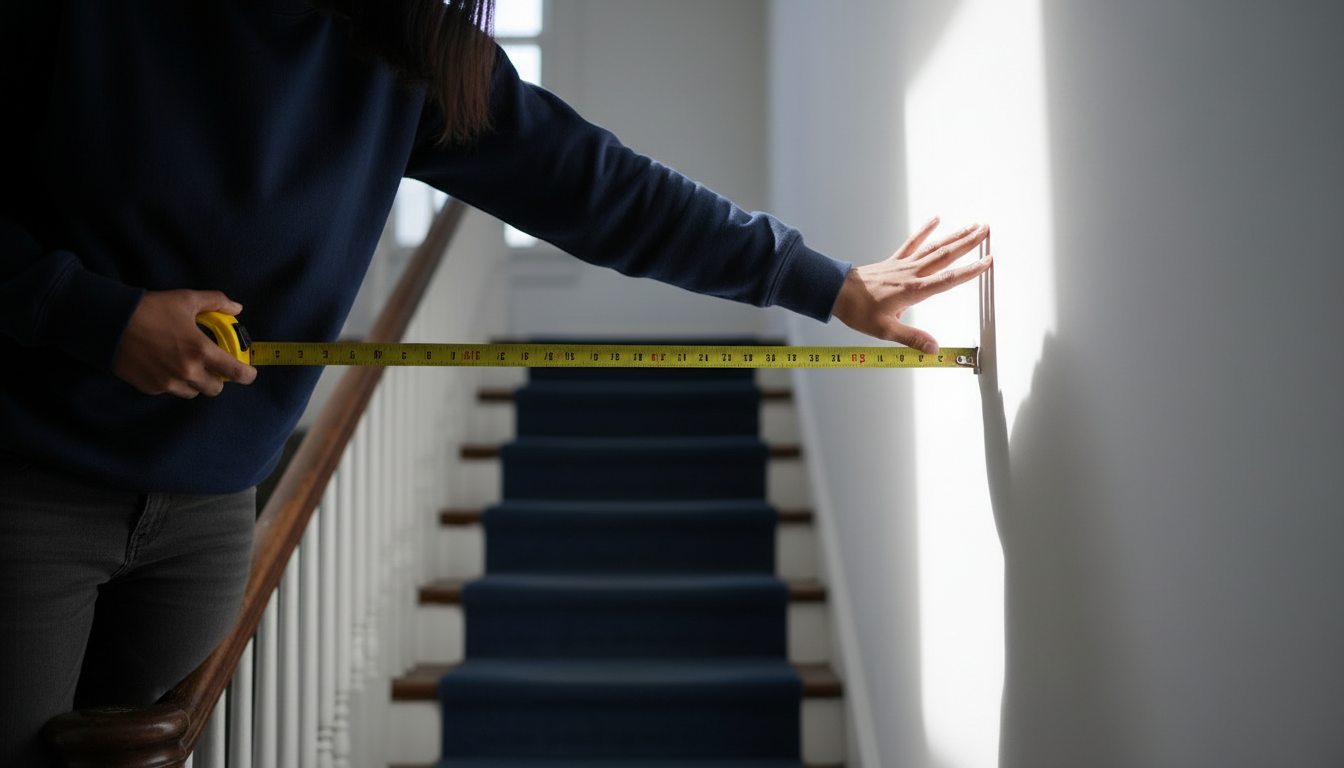
Four measurements decide whether furniture fits a Boston apartment: stairwell width at its narrowest point, door frame width and height, landing depth, and headroom over the stairs.
| Measure | Where exactly | Why it's the one that binds |
|---|---|---|
| Stairwell width at its narrowest | At the turn or winder, not along the straight run. Measure from the handrail to the wall, because the handrail is the real edge | The straight run is almost always wider. The turn is the constraint, and it is the part nobody measures |
| Door frame width and height | Inside the casing, with the door standing open | The stop, the casing and the hinges take an inch or more off the nominal opening |
| Landing depth | The flat area where you pivot, at every turn | A turn needs room for the item's long dimension to swing through. Width alone doesn't tell you this |
| Headroom over the stairs | The top flight especially, under any soffit or slope | You tilt furniture to get it up. Low headroom removes the tilt, which removes your options |
Take these once, write them in your phone, and you have them for every piece of furniture you will ever consider for that apartment.
What is diagonal depth, and why does it matter for a sofa?
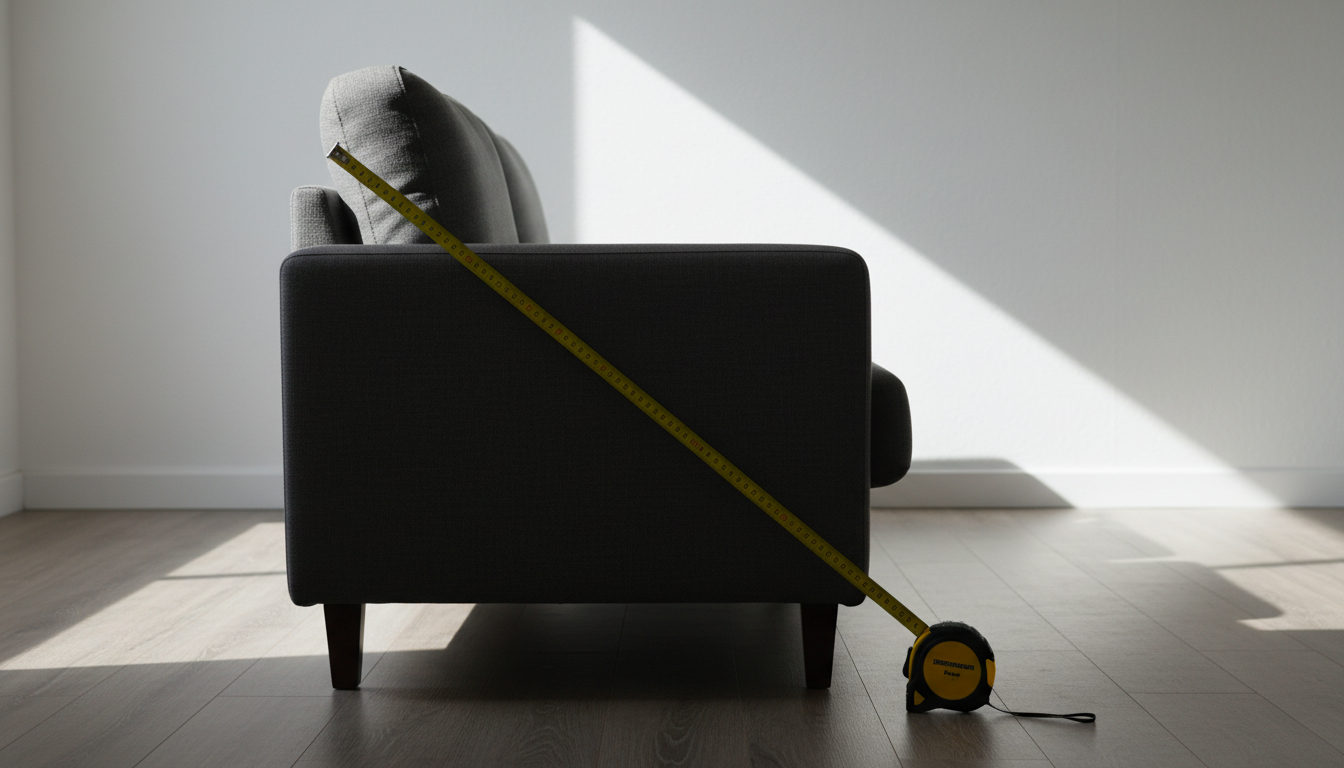
Furniture goes up stairs tilted, not flat. So the dimension that has to clear the stairwell is the diagonal depth: the distance from the top of the backrest to the front edge of the seat base, measured corner to corner across the side profile.
To measure it, stand at the end of the sofa and run the tape from the highest back corner to the lowest front corner. That single number is what has to fit through the narrowest point of the route.
This is why a sofa whose width clears the stairwell can still fail. Measure the diagonal first, and if that clears, check width and length after.
What furniture gets stuck on stairs, and what usually fits?
The regular offenders: large one-piece sectionals. Sleeper sofas, which are the worst of all, because they are heavy, completely rigid, and cannot be flexed even slightly. Oversized armoires and wardrobes. Large one-piece dining tables. Full-size refrigerators through an original door frame.
Usually fine: anything flat-pack, obviously. Foam mattresses, which bend enough to get around a turn where a sprung mattress will not. Modular sectionals that separate into pieces. Bed frames that disassemble. Anything with removable legs, which buys you more clearance than people expect.
What can you do if a couch won't fit up the stairs?
If furniture will not fit up the stairs, you have three options: take it apart, hoist it, or do not buy it. They are worth knowing before you are standing on the stairs.
Take it apart. Legs off, cushions out, doors off the frame. This solves more cases than anything else and costs nothing.
Hoist it. Through a window or over a balcony. This is a real thing that happens in Boston, it costs extra, and it has to be arranged in advance rather than improvised. Not every moving company offers it, and not every building or landlord will permit it, so ask both before you book anything.
Don't buy it. If you are furnishing a new place rather than moving existing furniture, this is the cheap answer. Measure first, then shop. A sofa that arrives and cannot get upstairs becomes a returns problem on top of a furniture problem.
Good Boston apartments rent fast, and one that checks all your boxes will not wait while you work out the furniture. If the couch you have now will not make the turn, ask what matters more to you: the apartment you actually want, or one you settle for because the couch fits. A couch can be taken apart, sold or replaced, so it should rarely be the reason you pass on an apartment.
Measure at the viewing, not on move day
Measure at the viewing, while you still have access to the building and no deadline.
Move day brings a crew on an hourly clock and a truck in a permitted space, which is a bad time to discover a problem. At the viewing you can take your time and walk the route.
So: walk the full route from the street to the unit door. Measure the stairwell, the door frames, the landing depth and the headroom. Note which floor you are on and whether there is any second access point.
If you are moving in with someone else and combining two households, this matters more, because you are deciding what to keep and what to sell before anyone lifts anything. We worked through that side of it, including what building access actually does to a moving bill, in moving in together in Boston.
Knowing the floor and whether there is an elevator before you book a viewing can save the trip. You can filter for an elevator under Amenities while you are still shortlisting apartments. The floor is often in the listing, and if it isn't, ask the agent.
For what this housing stock is like to live in more generally, renting a triple-decker covers what changes when your building is a house.
FAQ
What is the most important measurement? The stairwell at its narrowest point, which is almost always at a turn rather than along the straight run. Measure from the handrail, not the wall behind it.
Why does my sofa fit the door but not the stairs? Because furniture goes up tilted, so the dimension that has to clear is the diagonal depth across the side profile, not the width. A sofa can be narrow and still too deep on the diagonal.
Can movers get anything up any staircase? No, and a good crew will tell you so before they start rather than after. If you have a large rigid piece and a turning staircase, say so when you get the quote, and ask then about hoisting rather than on the day.