

A Boston parking ticket comes with a clock on it, and the clock is shorter than most people assume. You have 21 days before an additional penalty gets added, and the appeal route closes faster than that if your first attempt fails.
This covers paying, appealing, and the worse version of the problem, which is arriving at the space and finding the car gone.
How long do you have to pay a Boston parking ticket?
Pay a Boston parking ticket within 21 days of getting it to avoid an additional penalty.
That's the one number to remember. The city doesn't publish the penalty amount on the payment page, so treat the 21 days as the deadline rather than gambling on how much worse it gets.
If you appeal and the appeal is denied, a second and shorter clock starts. You then have 10 days to pay or to request a hearing, which you do by calling the Parking Clerk on 617-635-4410.
How to pay, and what each route costs you
There are four ways, and they are not priced the same.
- Online at boston.gov/tickets, using Mastercard, Visa, Discover or American Express. The service fee is 2.75 percent of the ticket.
- By phone on 617-635-3888, available 24 hours. Same cards, and the fee drops to 2.5 percent.
- In person at 1 City Hall Square, Room 224, Monday to Friday, 9 a.m. to 4:30 p.m. Cash, cards, checks and money orders. Card payments carry a 2.5 percent fee with a $1 minimum and you'll need photo ID. Debit cards that need a PIN are not accepted.
- By mail to City of Boston, P.O. Box 55800, Boston, MA 02205, with your ticket and registration number, name and address. Personal check or money order only, payable to the City of Boston.
The phone line being cheaper than the website is not intuitive, and on a large ticket the difference is real. For most renters the bigger point is that mail is the slowest route and the 21 days are counted from the ticket, not from when you got round to it.
How do you appeal a Boston parking ticket?
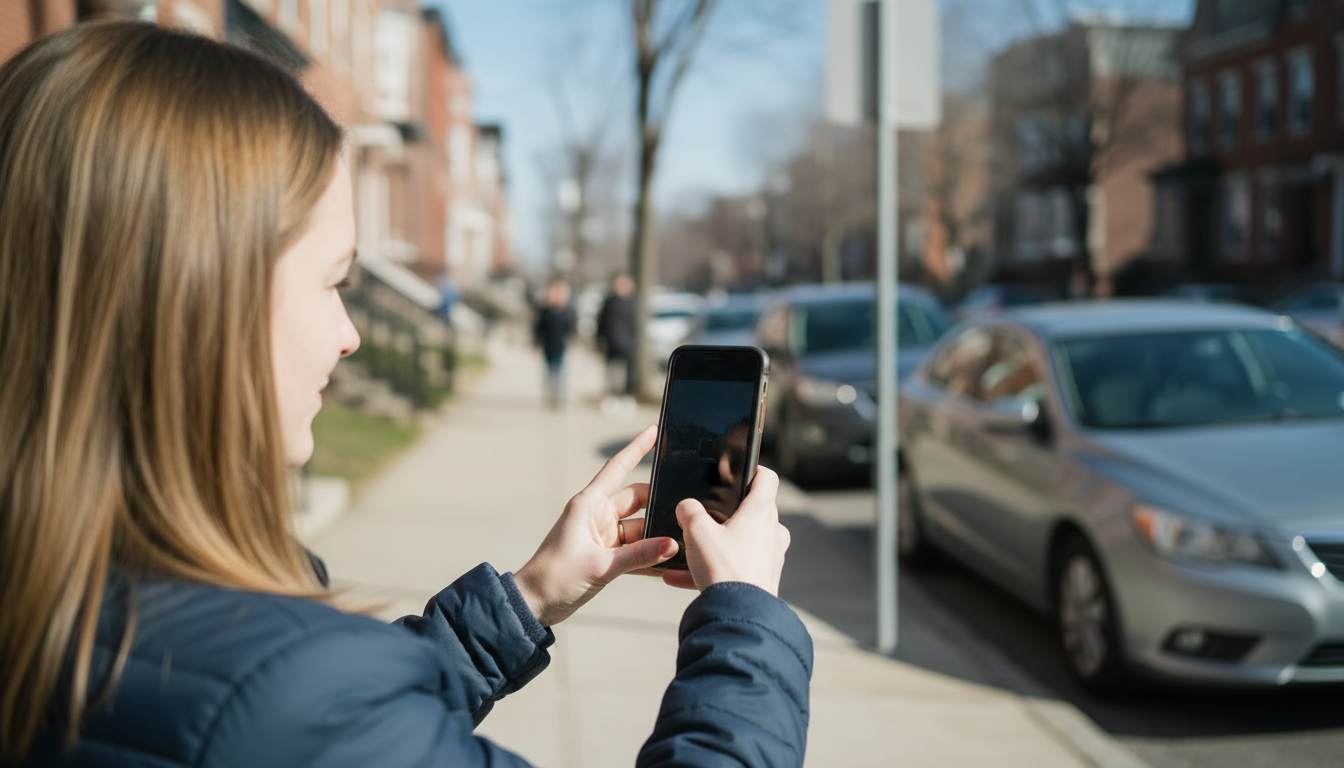
You appeal a Boston parking ticket through the Parking Clerk, starting at the city's appeal page.
Worth being honest about what tends to work. An appeal is strongest when you can show the ticket was factually wrong: the sign was missing or obscured, the meter was broken, the plate or location on the ticket doesn't match your car, or you were parked legally under a permit the officer didn't register. It is weakest when the argument is that you only left it there for a minute.
Photographs taken at the time are the thing people wish they had later. If something about the ticket looks wrong, photograph the sign, the space and the car before you move it. Get the sign and your car in the same frame if you can, because a photo of a sign on its own doesn't establish where you were parked relative to it.
Write down what happened while you remember it, too. Appeals often get decided weeks later, and by then the detail that made your case obvious has blurred into a general sense of unfairness, which is not an argument.
One thing worth being clear-eyed about: an appeal is not a delay tactic. If it's denied you're on a 10-day clock rather than the original 21, so appealing a ticket you expect to lose can leave you worse off than paying it on day two.
Why unpaid tickets get expensive beyond the fine
Letting tickets sit costs more than the penalty, and the way it bites renters specifically is the parking permit.
Boston requires you to clear overdue parking tickets before it will issue or renew a resident parking permit. So a couple of ignored tickets from last year can stop you getting the permit that would have prevented this year's tickets. It's a loop that's easy to fall into and annoying to climb out of, because the permit application is the moment you discover the problem rather than something that warns you in advance.
That's the practical argument for dealing with a ticket you intend to pay quickly rather than letting it drift. The 21-day penalty is the visible cost. The permit block is the one that actually disrupts things.
If you're new to the city and haven't applied for a permit yet, it's worth checking whether anything is outstanding against your plate before you start, rather than finding out at the counter.
What if your car was towed in Boston?
A car that isn't where you left it has usually been towed rather than stolen, and street cleaning is one of the most common reasons.
To find it:
- Search by plate number at the city's towed vehicle lookup
- If that doesn't find it, call Boston Police on 617-343-4629
- Or the Transportation Department on 617-635-3900
Getting a towed car back in Boston costs more than the ticket, and the price depends on who towed it. At the City of Boston Tow Lot, the city charges a $90 tow fee plus storage of $3 per hour, up to $15 a day. If a private tow company has your car, the state-set maximums for a police-ordered tow or a tow from private property are:
- Up to $132 for the tow
- $35 for each 24-hour period of storage
- A fuel surcharge, the rate set by the state
- Additional labor charges may apply
Storage accruing daily is why a car towed on a Friday is a genuinely bad weekend. The city has a step-by-step page on recovering a towed car, and if you have a complaint about the tow company itself, that's handled by the state Department of Public Utilities rather than by the city.
The cheapest version of all this is not getting towed
Most renter tickets and tows in Boston trace back to the same handful of things, and all of them are avoidable with a bit of setup.
Street cleaning is a big one, and it's the one people most often think their permit covers. It doesn't. Our guide to finding your street cleaning day covers the lookup tool, the reminder signup and the fifth-week rule that makes the pattern look inconsistent.
The others worth setting up once:
- Know what your resident permit actually exempts you from, which is narrower than most people think. Here's what it covers.
- Watch for temporary no-parking signs. A neighbor's moving truck permit is enough to make your legal space illegal overnight, and during the September 1 turnover that happens constantly.
- Snow emergencies move cars regardless of permit.
If you're deciding whether to keep a car at all
For a lot of Boston renters the honest answer is that the car costs more than it looks like it does once you add tickets, the occasional tow, insurance and the time spent moving it twice a month.
Our guide to the easiest Boston neighborhoods to own a car in is the place to start if you're weighing it, and bringing a car to Boston covers the registration and insurance side if you're moving from out of state. If the answer is that you'd rather not, we worked through whether an MBTA pass pays for itself.
You can also browse Boston apartments by neighborhood if parking is one of the things you're weighing.
The short version
- 21 days from the ticket before a penalty is added
- If an appeal is denied, 10 days to pay or request a hearing on 617-635-4410
- Paying by phone costs 2.5 percent, online costs 2.75 percent
- A private tow can cost up to $132, plus $35 a day in storage and a fuel surcharge. The City Tow Lot charges $90 plus up to $15 a day
- Find a towed car by plate at the city's lookup, or call 617-343-4629
- Street cleaning is one of the top causes, and your permit does not exempt you
A note on checking before you rely on it
Deadlines, fees and phone numbers above come from the City of Boston's own Parking Clerk and Transportation pages, linked throughout, and were current when this was written. Fees get adjusted. For anything specific to your ticket, the Parking Clerk on 617-635-4410 or [email protected] is the direct route.