

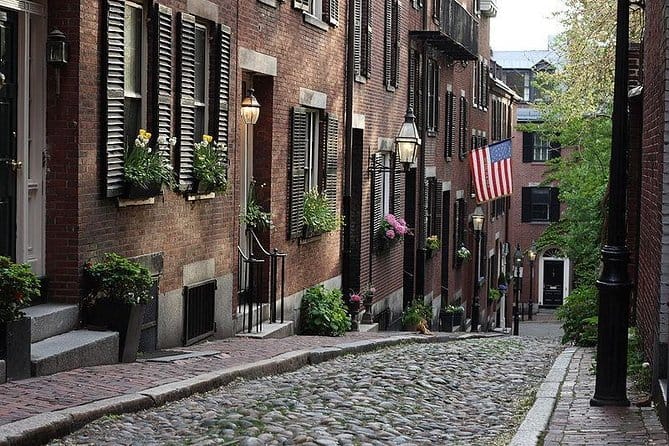
Beacon Hill is Boston's oldest intact rowhouse neighborhood, a few hundred yards of gas-lit brick streets between the State House and the Charles River. Renting here means renting into a nineteenth-century building, on a block where even the landlord can't repaint the front door without city sign-off. Below is what that looks like day to day, and what a Beacon Hill apartment costs right now. For current listings, see apartments in Beacon Hill on Spot Easy.
What kind of building are you actually renting into?
Almost every building on Beacon Hill is a converted rowhouse, not a purpose-built apartment block. Most went up between 1800 and 1850 as brick single-family townhouses in the Federal style, and after 1819 in the Greek Revival style that followed it, columns and all, at 42 Beacon Street and beyond. Owners divided them into apartments decades later, one house at a time, which is why no two units in the same building are alike.
That matters for what you should expect to find. Original details like fireplaces (ask whether they work), high ceilings, and tall windows are common on the lower floors of these houses. Elevators are not. A converted 1830s townhouse was never built with a shaft for one, so a four- or five-flight walk-up is normal, not an outlier, especially toward the top of the Hill. In-unit laundry is inconsistent for the same reason: some buildings have added it, plenty haven't, and it's worth confirming before you tour rather than assuming. Heating systems in these buildings also tend to be older than what you'd find in a new-construction building elsewhere in Boston, which can mean uneven room-to-room temperatures and higher bills in original-window units. Ask about the heating system and whether the windows have been replaced.
Does it matter if you're on the flat, the north slope, or the south slope?
Beacon Hill splits into three distinct sections, and the difference shows up in the building stock as much as the address. The flat of the Hill, the blocks between Charles Street and the river, was built later, on land filled in during the nineteenth century. The south slope, running down toward Boston Common and the State House, including Louisburg Square, is the most architecturally intact part of the neighborhood. Louisburg Square itself is 27 Greek Revival rowhouses built between 1834 and 1844 around a fenced private garden that only Square residents can enter, one of the clearest examples of the neighborhood's nineteenth-century character. The north slope, toward Cambridge Street, has a steeper grade and narrower streets than the flat or the south slope.
Can you park a car on Beacon Hill?
Most Beacon Hill streets are resident-permit-only, and a permit is the only way to park there overnight without risking a ticket. A Boston resident parking permit is free. To get one you need a Massachusetts registration showing the car is principally garaged at your Beacon Hill address, plus proof of residency, a lease or a recent bill, dated within the past 30 days. The permit is tied to your specific vehicle and to Beacon Hill specifically; it won't work if you park in a different resident zone. It also doesn't reserve you a spot. It only exempts you from resident-only restrictions, and it does not override street cleaning, snow-emergency rules, or metered hours. See how to get a resident parking permit at boston.gov. Street parking on the Hill is genuinely tight even with a permit, and plenty of renters here go without a car, or pay for a garage space separately.
How do you get around Beacon Hill without a car?
Beacon Hill sits between three T stations, which covers most of what a car would otherwise be doing. Charles/MGH, on the Red Line, sits at Charles Circle on the edge of the flat, right where Charles Street starts. Park Street, served by the Red and Green Lines, is a short walk from the south slope and Boston Common. Bowdoin, the Blue Line's downtown terminus at the base of the Hill on the Government Center side, has run on the same schedule as the rest of the subway since the MBTA made that permanent in 2016, so it's not a special-hours station the way it once was. Between those three stops, most of the rest of the T system is one transfer away. For the neighborhood's full Walk Score and Transit Score breakdown, block by block, see our guide to how walkable Beacon Hill really is.
What does living in a historic district actually restrict?
Beacon Hill is a local historic district, and the Beacon Hill Architectural Commission reviews any exterior work on a building that's visible from a public way, including from Boston Common, Storrow Drive, the Longfellow Bridge, or Cambridge Street. That covers things like window replacements, shutters, window boxes, paint colors on trim and doors, and signage. As a renter this rarely comes up directly, since it's usually the building owner who applies for and manages any exterior work, but it's the reason you won't see satellite dishes, visible window AC units on the street-facing side, or mismatched storm windows on most of the Hill, and why any exterior change a landlord makes can take longer than it would elsewhere in the city. See the Beacon Hill Architectural Commission's page at boston.gov for what's covered.
What's within walking distance for everyday errands?
Charles Street is the neighborhood's main commercial strip, running along the base of the flat from Beacon Street down toward Cambridge Street. It's small-format retail: antique shops, a hardware store, cafes, a handful of restaurants, and a pharmacy, not a supermarket. For a full grocery run, there's a Whole Foods at 181 Cambridge Street, just across the street from the Hill in the West End. It's a short walk from nearly anywhere on the Hill, which is part of why car ownership here is more optional than it is in most of Boston.
What does rent actually cost in Beacon Hill right now?
Beacon Hill averaged the following by apartment size in the Spot Easy Rent Index for August 2026, compared with Boston overall for the same month.
| Apartment size | Beacon Hill average | Boston average | Difference |
|---|---|---|---|
| Studio | $2,488 | $2,373 | $115 above |
| 1 bedroom | $3,069 | $2,928 | $141 above |
| 2 bedroom | $3,988 | $3,632 | $356 above |
These figures come from the Spot Easy Rent Index for August 2026, which re-queries live listing data monthly, so check the page directly for the current month's numbers. Beacon Hill runs above the Boston average at every size, and the gap widens with bedroom count.
How do you search for an apartment in Beacon Hill?
Spot Easy's search lets you filter Beacon Hill listings by price range, number of bedrooms, and pet policy (Cats Allowed, Small Dogs Allowed, or Big Dogs Allowed), and toggle to see no-broker-fee listings only. Every listing comes from a verified agent. Start with Beacon Hill apartments on Spot Easy and narrow from there.
Common questions about renting in Beacon Hill
Do Beacon Hill apartments have elevators?
Most don't. These are converted nineteenth-century rowhouses, not purpose-built apartment buildings, so a walk-up of three to five flights is common, especially on higher floors and toward the top of the Hill. Ask specifically about the floor and the stairs before you commit, particularly if you'll be moving furniture in regularly.
Do you need a car to live on Beacon Hill?
No. Charles/MGH, Park Street, and Bowdoin all sit within walking distance of most of the neighborhood, and Charles Street covers everyday errands on foot. Street parking is tight even with a resident permit, so plenty of renters here go without a car entirely.
Can a Beacon Hill renter change the outside of their building?
Not without review. Beacon Hill is a local historic district, and the Beacon Hill Architectural Commission reviews any exterior change visible from a public way, from window boxes to paint colors to signage. In practice this is almost always handled by the building owner rather than the renter.
Ready to look? Search current Beacon Hill apartments on Spot Easy, filter by price, bedrooms, and pet policy, and connect with a verified agent.