


In Massachusetts, the State Sanitary Code puts the snow and ice duty on the landlord of a building with more than one unit, for its exterior stairways, fire escapes, egress balconies and bridges. Your lease may still have a line saying snow is your job, or your landlord may have told you in passing that it is on you this winter.
Most people will tell you that is not allowed, that a Massachusetts landlord can never push snow removal onto tenants. That answer is only partly right. The Code's list is short, it says nothing at all about several of the places people argue about, and there is one configuration in which it can be shifted to you.
What the Sanitary Code actually covers

The relevant rule sits in the Minimum Standards of Fitness for Human Habitation, 105 CMR 410.260, the section on means of egress. In a building with more than one unit, the owner must keep every means of egress in a safe, operable condition, and must keep these free of snow and ice:
exterior stairways, fire escapes, egress balconies and bridges
This is an egress rule, written so that people can leave a building in an emergency.
When your lease can put it on you
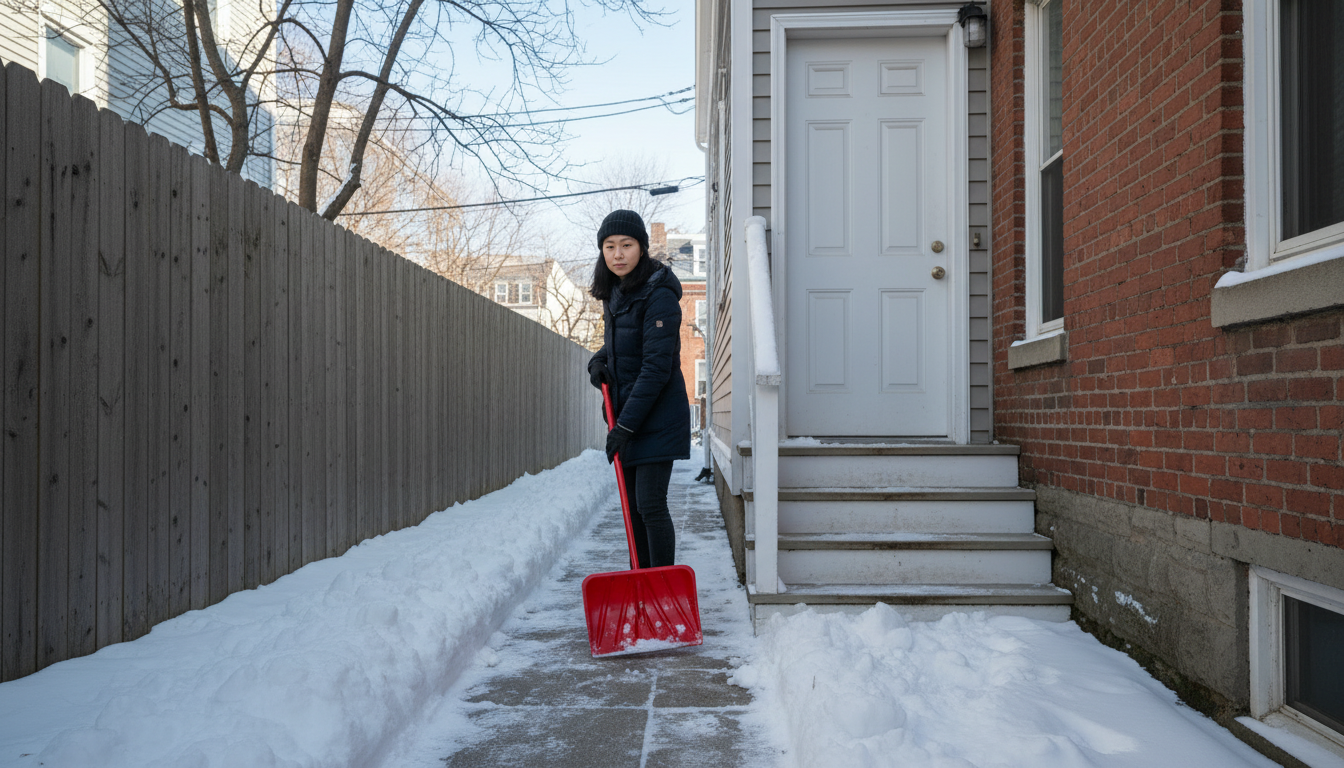
A lease can put the snow duty on a tenant only for a way out under the tenant's exclusive use and control, and only when a written rental agreement clearly says so.
1. The way out is under your exclusive use and control. Your own stairway or entrance, used by nobody else.
2. A written rental agreement clearly identifies it as your responsibility. The lease has to actually assign it.
When both apply, the Code makes you responsible for keeping that way out free of snow and ice.
A lease clause on its own does not move the duty if your stairway is shared.
For a typical Boston triple-decker or any building where tenants share a front stairway, the first condition fails. The stairway is not under anyone's exclusive use and control, so the owner's duty stands regardless of what the lease says about it.
For a unit with its own private entrance that nobody else uses, the opposite is true. The regulation contemplates exactly that arrangement and permits it.
A single-family rental works differently again. The owner's snow and ice rule is written for buildings with more than one unit. In a single-unit residence, the Code puts the duty to keep the ways out free from obstruction on the occupant. That leaves the lease as the main place to look for who shovels a single-family house.
What the Code does not mention
The Sanitary Code's snow and ice rule stops at those four ways out. The places people argue about most sit outside it.
| The Code addresses | The Code does not mention | So where does that leave you |
|---|---|---|
| Exterior stairways | Walks | Your lease and any local ordinance |
| Fire escapes | Driveways | Your lease and any local ordinance |
| Egress balconies | Sidewalks | Local ordinance, which is a separate system |
| Egress bridges | Parking areas | Your lease |
So "the sanitary code says they have to" applies to a stairway, not to a driveway.
The driveway question
The Sanitary Code does not say who clears a driveway, because its snow and ice rule covers only exterior stairways, fire escapes, egress balconies and bridges.
The answer usually comes from your lease. If your lease assigns the driveway to you, that is a contract term, and the Sanitary Code does not override it. If the lease is silent, there is no rule to point to, and you will be working it out with your landlord.
If this matters to you, settle it before you sign. It is a cheap thing to ask about in October and an expensive thing to argue about in February. If you are still looking, you can request a tour from the Boston apartment search on Spot Easy and ask who handles the snow while you are there.
The public sidewalk is a different rule
The strip of public sidewalk in front of a building is not governed by the Sanitary Code at all. Many Massachusetts cities impose their own sidewalk-clearing obligations on property owners, usually with a time limit after snow stops falling and a fine for ignoring it.
Those rules vary by municipality, so we are not going to quote a deadline or a penalty here. Check your own city's ordinance, because the number differs and getting it from a blog is how people end up with a ticket.
The sidewalk duty comes from the city, and it generally runs to the property owner. Some cities let a lease move it. Boston's ordinance, for one, reaches a tenant only when a written lease expressly requires the tenant to remove snow.
If nobody clears it
Start with a written request to the landlord or management company, because a dated message is worth more later than a phone call.
If the stairway or fire escape stays unsafe after that, this is a code enforcement matter rather than a private dispute. Local boards of health and inspectional services enforce the Sanitary Code, and our guide to who to call about a landlord problem in Boston covers which office handles what.
If snow is not being cleared, check whether your landlord is supplying heat properly as well. The heating rules have set dates, and we covered them in when your landlord has to turn the heat on.
Where this stops being general advice
Three situations need someone looking at your specific circumstances rather than an article.
Whether a clause in your lease is enforceable, because that turns on whether the way out is genuinely under your exclusive use and control, which depends on the facts of your building.
Anything involving an injury. If someone has fallen, that is a personal injury question and it is its own area of law. Do not try to work it out from a tenant-rights article.
A landlord insisting a clause overrides the Code in a shared-stairway building. Our guide to lease clauses that are not enforceable in Massachusetts covers the general principle that a lease cannot contract around certain protections, and a tenant-rights attorney or MassLegalHelp can tell you whether yours is one of them.
FAQ
Does my landlord have to shovel in Massachusetts? In a building with more than one unit, yes, for exterior stairways, fire escapes, egress balconies and bridges, under the State Sanitary Code. The duty is about safe exit from the building, not about the whole property.
Can my lease make me shovel? Only for a way out under your exclusive use and control, and only if a written rental agreement clearly makes it your responsibility. In a building with a shared stairway, a clause alone does not move it.
What about the driveway or the sidewalk? The Sanitary Code does not mention either. The driveway is a lease question. The public sidewalk is a city ordinance question, and those rules and deadlines vary by municipality, so check your own city's.