

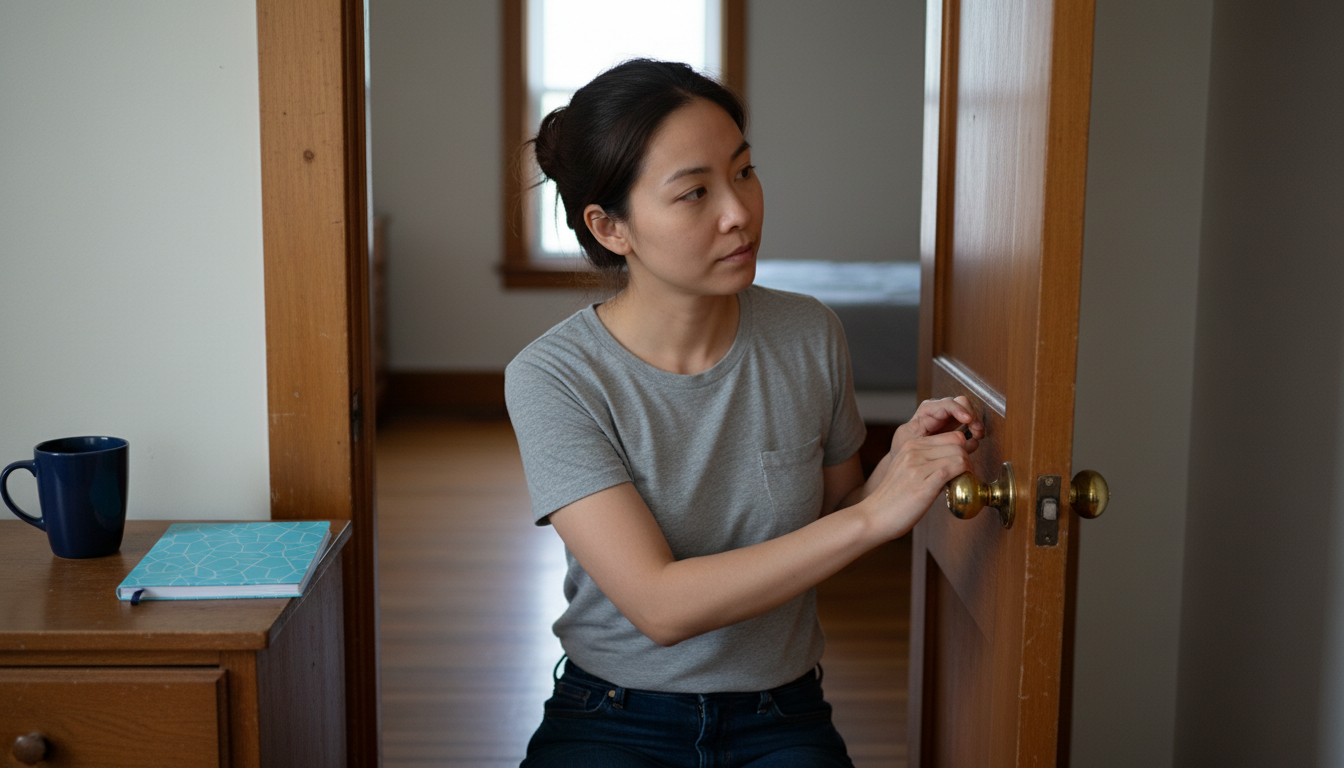
You bought a doorknob that locks, it would do no damage to the door, and your landlord said no — fire codes.
This guide separates the two questions that get tangled together in that moment: what the Massachusetts sanitary code actually requires about your bedroom door, and whether your landlord can refuse the change anyway. Those are different questions with different answers, and most renters only ask the first.
The short version is that the fire-code answer is half right, and the half that's wrong isn't the half most people expect.
Is the "fire code" answer right?
Partly. There is a real rule in this area, and it's worth understanding precisely, because it explains what your landlord is probably thinking.
The Massachusetts State Sanitary Code (105 CMR 410) requires that locking devices comply with the building code's egress provision (780 CMR 1017.4.1), to avoid entrapment in the building, and that doors used for exit can be opened without a key. That rules out a particular kind of lock: one you'd need a key or special knowledge to get out of. It does not rule out locks in general.
That distinction does a lot of work. A privacy knob or a thumb-turn, like the kind on most bathroom doors, always opens from the inside by turning it. It doesn't create an entrapment risk, because nobody inside the room is ever locked in. A keyed lock that could leave someone unable to get out in a fire is a different proposition, and that's the scenario the rule exists for.
So a landlord who says "fire code" isn't inventing a rule. They're applying a real one to a question it doesn't quite answer. Which raises the more useful question.
Is your bedroom door even covered?

The sanitary code's lock requirements are about entry doors, not the doors inside your apartment. That surprises people on both sides of the argument.
The code requires that a dwelling unit be capable of being secured against unlawful entry, that entry doors and exterior doors have working locks, that buildings above a certain size have self-closing main entrance doors, and that the owner give occupants keys. What it doesn't address is an interior bedroom door within a shared apartment.
That means for a lot of Boston renters, the code simply isn't the tool for this. Which category you're in decides everything:
| Your setup | You're probably in a… | What the code says about your bedroom door |
|---|---|---|
| You and your roommates all signed one lease and share the kitchen | Single dwelling unit occupied by one household | Your bedroom door is an interior door — the lock requirements don't reach it |
| You signed your own agreement for just a room, and reach a shared kitchen without passing through anyone else's space | Possibly a rooming unit | Your door may count as an entry door, which must be capable of being secured against unlawful entry |
| You rent a room in a home where the owner also lives | A different arrangement again, with its own rules | See renting a room from a live-in landlord |
The middle column says "probably" deliberately. These categories turn on the details of your letting arrangement, and no table can classify your tenancy for you.
The one case where it flips — rooming units
The code's lock requirement covers the entry door of a dwelling unit or a rooming unit. If your room is a rooming unit, its door is an entry door, and being able to secure it stops being a favor your landlord grants.
A rooming unit is defined in the sanitary code's definitions section (105 CMR 410.020) as a room or group of rooms let to an individual or household for living and sleeping quarters but not for cooking — whether or not shared cooking facilities are available, with the qualification that cooking facilities don't count as common if you can only reach them by passing through someone else's unit.
In practice that tends to separate two situations that look similar from the hallway. Roommates who signed one lease together and share a kitchen are usually one household in one dwelling unit. Someone renting a single room under their own agreement, in a house where rooms are let individually, may well be in a rooming unit.
It's a genuinely fine distinction, and it's the kind of thing worth getting an actual opinion on rather than deciding for yourself. See the end of this article.
If the code doesn't cover it, can they still refuse?
Usually, yes — though it depends on your lease. It's the answer nobody wants, and the lease rather than the code is where it actually gets decided.
Your landlord owns the door. Installing a new doorknob is an alteration to their property, and a landlord can usually decline an alteration without needing to point to a law that forbids it. "No" is a complete answer from a property owner asked for a modification, whatever reason they attach to it.
That's worth understanding clearly, because it changes what you should do next. If you go back armed with "the fire code doesn't actually say that," you may well be right about the code and still get the same no. The code was never the thing standing in your way. The refusal rests on ordinary lease and property grounds.
It's also worth reading your lease before you push. Most leases have a clause about alterations, and that clause, not the sanitary code, is where the real answer for your tenancy lives. Our guide to reading a Boston apartment lease walks through the rest of what's in there.
None of that means the conversation is over. It means the conversation is a negotiation rather than an argument about regulations, and that's a negotiation you can prepare for.
How to ask so the answer is yes
If the decision is discretionary, your job is to make saying yes easy and saying no feel unreasonable. A few things help more than others.
Propose a lock that's always openable from inside
Lead with the safety point rather than waiting for it to be raised. A privacy-style knob or thumb-turn that opens from the inside without a key doesn't create the entrapment problem the fire rule is concerned with. Saying so up front, and naming the specific hardware you want to fit, moves the discussion off "fire codes" and onto a concrete proposal.
Reversible, no damage, and offer a spare key
The strongest version of this request is one where nothing is permanently changed. A knob swap that reuses the existing holes, with the original hardware kept in a drawer to be reinstalled when you leave, is a much smaller thing to agree to than "I'd like to modify your door."
Offer your landlord a key or access as part of the proposal, before being asked. They may need to get in for repairs or an emergency, and volunteering it removes an obvious objection.
Put it in writing, and raise it before you sign, not after
Ask by email. A written request gets a considered answer where a doorstep conversation gets a reflexive one, and you'll both have a record of what was agreed.
And the single most effective move is to raise it before you sign. Nearly all of your leverage exists before you're a tenant. A request to have a lock fitted, or permission to fit one, is an easy thing to agree during negotiation and a much harder one to win in month four. If you're weighing a room in a shared apartment and privacy matters to you, put it on the list of things you settle up front, alongside the other questions worth asking when you're vetting a roommate situation.
Where this stops being a general answer
A few things in this article depend on facts a general guide can't see, and they're the ones most likely to matter to you.
Whether your room is actually a rooming unit. The definition turns on how your tenancy was let and how the kitchen is reached — details that vary house to house. If the answer would change your situation, get it confirmed rather than concluding it from a table.
Whether a particular refusal is lawful in your tenancy. That depends on your lease's alteration clause and the kind of tenancy you hold.
What happens if you install one anyway. People do this, and it isn't free of consequence — it can be treated as an unauthorized alteration, with restoration costs or a deduction from your deposit. This article isn't telling you it's fine.
For any of those, Mass Legal Help is a good free starting point, your local board of health can speak to what the sanitary code requires in your building, and a tenant-rights attorney or housing organization can advise on your specific arrangement.
FAQ
Can my landlord legally refuse to let me put a lock on my bedroom door? Usually yes. Fitting a lock is an alteration to the landlord's property, and a landlord can generally decline an alteration without needing a legal reason. The sanitary code's lock requirements are about entry doors, not interior bedroom doors within a shared apartment.
Is it actually against fire code to have a lock on a bedroom door? Not as such. The Massachusetts sanitary code requires locking devices to comply with the building code's egress rule (780 CMR 1017.4.1) to avoid entrapment, and exit doors must open without a key. That bars locks you'd need a key to get out of — not a privacy knob or thumb-turn that always opens from inside.
Does the sanitary code require a lock on my bedroom door? Not if you're one of several roommates sharing an apartment on one lease — that's a single dwelling unit, and your bedroom door is an interior door. The requirement covers the entry door of a dwelling unit or a rooming unit.
What's a rooming unit? Under 105 CMR 410.020, it's a room or rooms let for living and sleeping but not for cooking, whether or not shared cooking facilities are available. If your room qualifies, its door counts as an entry door and must be capable of being secured. Whether yours qualifies is worth confirming with Mass Legal Help or your local board of health.
Do I have to give my landlord a key if I install a lock? If a lock is agreed, expect your landlord to need access for repairs and emergencies. Offering a key up front is both reasonable and one of the most effective ways to get a yes.
What kind of lock is most likely to be approved? One that's always openable from the inside without a key, and that can be fitted and removed without damage — a privacy knob or thumb-turn reusing the existing holes, with the original hardware kept to reinstall when you leave.
What if I just install one anyway? It can be treated as an unauthorized alteration to the property, which may mean restoration costs or a deduction from your security deposit. Get advice before going that route rather than after.
This article is informational and isn't legal advice. Whether your room is a rooming unit, and whether a particular refusal is lawful in your tenancy, depend on your specific arrangement — confirm with Mass Legal Help, your local board of health, or a tenant-rights attorney.