

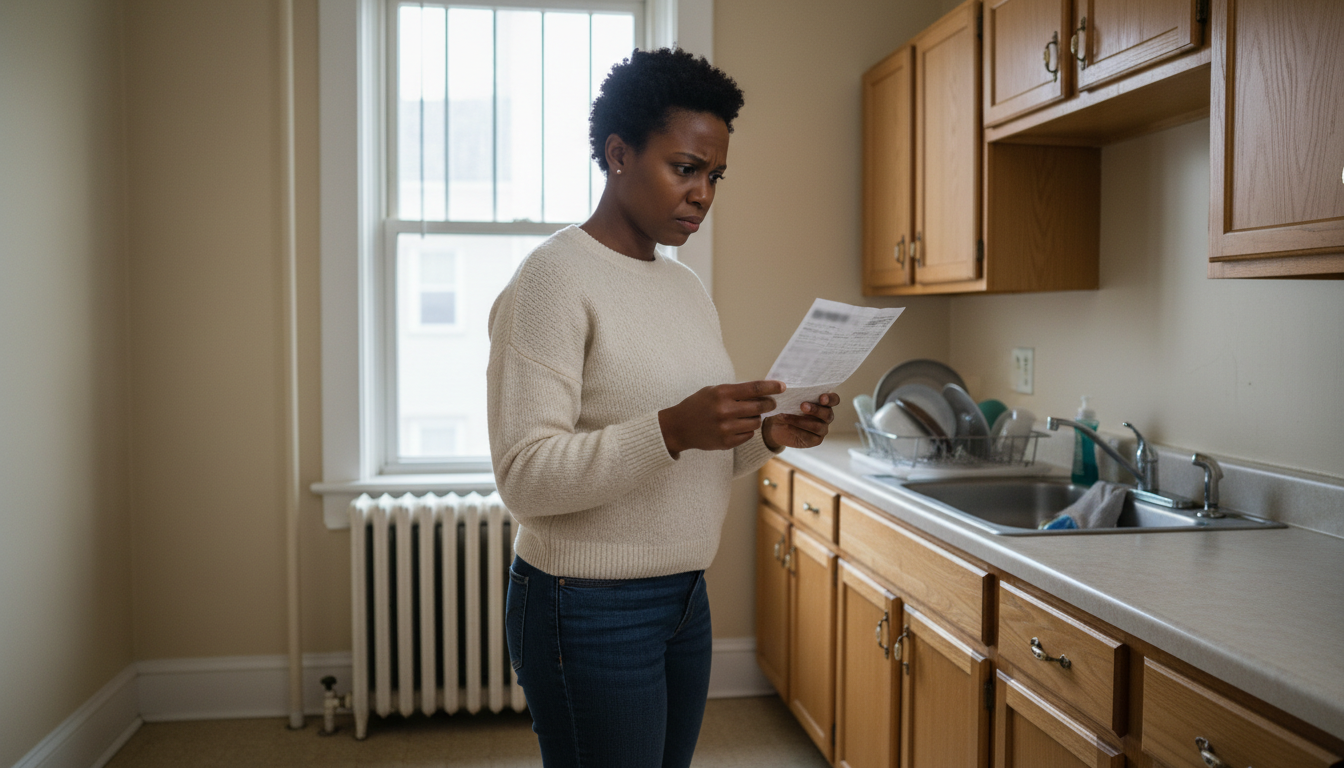
Your first bill lands at $152 for a 370-square-foot studio with no air conditioning, and a friend a block away is paying $25.
This guide covers both halves of that moment: how to work out whether your Boston electric bill is actually wrong, and who has to pay if it turns out to be. In Massachusetts, the answer to the second question is often not the tenant.
Most advice on this question assumes the problem is you: your thermostat, your old fridge, the things you left plugged in. Sometimes it is. But when the numbers are wildly out of line with an apartment of that size, the more likely explanation is that the meter is measuring electricity that isn't yours. Paying for it separately is the norm here, not the exception: across active Boston rental listings on Spot Easy, only about 5% include electricity in the rent, so a bill in your own name isn't unusual. A bill that doesn't add up still is.
First, the ordinary explanations
Before reaching for the regulations, rule out the mundane causes. Sometimes one of these is the whole answer, and it saves you a difficult conversation with your landlord.
- Your billing period may start before your lease did. Utility accounts and leases don't always line up. If your service began on the first of the month but you moved in on the tenth, you may be paying for days when someone else, or an empty apartment with the fridge running, was drawing power.
- The reading may be estimated, not actual. Utilities estimate when they can't access a meter, then reconcile later against a real reading. A period of low estimates followed by a correction can produce one alarming bill that isn't wrong so much as late.
- You may have inherited a balance. If the account transferred rather than opening fresh, an earlier unpaid amount can ride along on your first statement.
- Something in the apartment may be failing. An ageing refrigerator, a water heater on its way out, or an electric baseboard you didn't know was live can add a lot without you noticing. This is the one cause on the list that's genuinely yours, and it's worth ruling in or out early.
If none of those fit, particularly if your usage is high and steady while the apartment is small and mostly empty, it's worth looking at what the meter is actually connected to.
Work out which problem you actually have
Different symptoms point at different causes, and the check for each is different. Find the row that matches what you're seeing.
| What you're seeing | What it probably is | How to check |
|---|---|---|
| Bill far above neighbors in similar units | Possible cross-metering: your meter may serve more than your apartment | Identify your meter, then run the breaker test below |
| Service period starts before your move-in date | Billing period vs. lease start | Compare the service start date on the bill against your lease start date |
| Bill marked "estimated" | Estimated reading | Submit an actual meter reading and ask for the bill to be recalculated |
| Meter hasn't moved but you're being billed | An estimate being corrected | Ask the utility to reconcile the account against actual readings only |
| High, steady usage with almost nothing running | A failing appliance or an unknown load | Request an energy audit through your utility |
The last row matters even when you suspect something worse: an audit produces a written record of what your apartment actually draws, which is useful evidence whichever direction the problem turns out to lie in.
In Massachusetts, whose electricity is it?
Massachusetts law puts this responsibility on the landlord far more often than most renters realize, which is the reason this article exists.
The Massachusetts State Sanitary Code sets out who has to supply the electricity in a rented home. The default is the owner. The responsibility only shifts to you when two separate conditions are both satisfied.
Under 105 CMR 410.354(A) of the Massachusetts State Sanitary Code, the owner must provide the electricity and gas used in each dwelling unit unless both of the following are true: the electricity is metered through a meter that serves only that dwelling unit (or space under that occupant's exclusive use), and a written letting agreement provides for payment by the occupant.
Read that as two hurdles rather than one. Most people assume the question is simply "is there a meter with my name on it?", but a meter in your name that also feeds the hallway doesn't satisfy the first condition, and a properly separate meter with nothing in writing doesn't satisfy the second.
The same regulation adds a duty on the other side of it: where the owner isn't the one paying, the owner must install and maintain the wiring so that the electricity used in the unit is metered through meters serving only that unit. Getting the wiring right is explicitly the owner's job, not something a tenant is expected to discover.
What "serves only your unit" actually means
This is where Boston's housing stock becomes relevant. A great deal of the city's rental supply is older buildings subdivided over decades: three-deckers carved into more units than they were built for, single-family homes converted to apartments, basements finished long after the wiring went in. Every one of those conversions is an opportunity for a circuit to end up on the wrong meter.
The things that most commonly turn up on a tenant's meter by mistake:
- Hallway, stairwell and porch lighting, which often runs continuously
- Basement equipment: a sump pump, a shared washer or dryer, a boiler's controls
- Exterior lighting and outlets, including a garage or driveway
- An outlet or two in a neighboring apartment, which is more common than it sounds in a building where walls were moved
None of these need to be deliberate. Most cross-metering is old wiring and sloppy conversion work rather than anything anyone did on purpose. That's worth remembering when you raise it: an accusation gets a defensive answer, and a question usually gets a look at the panel.
The second condition people miss
Even a perfectly separate meter doesn't automatically make the bill yours. The regulation also requires a written letting agreement providing for payment by the occupant. If your lease is silent on electricity, that's worth noticing before you assume the charge is properly yours.
Read what your lease actually says about utilities: which ones you pay, which are included, and whether it addresses electricity at all. In the case that opened this article, the renter's lease included heat and hot water, which makes an unexplained electric bill more curious rather than less.
How to find out what your meter actually serves
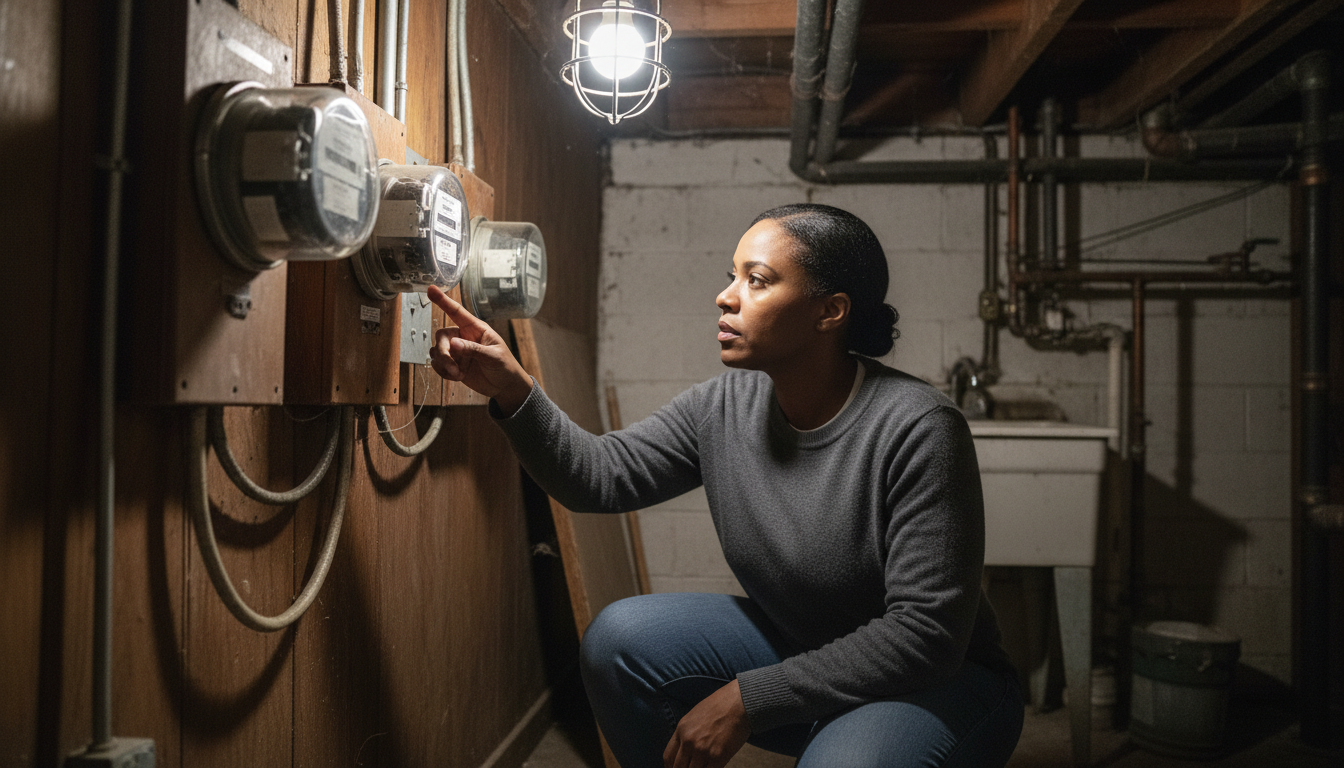
You can do most of this yourself in an evening.
Find your meter number and match it to your bill
In a multi-family building the meters are usually banked together in the basement, a utility closet, or outside. Each has a serial number on the face. Your bill carries a meter number too. Match them. If the meter you've been told is yours has a different number from the one on your bill, stop there. That alone explains a lot of anomalous bills, and it's a straightforward thing to raise.
Labels on the meter bank are worth nothing on their own. They're often handwritten, frequently decades old, and get copied forward through changes of ownership without anyone re-checking them.
The breaker test, and what it can and can't tell you
With the meter identified, turn off the main breaker for your apartment and watch the meter. A modern digital meter should stop registering usage; a disc meter should stop spinning. If it keeps running with your entire apartment dead, something outside your apartment is on your meter.
Two honest limits. The test proves that something else is drawing power, but not what, so you'll still need the utility or an electrician to trace it. And a small load, like a single hallway LED, may not move the meter visibly in a few minutes, so the test can produce a false all-clear. A clean result makes cross-metering less likely, not impossible.
What to ask the utility, and what to ask your landlord
Contact your utility and tell them plainly what you've observed: the meter number on your bill, the meter you tested, and what happened when your power was off. Ask them to investigate whether the meter serves anything beyond your unit, and ask for the outcome in writing. If you also want to rule out a failing appliance, ask about an energy audit at the same time.
Separately, and in writing, ask your landlord or property manager what your meter serves and whether the wiring has been checked since the building was last divided. Email rather than a phone call, not because you're building a case, but because it dates the request and records the answer.
What to do next, and where the answers stop
If the utility confirms your meter serves more than your apartment, you're no longer troubleshooting a bill. You're in a question about who owes what, and that's where a general article has to stop being specific.
The Sanitary Code sets out who must supply the electricity. What it doesn't settle is the money: how far back any adjustment reaches, whether it comes from the utility or the landlord, and what you can actually recover. That depends on your circumstances, your lease, and rules on utility billing that sit outside the Sanitary Code entirely. Don't assume a number, and don't let anyone tell you there's a standard one.
There are two separate avenues here, and it matters which one applies. The Massachusetts Department of Public Utilities takes consumer complaints about utility billing, and small claims court exists for money disputes of modest size. Which of those fits, if either, depends on whether your quarrel is with the utility's billing or with your landlord's wiring.
For free, Massachusetts-specific guidance, Mass Legal Help is the best starting point, and a tenant-rights attorney or a local housing organization can tell you where you actually stand. One thing to raise with them rather than act on alone: withholding rent over a utility dispute is narrow and risky in Massachusetts, and getting the conditions wrong can put your tenancy at risk. It is not a step to take on the strength of a blog post.
FAQ
Is my landlord allowed to bill me for common area electricity?
Not by default. Under 105 CMR 410.354(A) the owner must supply the electricity used in a dwelling unit unless it's metered through a meter serving only that unit and a written letting agreement puts payment on the occupant. A meter that also feeds a hallway or basement doesn't meet the first condition.
How do I know if I have a shared meter?
Match the meter number on your bill to the physical meter, then switch off your apartment's main breaker and watch it. If it keeps registering usage with your apartment completely off, something outside your apartment is on your meter. Ask your utility to investigate and confirm in writing.
My bill says "estimated." Do I have to pay it?
An estimated reading isn't necessarily wrong, but it can be corrected. Submit an actual reading and ask the utility to recalculate. If a later "actual" reading produced a large catch-up charge, ask them to reconcile the account against real readings.
Why is my bill so much higher than my neighbor's in the same building?
Similar apartments should produce broadly similar bills. Large, persistent gaps point at either a failing appliance drawing power continuously or a meter serving more than your unit. The breaker test distinguishes them quickly.
Can I be charged for electricity used before I moved in?
Compare the service start date on your bill with your lease start date. If service began earlier, raise it with the utility: you may be paying for a vacant period or the previous tenant.
Does it matter what my lease says about utilities?
Yes, and more than most renters realize. Even a properly separate meter only shifts the cost to you if a written letting agreement provides for it. If your lease doesn't address electricity, that's worth asking about.
Who do I complain to if the landlord won't fix the wiring?
Start with your utility, which can investigate what the meter serves. The Massachusetts Department of Public Utilities handles utility billing complaints, and Mass Legal Help or a tenant-rights attorney can advise on what to do about the landlord specifically.
This article is informational and isn't legal advice. The Massachusetts State Sanitary Code (105 CMR 410) was amended in 2023, so confirm the current text and how it applies to your situation with Mass Legal Help, the Massachusetts Department of Public Utilities, or a tenant-rights attorney.