

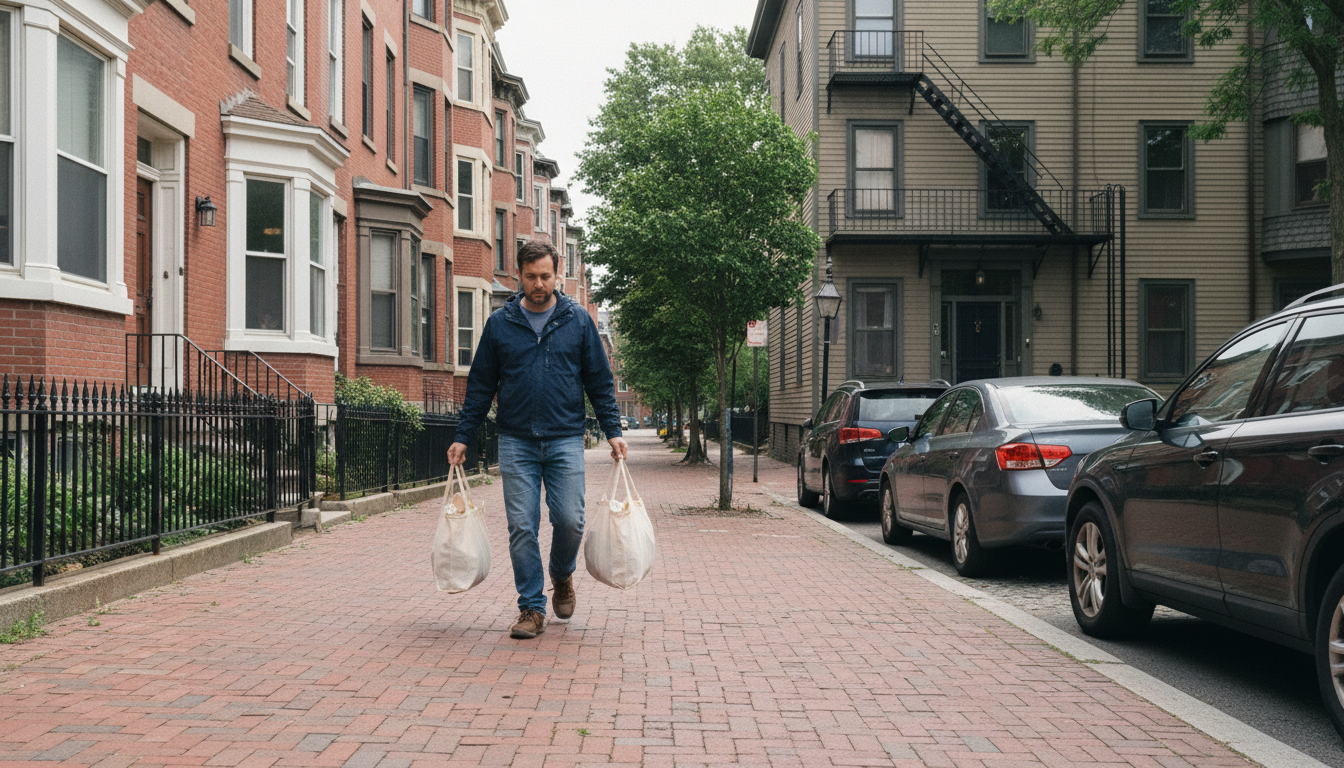
Every apartment-hunting checklist tells you to see whether there's a grocery store nearby. In Boston, that question is almost always answered yes, and it almost never tells you anything useful.
Ask people who live in the densest, most developed parts of Greater Boston what's missing from their neighborhood and you'll get a surprisingly consistent answer. Not another restaurant. Not another service. What they miss is "a grocery store that wasn't overly expensive or speciality, just a normal grocery store." In Kendall Square, one of the most built-up neighborhoods in the region, people still talk about the ordinary supermarket that used to be in walking distance and isn't anymore. The food retail is all still there. The affordable food retail left.
That's the gap this article is about. When you're comparing two apartments, the grocery question worth asking isn't whether there's a store nearby. It's which one — because the difference between the chains is large, it's geographic, and once you sign a twelve-month lease you've locked it in.
Why "is there a grocery store nearby" is the wrong question
The checkbox comes from national apartment-hunting advice, and in a car-dependent city it makes sense: if you drive, every store within fifteen minutes is equally available to you, so proximity is the only variable that matters.
Boston doesn't work that way. Plenty of renters here don't have a car, and even those who do think twice about driving and parking for a weekly shop. What that means in practice is that your walkable store, or the one on a bus route you'll actually use, becomes your default store. Not your preferred store. Your default one, for as long as you live there.
And unlike almost every other cost in an apartment hunt, this one is invisible at the showing. You can see the rent, ask about utilities, count the outlets. Nobody hands you a sheet showing that the only supermarket you can reach on foot charges meaningfully more than the one two neighborhoods over.
What the price gap actually costs
This is where it stops being a vibe and becomes a number.
Boston Consumers' Checkbook shops local supermarkets using a 150-item list and compares each chain against the all-store average. As of its November 2025 update, the spread across Greater Boston looked like this:
| Chain | Price vs. all-store average |
|---|---|
| ALDI | 28% lower |
| Price Rite | 17% lower |
| Market Basket | 15% lower |
| Walmart | 10% lower |
| Hannaford, Target | 8% lower |
| Wegmans, Trader Joe's, Shaw's | around average |
| Whole Foods | 17% higher |
| Roche Bros. | 18% higher |
Look at the top and bottom of that table rather than any single row. The distance between the cheapest chain and the most expensive one is roughly 46 percentage points. That is not a rounding error on your grocery bill; it's a different grocery bill.
Checkbook puts the savings in concrete terms: for a household spending about $300 a week on groceries, a 17% price difference works out to roughly $2,652 a year. For most Boston renters, that's around 6% of the roughly $3,600 average monthly rent for an active Boston listing on Spot Easy, spent or saved entirely as a side effect of where you signed.
Two honest caveats. These figures are a snapshot from late 2025, and grocery prices move; treat the ranking as more durable than the exact percentages. And a cheaper basket isn't automatically the right call for everyone — price is one factor among several, and quality, selection and sheer convenience all legitimately matter too. The point isn't that you should shop at the cheapest store. It's that you should know which one you're choosing before the lease decides for you.
The one that surprises people: Trader Joe's
If you assumed Trader Joe's was the budget option, you're in large company, and by this measure you'd be wrong. Checkbook puts it at roughly average — in the same range as Wegmans and Shaw's, well behind ALDI, Price Rite and Market Basket.
It's worth knowing because Trader Joe's is often the store people cite as proof that a neighborhood is affordable to live in. It's a genuinely good store. It is not a discount one.
Where the affordable stores actually are

Here's the part that matters for choosing a neighborhood: the cheap end of that table is not evenly distributed across Greater Boston.
The value tier tends to ring the city rather than sit inside it. Market Basket's nearby stores are in places like Union Square in Somerville, Chelsea, Revere and Waltham — the cities and inner suburbs around Boston rather than the core neighborhoods. If you live in Somerville, Chelsea or Revere, a value-tier store is plausibly a walk or a short bus ride. If you live in much of Boston proper, it isn't, and that changes your default store.
The mid tier is the default almost everywhere. Star Market, Shaw's and Stop & Shop have the broadest footprint across Boston's neighborhoods, and for most renters one of them will be the closest option. That's a perfectly reasonable place to shop — it's just squarely mid-priced, which is worth knowing rather than assuming.
The premium tier clusters exactly where renters want to live. Whole Foods and Roche Bros., the two chains at the expensive end of Checkbook's table, are concentrated in the dense, desirable, transit-rich neighborhoods that also command the highest rents. In some of those neighborhoods, a premium store is genuinely the only supermarket within comfortable walking distance. That's the specific situation worth catching before you sign, because you'd be paying a premium twice: once in rent, once at the register.
And there's an underrated tier most guides skip. Ethnic and international grocers, H Mart and the many independent markets across Greater Boston, are often dramatically cheaper on produce, rice, noodles and staples than any conventional supermarket, and they're distributed differently than the chains are. Haymarket, the open-air produce market near Faneuil Hall, has been Boston's cheapest produce for generations. Neither shows up on a "nearest grocery store" search in any useful way, and both can change the math for a neighborhood that looks expensive on paper.
How to check this for a specific apartment in ten minutes

You don't need to research a whole neighborhood. You need to research one address.
- Map from the exact address, not the neighborhood. Two apartments a half-mile apart in the same neighborhood can have completely different walkable options. Drop the actual street address into a map and search for supermarkets.
- Sort what comes back into the tiers above. You're not asking "how many stores are near?" You're asking "what's the cheapest chain I could genuinely reach on foot or on one bus?"
- Check the chain's own store locator. Map apps miss stores and keep closed ones. If a value-tier store looks reachable, confirm it exists at that location on the chain's site.
- Walk the actual route once. Fifteen minutes on a map can be an unpleasant walk with two full bags, uphill, across a six-lane road. Do it during your showing visit.
- Price your own basket. Not a theoretical one — the ten or fifteen things you actually buy every week. Check them at the two nearest stores. Twenty minutes online will tell you more about your real cost of living there than any neighborhood guide.
If the cheap store isn't walkable
Sometimes you love the apartment and the grocery answer is mediocre. That's a normal trade-off, not a dealbreaker — but make it deliberately, and know your workarounds.
- A bus route counts. A value-tier store one direct bus ride away, with a stop near your door, is a genuinely workable default. A store that requires a transfer usually isn't — you won't do it.
- Shift to a bigger, less frequent shop. If the cheap store is a monthly trip rather than a weekly one, non-perishables and freezer staples come from there and the expensive local store handles milk and produce. This is what a lot of car-free Boston renters actually do.
- Count delivery honestly. Delivery is a real option, but service fees, markups and tips add up fast and can quietly erase the savings you were chasing. If it's part of your plan, price it as a monthly line item, not a convenience.
- Use the underrated tier. An international market or a Haymarket run can cover produce and staples cheaply even in a neighborhood where the chains are all expensive.
If you're weighing a place where the affordable supermarket is a bus ride rather than a walk, transit access stops being a commuting question and becomes a grocery one too. Spot Easy lists Boston apartments by MBTA and Commuter Rail proximity, without the broker fee on partner units.
Weighing it against rent
Put the two numbers next to each other, because renters almost never do.
Suppose one apartment is $75 a month cheaper, and its only walkable supermarket is a premium chain, while the pricier apartment sits near a value-tier store. On Checkbook's spread, a household spending a few hundred dollars a week on groceries can easily see a difference of well over $75 a month between those two tiers. The "cheaper" apartment can be the more expensive place to live — and it stays that way for the whole lease.
Groceries shouldn't outrank rent, commute or condition in your decision. But the number belongs in the decision, instead of being a checkbox you tick at the showing and discover the truth about in month three.
FAQ
What's the cheapest grocery store in the Boston area? By Consumers' Checkbook's November 2025 comparison of a 150-item basket, ALDI came in about 28% below the all-store average, followed by Price Rite (17% below) and Market Basket (15% below). The catch is geographic: the cheapest chains aren't within walking distance of every neighborhood.
Is Trader Joe's cheap? Not especially, by this measure. Checkbook puts Trader Joe's at roughly the all-store average — comparable to Wegmans and Shaw's, and well above ALDI, Price Rite and Market Basket. It's a well-liked store, not a discount one.
Is there a Market Basket in Boston? The nearby Market Basket stores are in the cities ringing Boston, such as Somerville's Union Square, Chelsea, Revere and Waltham, rather than in Boston's core neighborhoods. Check the chain's store locator against your specific address before assuming one is walkable.
How much can the store I live near actually cost me? Consumers' Checkbook estimates that for a household spending about $300 a week, a 17% price difference adds up to roughly $2,652 a year. The full spread between the cheapest and most expensive chains in its table is around 46 percentage points.
What if I don't have a car? Then your walkable store, or the one on a single direct bus route, effectively becomes your default. Prioritize apartments where a value- or mid-tier store is genuinely reachable on foot or one bus, and treat anything requiring a transfer as unrealistic for a weekly shop.
Do delivery services solve this? Partly, but price them honestly. Service fees, per-item markups and tips can add up to more than the savings you were chasing. If delivery is central to your plan, budget it as a recurring monthly cost.
Where should I look besides the big chains? International and ethnic markets across Greater Boston are frequently much cheaper on produce and staples than conventional supermarkets, and Haymarket near Faneuil Hall is a long-standing source of very cheap produce. Neither turns up usefully in a "grocery store near me" search, so look for them deliberately.
This article is informational and isn't legal advice. Grocery prices and store locations change — confirm current prices and locations with the chains directly before making a decision based on them.