

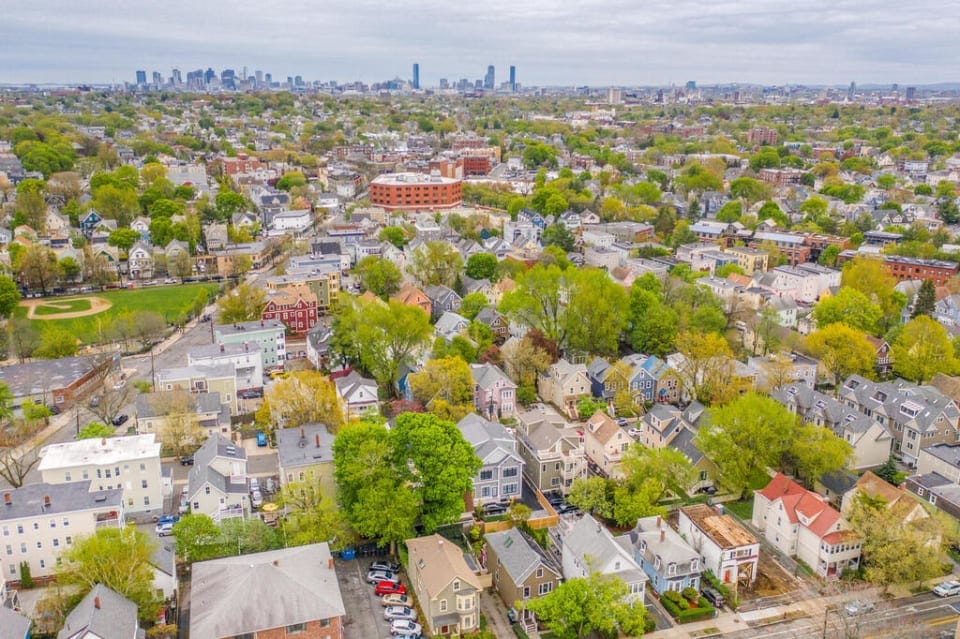
A one-bedroom in Somerville averages $2,563 across Spot Easy listings. Published figures elsewhere put the same apartment several hundred dollars higher, because they count a different slice of the market, and understanding that gap is the most useful thing a Somerville renter can know before setting a budget.
This guide covers what renting here actually costs, why the numbers you'll find disagree, how the squares differ from each other, and the calendar the whole market runs on.
What it costs to rent in Somerville
By bedroom
These are Spot Easy's own figures, averaged across active and recently rented Somerville listings over the 30 days to August 27, 2026.
| Size | Average asking rent |
|---|---|
| 1 bedroom | $2,563 |
| 2 bedroom | $3,264 |
| 3 bedroom | $3,806 |
| 4+ bedroom | $4,624 |
Studios are left out because Somerville has too few of them on the market to average honestly. Our Somerville rent index is rebuilt monthly and carries the studio figure whenever the sample supports it.
Why published rent figures for Somerville disagree
Some published rent figures count only large apartment buildings, often those with 50 or more units. Somerville barely has any. The city is overwhelmingly two- and three-family houses and small buildings, so a large-building sample captures newer developments that are a real part of the market but a small and unrepresentative one.
Others count every listing type, and land lower, because they include the triple-decker floors that most of Somerville actually is.
What this means for you: if you're budgeting for a triple-decker apartment, which is what most of Somerville is, a large-building figure will overstate what you need. If you're looking at newer amenity buildings, an all-listings figure will understate it. Match the figure to the kind of apartment you're actually renting.
The Spot Easy figures above count every listing type in Somerville, which is why they sit closer to what a triple-decker floor actually rents for.
This is also why published trend lines can point in opposite directions in the same year. A sample of large newer buildings and a sample of everything can genuinely move different ways, especially while new construction is being absorbed.
What changed in a year
Somerville rents did not move in one direction over the past year. Comparing listings that came on market in the first four weeks of August, 2026 against 2025:
| Size | Change, August 2025 to August 2026 |
|---|---|
| 1 bedroom | +1.4% |
| 2 bedroom | +2.3% |
| 3 bedroom | −4.8% |
| 4+ bedroom | +0.9% |
A single citywide average would have shown roughly a 1.5% rise and hidden the one real move in the data: three-bedrooms came down almost 5% while smaller units drifted up. That is the same sampling problem described above, happening inside one source.
What sits on top of the rent
The monthly figure is not what you need saved. Expect first month, last month and a security deposit at signing, which is roughly three times the monthly rent before anything else, plus a broker fee if one applies.
Utilities vary enormously by building, and in Somerville's older stock the difference between heat included and heat not included is one of the biggest swings in your real monthly cost over a winter. Ask before you sign, not after.
For what you need to earn and have saved to clear a Boston-area landlord's screening, see our guide to income and move-in costs. For how Somerville compares on price to its obvious alternative, Cambridge vs. Somerville does that directly, and comparing Somerville to other expensive areas in Massachusetts puts it in state context.
The calendar you're renting against
Greater Boston turns over on September 1. The overwhelming majority of leases start that day and end August 31, which means Somerville's rental market arrives as a wave rather than a trickle.
For a September move, start looking in earnest between January and March, and be ready to apply the same day you tour. By May most of the good September inventory is signed. For any other move-in month you are outside the wave and 30 to 60 days is usually enough.
The practical consequence is that a Somerville apartment search is not a browsing exercise. Inventory appears, moves and disappears on a schedule, and being early is worth more than being clever.
The squares, and how they differ
Somerville is organized around its squares, and they are the useful unit for a search. What follows compares them on what you can verify before signing.
Where a rent band is shown it is relative, not a figure. Neither of the sources above publishes neighborhood-level rents for Somerville, and inventing them on a page about rent-data honesty would be self-defeating.
| Square | Transit | Getting downtown | Rent band | Housing stock |
|---|---|---|---|---|
| Davis Square | Red Line | Direct on the Red Line | Higher | Mix of older two- and three-family houses and low-rise blocks |
| Porter Square | Red Line, Commuter Rail | Direct, plus rail north | Higher | Mixed; two- and three-family with some larger buildings |
| Union Square | Green Line | Green Line through Lechmere | Mid to higher | Older housing with substantial newer development around the square |
| Magoun Square | Green Line | Green Line through Lechmere | Mid | Predominantly older two- and three-family |
| Gilman Square | Green Line | Green Line through Lechmere | Mid | Older housing stock, largely two- and three-family |
| Ball Square | Green Line (station is in Medford) | Green Line through Lechmere | Mid | Older housing on both sides of the city line |
| Teele Square | Bus; walk to Davis | Via Red Line at Davis | Lower to mid | Mostly older two- and three-family houses |
| East Somerville | Green Line | Green Line through Lechmere | Lower to mid | Predominantly older two- and three-family |
| Winter Hill | Bus; walk to Gilman or Magoun | Via Green Line | Lower to mid | Older housing stock |
| Assembly Square | Orange Line (Assembly) | Direct on the Orange Line | Mid to higher | Almost entirely new construction, mid- and high-rise |
The single biggest lever on your daily life is walking distance to a station, not which square you nominally live in. Two apartments in the same square can differ by fifteen minutes of door-to-door commute depending on which end of it they sit.
The Green Line Extension changed this map considerably, and which neighborhoods gained a station is covered in living near the Green Line Extension.
What the housing stock is actually like
This matters more in Somerville than in most places, because the buildings are old and consistent in a way that shapes the experience.
Most of it is two- and three-family houses. The triple-decker is the characteristic Somerville building, and a large share of the rental market is a floor of one. That usually means more space per dollar than a comparable apartment building, and it also means you hear your neighbors, share a driveway, and deal with a small landlord rather than a management company.
Old buildings behave like old buildings. Radiators, variable insulation, original windows more often than not, and frequently no central air. None of that is a dealbreaker, but it affects your winter bill and your summer comfort, and it is worth asking about specifically.
In-unit laundry is a premium. Check whether it is in the unit, in the basement, or down the street.
Newer construction exists but is concentrated. Mostly around Union Square and toward the Cambridge line. If amenities matter to you, that is where to look, and the rent bands reflect it.
Getting around
Somerville is unusually well served for a city its size. Three rapid transit lines touch it: the Red Line along its western edge at Davis and Porter, the Green Line Extension through the middle and north, and the Orange Line at Assembly on its eastern side.
That third one is easy to overlook. Assembly is the only Orange Line stop in Somerville, it connects directly into downtown, and the housing around it is almost entirely new construction rather than the triple-deckers that dominate the rest of the city. If you want an amenity building on a direct downtown line, that is where to look, and it is a different kind of Somerville apartment from everywhere else on the table above.
How walkable it is on foot, separately from the rail, is covered in our guide to walkability in Somerville.
If you drive, research parking before you sign. Somerville runs a resident permit system, spaces near the busier squares are genuinely contested, and street cleaning and winter snow emergencies both move parked cars.
If a specific square is what's driving your search, it's worth filtering by transit access rather than by neighborhood name — walking distance to a station varies a lot within one square. Spot Easy lists Boston-area apartments by proximity to the T, with no broker fee on partner units.
What you need ready to sign
Somerville apartments move in days during the season, so the applicant with a complete file beats the applicant with a better story.
Have these as PDFs before you tour: recent pay stubs or an offer letter, photo ID, and references. Most landlords will also run credit. If you're renting from a small owner rather than a management company, which is common here, expect a less formal process but the same underlying questions about whether you can pay.
Where to go next
This page is the overview. Each of these goes deeper:
- Cost: income and move-in costs · Cambridge vs. Somerville · Somerville vs other expensive Massachusetts areas
- Transit: the Green Line Extension · walkability in Somerville
- Negotiating: negotiating rent when your landlord is one person
- Comparing: Somerville vs. Cambridge for Harvard students · Somerville vs. Allston for MIT students
- Timing: when to start your search
Frequently asked questions
How much is rent in Somerville? Across Spot Easy listings over the past 30 days, a one-bedroom averages about $2,563 and a two-bedroom about $3,264. Three-bedrooms run to roughly $3,806.
Why do rent websites disagree about Somerville? Because they sample different slices of the market. A figure drawn only from large apartment buildings runs high for Somerville, which is mostly two- and three-family houses. A figure that counts every listing type runs lower.
Which average should I budget from? Whichever matches the kind of apartment you're actually looking at. For a triple-decker floor, an all-listings figure like ours is closer. For a newer amenity building, a large-building figure is.
When should I start looking for a September 1 apartment? January to March. By May most of the good September inventory is gone.
Which Somerville squares are cheapest? Rent bands are generally lower away from the Red Line and toward the northern and eastern squares. We do not publish a per-square rent figure, because no single square has enough listings to average honestly, so treat that as a pattern rather than a figure.
Do I need a car in Somerville? Many renters don't. The Red Line runs along the western edge and the Green Line Extension through the middle and north. If you do drive, research the resident permit system before you sign.
What is a triple-decker like to rent? Usually more space per dollar than a comparable apartment building, with the trade-offs of an older building: audible neighbors, shared entry, radiator heat and often no central air.
Sources, and when this was current
Written August 2026.
Rent figures are Spot Easy's own, averaged across active and recently rented Somerville listings over the 30 days to August 27, 2026, counting every listing type in the city. The year-over-year table compares listings that came on market between August 1 and 27 in each of 2026 and 2025. Studios are omitted from both tables because the sample is too small to average honestly.
Rent bands by square are relative and are not published figures. No individual Somerville square has enough listings to average honestly, and we have not invented numbers to fill that gap.
Rents move monthly, and the figures above are a dated snapshot. Our Somerville rent index is rebuilt monthly, and is the place to check the current number for your bedroom count before you budget.