

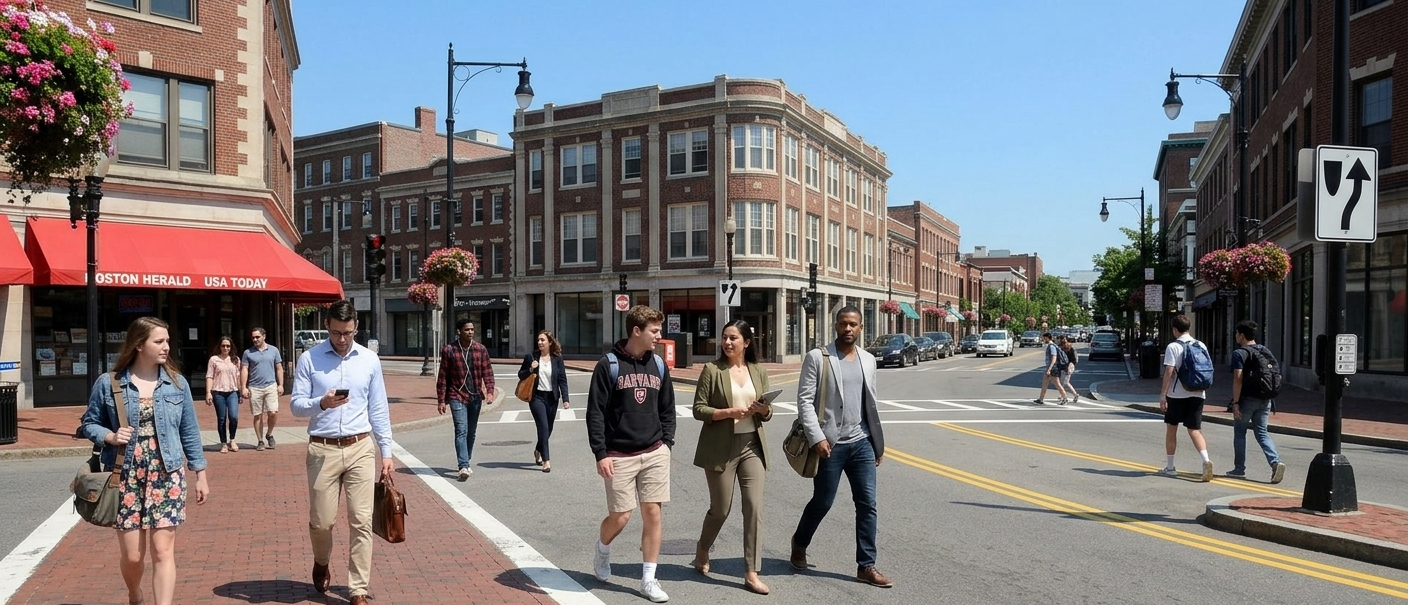
Cambridge posts a citywide Walk Score of 90 — a genuine "Walker's Paradise" rating and one of the highest of any city in Massachusetts. Unlike Boston's wide spread between its top and bottom neighborhoods, Cambridge is remarkably consistent: nearly every square in the city scores well into the 90s. That consistency comes from Cambridge's compact size and its square-based layout: Harvard, Central, Porter, Inman, Kendall, and the streets radiating from each. This guide breaks down how those squares actually compare, and what walkability looks like on the ground in each one.
Key features of a walkable Cambridge neighborhood
Cambridge's walkability comes from the same formula that works everywhere: density, mixed-use streets, and short blocks. What sets Cambridge apart is how evenly this is distributed. The city's squares function almost like a string of small, self-sufficient downtowns, each with its own retail corridor, restaurants, and transit access, connected to each other by a short walk or a quick bus or train ride. Cambridge's Red Line spine, running the length of the city, reinforces this pattern rather than working against it.
Cambridge's overall Walk Score
At 90, Cambridge ranks among the most walkable cities in Massachusetts, narrowly ahead of Somerville's 89 and well ahead of Boston's citywide average of 83. The city's Bike Score of 96 is especially notable; Cambridge is one of the most bikeable cities in the country. The table below shows how six of Cambridge's best-known squares compare.
| Neighborhood | Walk Score | Transit Score | Bike Score |
|---|---|---|---|
| Central Square | 99 | 72 | 99 |
| Inman Square | 97 | 68 | 100 |
| Porter Square | 96 | 72 | 97 |
| Harvard Square | 96 | 80 | 97 |
| East Cambridge | 93 | 69 | 96 |
| Kendall Square | 87 | 71 | 97 |
Scores reflect walkscore.com's published neighborhood rankings for Cambridge, MA.
Cambridge's squares, compared
Harvard Square
Harvard Square scores 96 for walkability, with the highest Transit Score on this list at 80. It's a major Red Line stop just south of the line's northern terminus at Alewife, and one of the busiest bus hubs in the entire MBTA system, with numerous routes converging here. Bookstores, cafes, and Harvard University's campus itself keep the square dense with foot traffic well into the evening. Trader Joe's and a cluster of pharmacies and small grocers cover day-to-day errands without needing to leave the square.
Central Square
Central Square ties for the top spot on this list with a Walk Score of 99, a true Walker's Paradise, and one of the most diverse retail and dining corridors in Cambridge. It's served directly by the Red Line's Central station, and its Bike Score of 99 reflects heavy everyday cycling traffic. Whole Foods and H Mart both anchor the square for groceries, alongside a dense strip of restaurants and shops along Massachusetts Avenue.
Kendall Square
Kendall Square scores 87, still solidly walkable, though the lowest of the six squares on this list. It's anchored by MIT and a fast-growing biotech and tech campus, served directly by the Red Line's Kendall/MIT station. What Kendall trades for in walkability compared to Cambridge's older squares, it makes up for with newer infrastructure: wide sidewalks, bike lanes, and proximity to the CambridgeSide retail area and a Trader Joe's just across the Charles.
Porter Square
Porter Square scores 96, tied with Harvard Square, and benefits from a rare combination: Red Line subway access plus Commuter Rail service on the Fitchburg Line, both from the same station. The Porter Square Shopping Center, anchored by a Star Market, sits right at the square, making it one of the more errand-friendly stops on this list.
Inman Square
Inman Square posts the highest Bike Score in Cambridge at 100 and a Walk Score of 97, but its Transit Score of 68 is the lowest of the six. Notably, Inman Square has no direct subway stop of its own. Bus routes 69, 83, 91, and 85 serve the square directly, and the nearest T stations (Central Square on the Red Line, or Union Square on the Green Line Extension) are each a short walk away. What Inman lacks in direct rail access, it makes up for with one of Cambridge's most walkable, restaurant-dense micro-neighborhoods.
East Cambridge
East Cambridge scores 93, and its transit picture changed substantially in 2022 with the opening of Lechmere station as part of the Green Line Extension, serving the D and E branches. That's on top of proximity to the Red Line's Kendall/MIT station. The CambridgeSide Galleria and a nearby Whole Foods cover the neighborhood's grocery and retail needs, alongside the growing NorthPoint development.
Benefits of walkability in Cambridge
Health and lifestyle advantages
Cambridge's square-based layout means walking is built into daily life almost by default — to class, to the Red Line, to dinner. That kind of routine physical activity, without requiring a dedicated trip to a gym, is one of the quieter benefits of living somewhere this walkable.
Environmental impact
With a citywide Bike Score of 96 on top of its Walk Score, Cambridge residents have more reason than most to leave a car parked, or skip owning one entirely. Fewer car trips citywide means a smaller collective carbon footprint.
Economic benefits
Cambridge's most walkable squares also tend to be its most in-demand for renters, but the flip side is real savings on transportation: less spent on gas, parking, and car maintenance for residents who can walk, bike, or take the Red Line for most of what they need.
Public transportation and accessibility
The Red Line and MBTA bus network
The Red Line is the backbone of Cambridge's transit system, running directly through Harvard, Central, and Kendall Squares before continuing into Boston. Porter Square adds Commuter Rail into the mix. Where the Red Line doesn't reach directly, such as around Inman Square, a dense bus network fills the gap.
Biking in Cambridge
Cambridge's Bike Score of 96 citywide reflects real investment: protected bike lanes, especially along Massachusetts Avenue and the Charles River, plus bike-share stations distributed across every square on this list. Inman Square's perfect 100 Bike Score is a direct result of this infrastructure combined with its central, flat location.
Connectivity across squares
Cambridge's squares aren't isolated. A few Red Line stops connect Harvard, Central, and Kendall directly, and the bus network stitches in Porter, Inman, and East Cambridge just as easily. It's realistic to live in one square and regularly walk, bike, or bus to another for work, shopping, or dinner.
Living in Cambridge: what to expect
Safety and walkability
Cambridge's dense, active squares generally mean more people on the street at any given hour, which tends to support a stronger everyday sense of safety compared to quieter, car-dependent areas.
Rental prices in walkable areas
Rent in Cambridge doesn't track walkability as cleanly as you'd expect. Central Square is genuinely the priciest of the six squares, averaging around $4,460 a month, driven by its density and proximity to both Harvard and MIT. East Cambridge runs close behind at roughly $4,350, despite a lower Walk Score than most of the others on this list. Porter Square and Kendall Square land in the middle, both averaging in the high $3,700s — Kendall's biotech boom drives demand, but hasn't pushed its rents past the citywide leaders. Harvard Square, despite its near-perfect walkability and name recognition, is actually the most affordable of the six, averaging closer to $3,470, likely a reflection of its older housing stock and smaller units.
Amenities and services
Every square on this list supports daily errands on foot, but the character varies: Harvard and Central lean academic and eclectic, Kendall leans corporate and modern, Porter and Inman lean neighborhood-scale and residential, and East Cambridge is in the middle of a genuine retail and housing boom around NorthPoint.
Comparisons with other Massachusetts cities
Cambridge vs. Boston
Cambridge's citywide Walk Score of 90 outpaces Boston's 83, but Boston's very best neighborhoods, like Beacon Hill and the North End at 99, match Cambridge's top squares point for point. The difference is consistency: Cambridge stays high across nearly the entire city, while Boston has a much wider range between its most and least walkable neighborhoods.
Cambridge vs. Somerville
Cambridge (90) and Somerville (89) are effectively neck-and-neck, and both significantly outpace Boston's citywide average. Both cities share a Red Line/Green Line Extension backbone and a similarly dense, square-based layout. The choice between them often comes down to cost and specific neighborhood fit rather than walkability itself.
Other walkable areas in Massachusetts
Beyond Boston's core neighborhoods, Cambridge and Somerville together represent the most consistently walkable stretch of Greater Boston. Renters prioritizing walkability above all else will find some of the strongest, most reliable scores in this specific corridor.
Finding a no-broker-fee rental in Cambridge's most walkable squares
Harvard Square, Central Square, and Porter Square are some of the most competitive rental markets in Cambridge, and that competition often comes with broker fees stacked on top of already-high rent. Spot Easy currently lists over 340 active Cambridge apartments, searchable by proximity to Red Line and Green Line Extension stops, with no broker fee on partner units, which matters even more in a market where walkability commands a real premium.
FAQ
What is Cambridge's overall Walk Score?
Cambridge has a citywide Walk Score of 90, rated a "Walker's Paradise."
What is the most walkable square in Cambridge?
Central Square, with a Walk Score of 99.
Does Inman Square have a T stop?
No — Inman Square has no direct subway station. It's served by MBTA bus routes (including the 69, 83, 91, and 85), with the nearest T stations, Central Square and Union Square, each a short walk away.
Is Cambridge more walkable than Boston?
By citywide average, yes — Cambridge's 90 outpaces Boston's 83. But Boston's top individual neighborhoods, like Beacon Hill and the North End at 99, match Cambridge's highest-scoring squares.
Is Cambridge more walkable than Somerville?
They're very close — Cambridge scores 90 citywide against Somerville's 89, a difference small enough that either city delivers a strongly walkable, car-optional lifestyle.
Which Cambridge square has the best transit access?
Harvard Square, with a Transit Score of 80 — it's a major Red Line stop just south of the line's Alewife terminus, and a major MBTA bus hub.
For the wider picture on costs, neighborhoods and the September 1 calendar, see our guide to renting in Cambridge.