


Most of Back Bay's brownstones were built as single-family houses. They were divided into apartments later, one building at a time, by different people, at different times, with no particular standard.
That one fact explains almost everything a renter needs to know about the neighborhood. No two units are alike, the floor you end up on changes your daily life more than the street does, and two apartments in identical-looking buildings can be completely different products.
If you want the neighborhood on foot, with a block-by-block read of what is walkable from where, we have that in our street-by-street walkability guide to Back Bay. This guide is about the buildings.
In a brownstone, the floor is the product
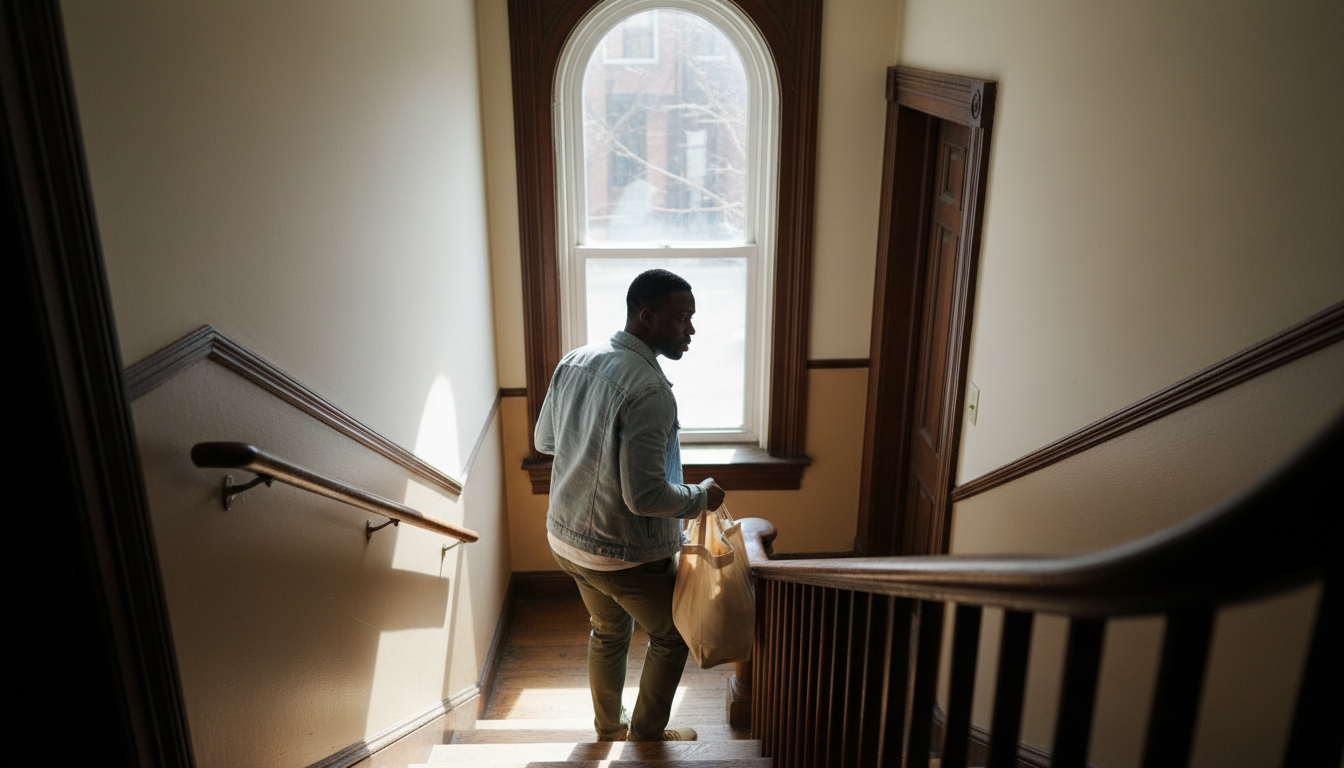
In a Back Bay brownstone, the floor you rent shapes your daily life more than the address does. Garden level, the parlor floor and a top-floor walk-up are effectively three different apartments, at three different prices, inside one house.
Garden level. Below or partly below street level, usually the cheapest unit in the building. Lower ceilings, less light, and the usual questions about damp and street noise at window height. Worth seeing in person and in daylight.
The parlor floor. The original main floor of the house, up the stoop. This is where the high ceilings and the tall bay windows are, and it is usually the most impressive space in the building.
Upper floors. Often the smallest units, carved out of what were bedrooms and servants' quarters. Frequently good light. And frequently no elevator, because a converted townhouse was never built with one.
A four-flight walk-up is ordinary in Back Bay, not unusual. That is fine at twenty-five with a backpack and a different proposition with a bicycle, a large dog, groceries, or a sofa on September 1.
The garden-level question comes up constantly in this neighborhood because those units are the entry point into an expensive area. The wider tradeoffs of renting below street level, including what to check for water and light, are covered properly in our guide to Boston basement apartments.
The practical instruction is simple. Two listings in the same block, same rent, same bedroom count, can be a bright parlor floor and a dim fourth-floor climb. The listing will not always make that obvious, and the floor is the first thing to ask.
There is a second question that follows from the first, which is where the windows face. Back Bay's blocks are deep and the buildings back onto alleys, so a unit at the front looks onto a tree-lined street and a unit at the back of the same building looks onto the alley and the backs of the houses on the next street. Both have their arguments. The front is the view; the back is usually quieter and darker. Neither is signposted in a listing and both are obvious in thirty seconds on a viewing.
The third is ceiling height, which sounds like an aesthetic detail and is actually a heating one. The parlor floor's tall windows and high ceilings are the best thing about the building and they are also expensive to keep warm in January, particularly if the windows are original. If heat is not included, that grandeur has a running cost attached to it.
Brownstone or high-rise

Back Bay holds two quite different rental products, and it is worth knowing which one you are looking at before you tour.
| Converted brownstone | Modern high-rise | |
|---|---|---|
| Elevator | Often none | Standard |
| In-unit laundry | Sometimes, often not | Usually |
| Layout | Irregular. Varies floor to floor and building to building | Consistent across the building |
| Ceilings and windows | Excellent on the parlor floor, variable elsewhere | Uniform |
| Outdoor space | Rare, sometimes a small patio or roof access | Amenity terraces, shared |
| Who you deal with | A small landlord or an individual owner | A leasing office |
| What varies unit to unit | Almost everything | Almost nothing |
There is no rent column on purpose. We do not publish Boston rent figures we have not sourced ourselves.
A fair number of the high-rise units, and some of the brownstone ones, are individually owned condos rather than apartments in a rented building. That changes who your landlord is and what rules apply to you, and we have covered it in detail in our guide to renting an apartment versus a condo in Boston.
The row worth dwelling on in that table is the last one. In a managed high-rise you can reason from the building to the unit: if the building has in-unit laundry, your apartment has in-unit laundry. In a brownstone you cannot reason that way at all. The garden-level unit and the third-floor unit in the same house may have been converted decades apart by different owners with different budgets, and they can differ on heating, wiring, windows, kitchen and layout. Reviews of a brownstone address tell you much less than reviews of a high-rise address.
That cuts both ways. It means more risk of a disappointing unit in a handsome building, and it also means genuine variation to find if you look at enough of them. The neighborhood rewards seeing several before deciding, which is the opposite of how most people shop for an apartment under time pressure in August.
Why the buildings look alike
Back Bay is unusually uniform for a Boston neighborhood, and that is deliberate rather than accidental. The area sits within an Architectural District, which governs changes to the exteriors of its buildings, and the effect is that the streetscape has stayed broadly consistent while the insides have been divided and redivided for over a century.
The Commonwealth Avenue Mall, the tree-lined greenway running down the middle of Comm Ave, is part of the same designed logic. It is one of the reasons the neighborhood reads as calm despite being dense and central.
For a renter this mostly matters as context. Exterior changes in a historic district are constrained, which can affect things like window replacements and anything mounted outside a building. What is and is not permitted for a specific building is a question for the landlord or the city rather than for a guide, and it is worth asking if it matters to you.
Parking in Back Bay

Back Bay is among the hardest places in Boston to keep a car.
The buildings predate cars, so off-street parking is scarce and usually expensive when it exists at all. On-street parking runs on Boston's resident permit system, which we explain in detail in our guide to Fenway parking for renters since the mechanics are citywide: the permit is free, renters qualify, it guarantees you nothing, and Boston has no visitor pass of any kind.
If keeping a car is non-negotiable, our roundup of the easiest Boston neighborhoods to own a car in as a renter is the more useful starting point, and Back Bay is not on it.
What it costs
Back Bay sits above the Greater Boston average at every size we publish. Here is our own rent index for August 2026, set against the Greater Boston average for the same bedroom count.
| Apartment size | Back Bay average asking rent | Greater Boston average |
|---|---|---|
| Studio | $2,790 | $2,361 |
| 1 bedroom | $3,574 | $2,863 |
| 2 bedroom | $5,196 | $3,533 |
Source: the Spot Easy Boston Rent Index for Back Bay, as of August 2026.
A Back Bay studio asks $429 above the Greater Boston average, a one-bedroom $711 above, and a two-bedroom $1,663 above. The premium gets steeper with every bedroom, so the size you could afford in another neighborhood is not the size you can afford here.
What moves the number beyond the headline:
Heat, and who pays. In a century-old conversion this is a real variable. Heat is included in about half of the Back Bay listings on Spot Easy over the past 30 days, so ask rather than assume. Our guide to what's included in Boston apartment rent covers what to ask and what Massachusetts requires regardless of the lease.
The floor. Garden level and fourth floor price differently in the same building for good reasons.
Amenity fees. Common in the high-rises, not always in the advertised rent.
Parking, if you need it. Almost always separate and often the largest single add-on in this neighborhood.
If Back Bay is on your list, compare on total move-in cost rather than headline rent. Spot Easy has a no-broker-fee filter, so you can search Back Bay apartments with the fee-charging listings taken out.
What to check before you sign
What floor, and is there an elevator. The single most useful question in this neighborhood.
What the heat runs on and who pays for it. Old conversions vary enormously.
Where the laundry is. In-unit, in the basement, or not in the building at all.
The windows. In an old building these are the difference between a comfortable winter and an expensive one.
Whether the unit is a condo, and if so whether association rules apply to you.
How you would actually move in. Stairs, a narrow stairwell and a Back Bay street on September 1 is a combination worth thinking about before signing, not after.
Where this stops being general advice
What the Architectural District permits for a specific building. Ask the landlord or the city.
What any specific building charges, includes, or requires. In converted stock this varies unit by unit, not just building by building.
Whether a particular garden-level unit has a damp problem. Only a viewing, ideally in daylight and ideally not in a dry spell, tells you that.
What a condo association's rules allow. Only the association's documents answer that.
Frequently asked questions
Is Back Bay a good place to rent? It's central, dense and unusually consistent architecturally. The tradeoffs are converted older stock where units vary a lot, frequent walk-ups, and some of the hardest parking in the city.
What is a garden-level apartment? A unit below or partly below street level, usually the cheapest in a brownstone. Lower ceilings and less light, and worth viewing in daylight before deciding.
Do Back Bay brownstones have elevators? Often not. They were built as single-family houses and converted, so a four-flight walk-up is ordinary rather than unusual. Always ask.
What's the parlor floor? The original main floor of the house, up the front stoop, where the high ceilings and tall bay windows usually are.
Brownstone or high-rise, which is better? They're different products rather than better and worse. High-rises give you an elevator, in-unit laundry and consistency. Brownstones give you the ceilings, the windows and the character, with more variation between units.
Is parking difficult in Back Bay? Yes, among the hardest in Boston. The buildings predate cars, off-street spaces are scarce and expensive, and a resident permit never guarantees a space.
Why do all the buildings look the same? Back Bay sits in an Architectural District that governs exterior changes, so the streetscape has stayed consistent even as the interiors were divided into apartments.
Are Back Bay rentals condos? Many are, particularly in the high-rises. That changes who your landlord is and what rules bind you, so it's worth asking directly.
Sources, and when this was current
- Back Bay housing stock and conversion history.
- Boston Architectural District and the Commonwealth Avenue Mall.
- City of Boston resident parking permit rules.
Checked September 15, 2026. Building details, fees and district rules change, so confirm anything specific with the landlord or the city before relying on it.